Steve Pearce, a journeyman first baseman, was named most valuable player of the World Series, but my choice is Dave Dombrowski. Yes, I know that Dombrowski didn’t wear a uniform and run around the bases whereas Pearce hit three home runs, two in the final game, a 5-1 Boston win.
Pearce’s home runs were critical, but not moreso than Dombrowski’s home runs, without which the Red Sox wouldn’t have been in the World Series, let alone win it.
Dombrowski is the Red Sox president of baseball operations. He has held that position since Aug. 18, 2015, two weeks after the Detroit Tigers fired him. It was not the smartest move Mike Ilitch, the Tigers’ elderly owner ever made, but he was desperate to win a World Series before he died and he felt he had given Dombrowski enough time (14 years).
Ilitch died before fulfilling his desire, but any Red Sox fan can die happy because Dombrowski has engineered their fourth World Series title in 15 years and the fourth title of the current ownership.
In case anyone is wondering, Boston’s fiercest rivals, the Yankees, have won one World Series in that same period.
With Dombrowski running the Red Sox, the Yankees need to worry about the future, not the past. The Red Sox obtained Pearce from Toronto last June 28. They acquired their other first baseman, Mitch Moreland, as a free agent last December.
J.D. Martinez, one of the American League’s best hitters and run producers this year, arrived via free agency, though late, last Feb. 26. Why did he sign so late? Two words: Scott Boras. The agent takes his time agreeing to big contracts, and this one wound up at $110 million for five years.
Dombrowski began recruiting top-flight players as soon as began working for the Red Sox. Three months on the job he traded for Craig Kimbrel. Three weeks later he signed David Price as a free agent. The contract was huge — $31 million a year for seven years. A year later Dombrowski traded for Chris Sale.
Before this month Price had pitched poorly in the post-season. But not this October. He emerged from the World Series with two victories, capping his performance by limiting the Dodgers to one run and three hits in seven innings.
He joined another Dombrowski acquisition in dazzling performances. After the Red Sox lost an historic 18-inning World Series Game 3 to the Dodgers, Alex Cora, the rookie Boston manager and another Dombrowski recruit, addressed his team and heard his players give Nathan Eovaldi, the losing pitcher, a standing ovation.
Eovaldi deserved the unusual salute. He did not deserve the losing-pitcher label.
Technically, under baseball’s scoring rules, Eovaldi is listed as the losing pitcher, but he was anything but a loser in that game. His performance very likely earned him a hefty offer from the Red Sox to continue pitching for them.
Sale-Price-Porcello-Eovaldi…That starting rotation could pitch the ed Sox to another World Series next October.
HOME RUNS WERE SPECIAL IN PITTSBURGH
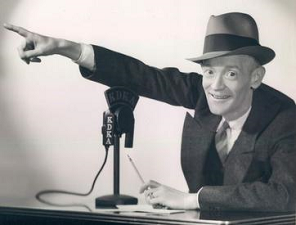 “Raise the window, Aunt Minnie, here she comes!”
I grew up frequently hearing that exclamation. It was Rosey Rowswell’s way of describing a home run in a Pittsburgh Pirates’ game. Rowswell’s raised voice was accompanied by sound effects that duplicate the sound of a batted baseball breaking a window – in Aunt Minnie’s home, of course.
Rowswell (pronounced Rose-well) was the Pirates’ broadcaster from 1936 until his death at the age of 71 in 1955. I don’t think Aunt Minnie would have made it in the 21st Century, but her creator is relevant now because he is on a ballot as one of eight candidates for the 2019 Ford C. Frick award.
Rowswell has made it onto the ballot because the Hall of Fame, which oversees the award, has changed the system, creating three divisions similar to the system of voting for players who are beyond eligibility for the writers’ ballot. Rowswell is in the Broadcasting Beginnings category. The other two categories are Current Major League Markets and National Voices.
Joining Rowswell on this year’s ballot are Connie Desmond, Pat Flanagan, Jack Graney, Harry Heilmann, Al Helfer, Waite Hoyt and Ty Tyson. The electorate will be the 11 living Frick award winners.
Rowswell was a welcome daily guest in my family’s home. My parents, my two sisters and I were all baseball fans, and listening to Pirates gams as delivered by Rowswell was a religious requirement.
We were big Aunt Minnie fans, and we were fans, too, of Rowswell’s other linguistic delights. A Pirates’ extra-base hit was a “doozie maroonie,” the Pirates were “Picaroonies” or Buccos, a breaking pitch that struck out a batter was a “dipsy doodle,” and when the Pirates loaded the bases, they were F.O.B., full of Buccos.
And when a home run crashed through Aunt Minnie’s window, Rowswell said, “She didn’t make it.” A Pirates loss would produce this comment: “Oh, my achin’ back.”
Rowswell’s back must have hurt a lot because the Pirates weren’t very good during his time broadcasting their games. There was, however, one outstanding season, 1948. In fact, the Pirates were so good that year that well before the end of the season my father sent Rowswell a check, explaining that it was for World Series tickets.
Rowswell, however, returned the check with a note. “Brother,” he wrote, “you’re far more optimistic than I am.” The Pirates finished in fourth place, 8 ½ games behind the first-place Boston Braves.