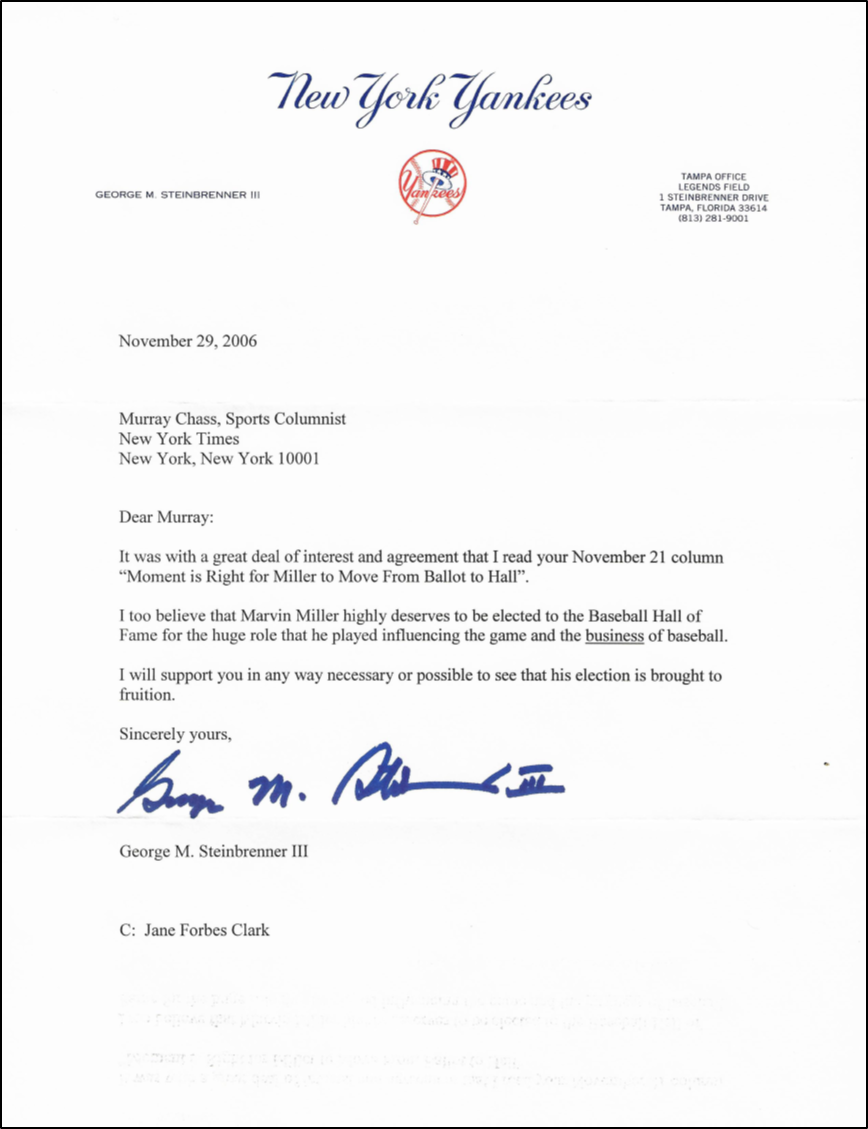
I received a letter from George Steinbrenner the other day. No, really, I did. Now I acknowledge that was an unlikely development considering that the Yankees’ owner died nine years earlier, but Steinbrenner did some pretty remarkable things when he was alive so I wouldn’t be so quick to doubt that he wrote that letter.
After opening the envelope and reading the letter, I can assure you that he did write it. Only he wrote it in 2006, Nov. 29 to be precise, meaning he wrote it almost exactly 13 years ago.
I would like to blame the United States Postal Service for the delay in delivery of the letter, but somehow, I overlooked it, and it wound up buried in a pile of papers that were apparently undisturbed for years.
Finding the letter now, though, was timely because the subject matter was Marvin Miller and the Hall of Fame.
Dear Murray:
It was with a great deal of interest and agreement that I read your November 21 column “Moment is Right for Miller to Moved From Ballot to Hall.”
I too believe that Marvin Miller highly deserves to be elected to the Baseball Hall of Fame for the huge role that he played influencing the game and the business of baseball.
I will support you in any way necessary or possible to see that his election is brought to fruition.
Sincerely yours,
George M. Steinbrenner III
I regret that Miller never got to see that letter. Maybe he would have appreciated it; maybe he would have seen it as Steinbrenner grandstanding. No matter. What matters today is that after 16 years of futility covering rejections on veterans ballots seven times, Miller was elected to the baseball Hall of Fame Sunday.
Ironically, this is not where Miller wanted to be right now, and I’m not talking about his having died in 2012.
Four years earlier, Miller told me he was fed up with being a punching bag – he used another metaphor – for the Hall of and asked whom he should write to to be removed from consideration. I told him, and he wrote the letter.
“Paradoxically, I’m writing to thank you and your associates for your part in nominating me for Hall of Fame consideration, and, at the same time, to ask that you not do this again,” Miller wrote to Jack O’Connell, secretary-treasurer of the Baseball Writers Association of America.
Miller added: “The antiunion bias of the powers who control the Hall has consistently prevented recognition of the historic significance of the changes to baseball brought about by collective bargaining. As former executive director (retired since 1983) of the players’ union that negotiated these changes, I find myself unwilling to contemplate one more rigged veterans committee whose members are handpicked to reach a particular outcome while offering the pretense of a democratic vote. It is an insult to baseball fans, historians, sports writers and especially to those baseball players who sacrificed and brought the game into the 21st century. At the age of 91, I can do without farce.”
In the years since his father’s death, Miller’s son, Peter, has resolutely held to his father’s position and did so again Tuesday in an e-mail to me from Japan, where he lives.
Miller wrote:
“As previously mentioned, my father did not wish his name to be placed in nomination for the HOF. And he repeatedly reaffirmed that wish, as well as his desire that I not participate in any HOF activities related to him. So the HOF results this year change nothing. He would of course wish the players elected to the Hall all the best for this recognition of their accomplishments.
I will just add that my father never sought personal fame. And while the case for electing Major League players to the Hall can be based on statistics, the salary numbers that my father is most famous for meant less to him than the simple freedom to choose employers to the extent one’s professional ability would allow.
For those like your reader(s) who believe they understand my father’s motives, I assure them that personal resentment had nothing to do with his decision not to take part in HOF procedures. The only ‘grievances’ that meant anything to him were those that could be taken up in independent arbitration between Major League Baseball players and club management.
Free agency in Baseball, made possible by independent arbitration, is an integral part of the story of American freedom. As such, Marvin Miller’s portrait in a public national institution, the National Portrait Gallery, presents this achievement in the most appropriate historical context.”
Hall of Fame officials will very likely seek someone, perhaps from the Players Association, to stand in for Miller, but owners and other management officials will be thrilled that they won, to not have to hear a possible Miller harangue about the way owners treated players before free agency.
I don’t know what Miller might have said in an induction speech, but I sure would have liked to hear it.
Miller was elected with 12 votes, the minimum number he needed for election from the 16-man panel. In 2011 Miller received 11 votes, falling one vote short of election by a different 16-man committee.
Ted Simmons, a former major league catcher, was the only one of nine players on the ballot who was elected. He got 13 votes. Simmons’ election, though, showed the fallacy in the election.
When he was eligible for the writers’ ballot, he received only 17 votes, 3.7 percent, and he was dropped from the ballot because he didn’t get the requisite 5 percent. Now he’s in the Hall of Fame.