The word collusion has become one of the most commonly used words in the English language today. “There was no collusion,” President Donald Trump proclaims on a virtually daily basis, referring to accusations that he colluded with Russians in his 2016 campaign. Even if there was collusion, Trump’s lawyer, Rudy Giuliani, says just as often, “collusion is not illegal.”
In the Trump-Giuliani context, they are correct. There is no federal statute that says collusion is unlawful. In Major League Baseball, on the other hand, collusion is banned and has been banned for more than three decades. The collective bargaining agreement clearly and simply states:
“Players shall not act in concert with other Players and Clubs shall not act in concert with other Clubs.”
The ink was hardly dry on the signatures in the 1985 agreement, which first contained that stipulation, when the owners violated it. But they didn’t violate it only once; they violated it three consecutive years. Losing three union grievances in three tries, club owners found out how expensive their cheating and arrogance could be.
Confronted with rulings from two different arbitrators, the owners agreed to pay the players $280 million. The owners also paid another price. In a subsequent collective bargaining agreement, they agreed to pay treble damages if they were caught cheating again. I’ll do the math. If they had been hit with treble damages in 1990, the cost would have been $840 million.
In the interest of historical accuracy, I will repeat that those three seasons weren’t the first in which the owners colluded against free agents. They did it for the first time earlier in the ‘80s and got away with it, although collusion wasn’t yet illegal.
“We did it better the first time,” Jerry Reinsdorf told a baseball newcomer some years after Collusion I. Reinsdorf was chairman of the Chicago White Sox then and still is, the only owner remaining from the collusion years.
The union, which never caught on to that first foray into collusion, hasn’t accused the owners of collusion against free agents in this off-season, though there is reason, as there was last off-season to be suspicious. In fact, the union has been utterly silent on the subject. Tony Clark, the union’s executive director, and other union officials have been so silent on the issue of free agents they are making it obvious they are scrutinizing free-agent activity, seeking the evidence they need to make a collusion case.
“It’s very different,” said a lawyer in the players’ camp, comparing collusion then and possibly now. “There were smoking guns that led to the collusion decision in the ‘80s. No one wants to talk about collusion now because there’s not enough evidence to support a case. They don’t feel it does any good to talk about it without evidence.”
Ian Penny, the union’s general counsel, did not return a telephone call to talk about it. Clark, the union chief, was silent as usual. No one would mistake him for Marvin Miller, the founding executive director of the union and its best spokesman and salesman.
“Tony isn’t going to be talking about any of this stuff any time soon,” said Chris Dahl, the assistant communications director. What stuff? “The market,” said Dahl, who himself declined to provide information when I asked how many free agents had signed before and since Jan. 1.
“Is that not all publicly available information?” he responded.
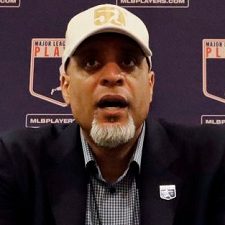 Given that the current labor agreement runs for three more years (Dec. 1, 2021), Clark has a lot of time to strengthen his staff. But strengthen it he has to because he is not Marvin Miller, Richard Moss, Don Fehr, Gene Orza or Michael Weiner.
Management knows that from the 2016 negotiations and will try to take advantage of what they perceived as Clark’s labor weakness. Recognizing that potential problem, Clark hired a more experienced labor negotiator, Bruce Meyer, from Fehr’s staff at the National Hockey League Players Association.
The only question I have about that move is why did another lawyer tell me Fehr was not bothered at all by Meyer’s departure.
However, before baseball gets to negotiations for the next basic agreement, the players have to confront possible collusion. There may not yet be a smoking gun, but there is circumstantial evidence to ponder.
“Look at the market the last two years,” a veteran agent said. “They are similar, and they are different from the markets of previous years.” And he added, “They’ve slowed down the process. No question about that.”
With the union refusing to provide information on free-agent signings, I asked Ron Blum of the Associated Press, from whom I know I can get accurate figures. According to Blum’s data for the last three off-seasons, free-agent signings before Jan. 1 numbered 56, then 32, then 38, a clear sign that confirms the agent’s characterization of a slowing market.
What significance does a slowing market have? When free agents go beyond the holidays without contracts for the next season, they begin to get anxious and start wondering if they will get contracts at all. Worse, their families begin to wonder and start asking questions:
- Should you have signed with your old team for what it offered?
- Should you have accepted its qualifying offer and not tested free agency?
- Should you change agents?
- What happens if you don’t get an offer from a team you want to play for?
Family members, you see, are as human as anyone and have the same concerns as anyone, if not more.
At the opposite end of a slowing market, but one that is just as real, is one in which players are willing to sign for less because they want to make sure they have a contract. The A.P. says 19 of 164 free agents had announced deals before the start of the winter meetings, up from eight of 166 heading into the meetings last year.
Whether free agents sign early to insure they have a contract or sign late because they were unable to get what they want or where they want it, they settle for less. If 100 free agents go in either direction, the clubs’ overall expenditure is less than it otherwise might be.
Last season M.L.B. had an unusual development. The average player salary, according to Players Association figures, was $4,095,686, which was a few dollars below the 2017 average of $4,097,122. It was a rare instance when the average salary dropped. The previous season in which the average dropped was 1995, whose start was delayed by the strike that was left over from 1994.
Of the three collusion seasons, only 1987 saw the average salary drop, and that was only from $412,520 to $412,454.
Baseball officials have long been reluctant to acknowledge that owners colluded against free agents. Bud Selig was the owner of the Milwaukee Brewers and a collusion leader in the ‘80s but has never admitted having participated in collusion. When Bart Giamatti was elected commissioner in 1988, I asked him about collusion, and he said, “I’ve seen the same set of facts as the arbitrators, and I don’t see collusion.”
Fay Vincent, who succeeded Giamatti when he died, is the only commissioner and one of the few baseball officials who have acknowledged the existence of collusion.
 Rob Manfred, the current commissioner, made some comments I found interesting on last year’s free agency when he spoke with reporters before last summer’s All-Star Game.
“The only purposeful behavior that took place in the free-agent market last year,” Manfred said, “is our clubs carefully analyzed the available players and made individual decisions as to what they thought those players were worth. … I’m pretty sure, based on what’s already in the books, you’re going to make the judgment that the clubs made sound decisions as to how those players should be valued. That’s how markets operate.”
Clark might want to study that statement and look closely into how the clubs analyzed players and how independent all of their decisions were. If Clark and his laywers look closely enough, they might find a treble-damage collusion case.
I leave Clark with one anecdote.
In 1985, when I was the first, actually the only, reporter to write about alleged collusion or utter the word, Barry Rona, MLB’s labor negotiator, got a big charge out of it and laughed. He always laughed. All of those hundreds of millions of collusion dollars later, Rona was no longer laughing or working in baseball. It was just before the 1990 negotiations for a new collective bargaining agreement, and Vincent fired him, saying he couldn’t have a lawyer who was part of collusion.