Who’s the Evil Empire now?
That question has become relevant in these last weeks of the regular season because the Boston Red Sox are running away from the New York Yankees in the American League East and making the six games remaining between the teams irrelevant. In the last several weeks the rabid rivals simply haven’t played in the same ball park.
As the Red Sox have separated themselves from the Yankees, opening a 10 ½-game lead, largest of the season, the teams haven’t seemed to be close competitors. I suppose that’s what prompted a reader to ask who the Evil Empire is today.
The question alludes to the name attached to the Yankees 15 years ago when they snatched Jose Contreras, a Cuban free-agent pitcher, out of the Red Sox grasp.
“The Evil Empire extends its tentacles even into Latin America,” Larry Lucchino, the Red Sox president said to me at the time, coining a phrase that would go down in baseball linguistic history and outlive his tenure with the Red Sox.
I asked Lucchino last week if it was accurate, appropriate, or fair to turn the name over to the Red Sox.
“It takes years and years to earn that distinction,” he said in a telephone conversation.
Lucchino is no longer a Red Sox executive, having been invited three years ago to retire with the title President/CEO Emeritus by his partners, John Henry and Tom Werner, who apparently thought he was getting more than his share of credit for the Red Sox success. It wasn’t all success, though.
“When I came here,” Lucchino recalled, “I had my choice of telephone numbers and I took 2 2 2 2 because we were always finishing second to the Yankees in everything—standings, revenue, attendance. I think it’s safe to change my number now.”
Times and Red Sox fortunes have changed. The Red Sox have won the A.L. East title the last two years and three of the last five and appear set to make it the last three years and four of the last six. This will be the sixth successive season the Yankees haven’t finished first.
In another change-of-status development, the Red Sox began the season with the highest payroll in the majors, $224 million, while the Yankees were seventh at $167 million.
The Yankees have usually been at the top; they were, for example, from 1999 through 2013, the biggest spenders, until new owners of the Los Angeles Dodgers found that every dollar they had was worth spending on players.
But barring a splurge of Yankees spending, the Red Sox will finish the season No. 1 in player payroll as well as No. 1 in the A.L. East and No. 1 in number of wins. That’s a trifecta the Yankees would take, but they didn’t want to be No. 1 in payroll this season.
Of course, having the largest payroll doesn’t guarantee being No. 1 at the end of the year. The Yankees learned that fatal fact of life most of the years they had the largest payroll. Money produces no guarantee of winning.
Unlike the year the Evil Empire burst into prominence, the Yankees and the Red Sox were not competing last winter for the same free agent. The Yankees liked their young team and weren’t looking for expensive free agents. The Red Sox, on the other hand, wanted a slugging outfielder and found one in J.D. Martinez.
However, Scott Boras was Martinez’s agent, and it took until Feb. 26 for them to agree on a 5-year, $110 million contract.
A 20th-round selection by Houston in the 2009 draft, the 31-year-old Martinez is competing with teammate Mookie Betts for the A.L. most valuable player award. Martinez is hitting .328 with 41 home runs, 106 runs scored and 122 runs batted in. Betts is hitting .338 with 29 homers, 118 runs scored and 71 r.b.i..
If the Yankees’ Aaron Judge hadn’t fractured his wrist when he was hit by a pitch, he may have been the default choice for m.v.p. because Martinez and Betts could split votes and cancel each other out.
CASH IS PURE GOLD FOR RAYS
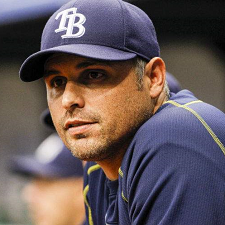 As long as I have been watching and covering baseball, I still wonder at times how some teams can be consistently good and some consistently bad.
Look at the Tampa Bay Rays. They have always played in the worst ball park and have struggled with one of the lowest payrolls. The combination is enough to demoralize anyone. Yet with two weeks left in the season the Rays have clinched a .500 record playing in the majors’ toughest division.
Kevin Cash is a logical candidate for manager of the year.
Worst managing job of the year has to go to Dave Martinez of the Washington Nationals. The Nationals hired him after they fired Dusty Baker, under whom the team won two division titles in two years.
Whether the Baker decision belonged to General Manager Mike Rizzo or ownership, as has been suggested, the Nationals hierarchy might want to consider a do-over.
Meanwhile, Jerry Reinsdorf is the leading candidate as worst owner of the year.
Reinsdorf has one commendable quality but only one. He has long been baseball’s best owner with diversity hiring. It’s too bad Commissioner Rob Manfred doesn’t learn about diversity hiring from Reinsdorf. Instead Manfred tries gimmicks that never work.
Reinsdorf, however, seems to have lost touch with the successful way to run his baseball organization. He has allowed his front office to oversee six successive losing seasons, making the White Sox sweep of Houston in the 2005 World Series a faded memory of the distant past.
Finally, we come to the Yankees and the decision to fire Joe Girardi. I don’t say “their” decision because it was the decision of General Manager Brian Cashman, who was given that authority by Hal Steinbrenner, the managing general partner.
It’s possible Steinbrenner told Cashman to make the decision because he doesn’t like to fire people. He saw too much of that nonsense when his father operated the team.
But my question here is not who fired Girardi but why. Was there a valid reason to fire the man who had done a creditable job in the 10 years he managed the Yankees?
The only reason that has emerged from Yankee Stadium has been that the young players weren’t comfortable with Girardi. I suspect the real reason was Cashman was no longer comfortable with Girardi because Girardi’s veteran status prevented Cashman from telling him what to do as he would be able to with a younger, less experienced Aaron Boone.
Baseball is changing. Teams are hiring younger general managers, who are taking greater control of the team on the field. Will the new system work better than the old? I’ll have an answer to that question when a general manager fires himself for doing a poor job.