In earlier times it was simple. Representatives of Major League Baseball and the Players Association would negotiate for weeks, more likely months, in an effort to reach accord on terms of a new basic agreement. Unable to agree on those terms, they would call time outs. The first eight negotiations were interrupted by work stoppages – five strikes and three lockouts.
After a 234-day strike, prompted by the owners’ foolish demand for a payroll cap, more commonly but erroneously known as a salary cap, Commissioner Bud Selig saw the light and decided peace was better and more lucrative than war. Selig adopted a mantra of peace, not war, and the owners followed his lead through the end of his tenure in January 2015.
Since the day the players returned to work in 1995, courtesy of an injunction issued by Judge (now Supreme Court Justice) Sonia Sotomayor, the owners and the players have existed peacefully. That’s a span of 23 years, and when the current agreement expires Dec. 1, 2021, it will be a quarter century plus a year since the two sides were last at war.
If they want to extend their reign of peace, they certainly have enough time to reach agreement on any differences they might have. But will they forgo their goals to maintain their peace?
The union, for example, is bitterly unhappy with the results of last off-season’s free-agent market. It went so poorly for free agents that it raised the specter of collusion, and I don’t mean collusion with Russia.
In 1985, ‘86 and ’87, the clubs were accused of and found guilty of colluding to depress the free-agent market. Selig, who as owner of the Milwaukee Brewers was one of the leaders of the illegal practice, has never admitted that the owners committed such a dastardly act. In fact, his predecessor, Fay Vincent, whose time in baseball followed the collusion era, is one of the very few members of management who has acknowledged that the owners colluded.
But the owners who have never admitted they colluded agreed to pay the players $280 million plus sizable interest to settle the grievances.
However, as suspicious as union officials were about this past off-season, they did not find enough evidence to file a grievance. They will, of course, scrutinize the free-agent markets in subsequent seasons and make what they find a subject for the next round of bargaining.
Before addressing intermural matters, the union has to deal with intramural matters. One official said last week Tony Clark, the union’s executive director, had been under pressure from the players to make changes and strengthen the collective bargaining lineup.
That was the reason the union last week hire Bruce Meyer to serve as senior director of collective bargaining and legal. Legal? Legal what? The union didn’t say but presumably legal matters.
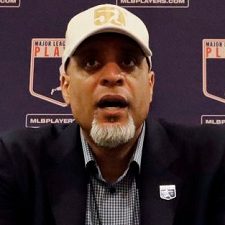 Clark is not a lawyer. He’s a former major league baseball player and only the second of five Union executive directors who is not a lawyer. The first? Marvin Miller. He was an economist but learned about leading a union from David J. McDonald, the legendary head of the United Steelworkers.
Meyer is a veteran lawyer, having served as outside counsel to the football, basketball and hockey unions. The past two years he worked for the hockey union under Don Fehr, a former head of the baseball union. If it sounds like sports incest, it just might be.
“Tony was looking to beef up the team; he thought I would be helpful,” Meyer said in a telephone interview. “For me, it was an opportunity to come back to New York. I’m from New York.”
Clark was said to be traveling and not available for comment, but one issue that the union didn’t address in its announcement was the division of duties. The announcement said Meyer would handle all collective bargaining negotiations and report to Clark.
It left unsaid what Meyer’s appointment meant for Ian Penny, whom Clark named general counsel only a year ago. In the baseball union’s history the general counsel has played a significant role, second only to the executive director.
When Richard Moss was Miller’s general counsel, he argued and won some of the most significant grievances in sports labor history. They included the Messersmith-McNally case, which created free agency, and the Catfish Hunter case, which demonstrated the economic value players could have as free agents.
The union’s announcement did not address which lawyer might handle grievances, but they aren’t collective bargaining so perhaps that suggests grievances would fall into Penny’s territory. I am not here, however, to make union assignments. That is Clark’s job.
On the other hand, I believe we can expect that Meyer and not Clark or Penny will be the union’s man in bargaining sessions across the table from Dan Halem, the deputy commissioner and M.L.B.’s chief legal officer. Unlike Meyer, Halem did not return a call seeking comment on the union development or management’s position on the union’s stance on certain issue.
Halem had no problem talking to Yahoo Sports about what he said the union had done to undermine a program M.L.B. had worked out with Latin American trainers to prevent boys as young as 13 from using steroids to enhance their chances of getting to the United States to play baseball professionally.
The union’s action, Jeff Passan wrote in a long article filled with excellent reporting, virtually scuttled the program, for which M.L.B. had worked long and hard to achieve.
Passan cited that incident as an example of the perils that had developed between M.L.B. and the union. However, a union official said the report of the incident was “way overblown,” and the problem would be fixed.
I respect Passan and think he’s one of the two or three best baseball writers working today. I know of other baseball writers working for major newspapers who would do well to follow his lead.
In this instance, however, Passan would do well to view the labor developments cautiously. With more than three years before the current labor agreement expires, the owners and players have plenty of time to have disputes, resolve them and have more disputes.
Where baseball labor is concerned, things are not always the way they seem. An example:
Some years ago, when I was no longer working for The New York Times, a young member of the Times sports staff wrote a story that the commissioner’s office was going to file a grievance against the union. I knew, however, that it would never happen. I was certain the commissioner’s office would not take that step.
But I liked the reporter, thought he was good and was probably the first person to see his potential. I didn’t want to see him hurt by a bad story and suggested a way he could get out of the predicament he had created for himself.
He ignored me, though, got angry, stopped talking to me and hasn’t talked to me since.
The commissioner’s office never did file a grievance, but earlier this year, having been transferred to the Times’ Washington bureau, Michael Schmidt shared in two Pulitzer Prizes.
As for baseball union, at this distant juncture, I think the key to an agreement without war will be the owners’ mindset. If the owners think Clark is vulnerable, even with Meyer at the table, they are likely to do crazy things. For example, Jerry Reinsdorf of the Chicago White Sox is still around, and he won’t die happy until he gets a payroll cap.