With the World Series over, the next baseball development will be the Hall of Fame’s announcement of its ballot for what it calls the Modern Baseball era. The Hall of Fame has changed its ballot structure so frequently it’s not easy to keep track of the players without a scorecard.
This year’s ballot, though, is the one on which the Hall gets to insult Marvin Miller yet again. That has become the Hall’s favorite sport. The Hall places Miller’s name on the ballot and turns it over to the 16-man electorate it knows will reject Miller once again. This time would be rejection No. 7. It’s as if the Hall is in cahoots with the owners in getting even with Miller for destroying the owners in every negotiation and every grievance.
There is no more deserving person to be in the Hall of Fame than Miller for what he did for baseball, not just the players but for the game and the owners. But the owners, who dominate the voting committee, are too stupid and too narrow-minded to see what Miller did for them.
In May 2008, after he had been snubbed for the third time, Miller wrote to the Baseball Writers Association, which compiles the ballot, saying he no longer wanted to be considered for Hall of Fame election.
Hall officials did not respond to Miller’s letter, but in the May 22, 2008 edition of The New York Times, Hall of Fame President Jeff Idelson said insultingly, “We’re two years away from this process taking place again for executives. It’s a bridge we’ll cross in time. Marvin has always been very proud and very emotional. And I have no doubt it hurt him that he wasn’t elected, but again, he’s eligible in perpetuity. Just because he wasn’t elected doesn’t mean he can’t be in the future.”
Three more elections later, Miller had still not been elected. Anticipating yet another hopeless election, I sent an e-mail to Peter Miller, Marvin’s son, before the post-season:
“The HOF ballot for which your father is eligible will be announced, I am told, sometime after the World Series. I plan to write a column about it and am asking if you feel as you have in the past about his not wanting to be on the ballot or have you altered your view in any way.”
This was Miller’s reply:
“It’s not about how I feel. It’s that my father gave specific instructions to me on numerous occasions during his lifetime, and on his deathbed. He said very clearly and repeatedly that he did not want to be on the HOF ballot and would not accept induction if it were to be offered. His instructions to me are to not accept or participate in any way in any HOF activity related to him. There is nothing personal about this, it is simply that it would be inappropriate for a labor leader to accept an honor conferred by a management organization. (Of course there is nothing wrong with players being inducted into the HOF, because in their case the award is based on their baseball record.)
“If you ask about my feeling, I agree with my father about it. I don’t see any point in having him inducted into the HOF, and I would not participate in any effort to bring that about or in any HOF activity. I understand the feelings of those who might wish for it, but the HOF is really not the right institution, is not in a position to award anything to a labor leader. A suitable analogy might be the struggle the MLBPA engaged in at the outset to gain independent arbitration of players’ contract disputes. Baseball owners had maintained for many years that their appointed representative, the Commissioner, was competent to act as an independent arbitrator. That of course was nonsense. In a truly independent arbitration system, one arbitrator appointed by management, the other by the union, selected the third — independent — arbitrator. That was how free agency was achieved. Similarly, the HOF as a management organization (no matter how many former players are named to its panels) cannot act as an independent judge of the worthiness of a labor union representative.
“I have always felt that the HOF is not an appropriate institution to honor or memorialize my father. The National Portrait Gallery (NPG) in Washington DC expressed interest in the portrait of my father currently held by the SupremeCourt. NPG historians were enthusiastic about having my father’s portrait there. Unfortunately the portrait was deemed not to have sufficient artistic merit (a judgment I agree with). I met with then-NPG Director Kim Sajet about this in 2015. She said NPG staff would search in photo-journalistic sources for a suitable portrait of artistic merit. Historian Robert Burk wrote the attached letter supporting the NPG effort. Nothing further has occurred.”
Before he wrote his letter in 2008, Miller discussed it with me, and he didn’t say anything about the Hall of Fame being an inappropriate place for a labor leader to be honored. It’s possible that he subsequently came to feel that way.
At that time, though, he was tired of being set up to be knocked down, and I agreed with him that enough is enough. He was critical of Hall of Fame officials, who he noted – correctly, I have to say – changed the rules every time he came closest to election.
The most obvious time occurred in 2009 when he was two votes short of election and 2010 when he was only one vote short of election.
HOF officials have denied rigging the elections, but they have been guilty of not giving Miller a fair chance to be elected. The voting committee has always been stacked against Miller.
When I raised that issue with Idelson, he basically threw up his hand and said what are we supposed to do. One thing the Hall could have done is change the makeup of the 16-member committee that decides the inductees. Instead of having people like David Glass, owner of the Kansas City Royals, who wouldn’t vote for Miller if his life depended on it, substitute someone like Fay Vincent, the former commissioner, who has always recognized what Miller meant to the game.
Another idea. No official or former official of the Major League Baseball Players Association has ever been on the voting committee. Don Fehr and Gene Orza would be as legitimate as any other voters, but they have never been asked to serve on the committee.
Why no Vincent, Fehr or Orza? They don’t pass the smell test. Jane Forbes Clark, the HOF chairman, knows who would and who wouldn’t vote for Miller, and Idelson isn’t going to put certain or even potential Miller voters on the committee. He likes his job too much to jeopardize it.
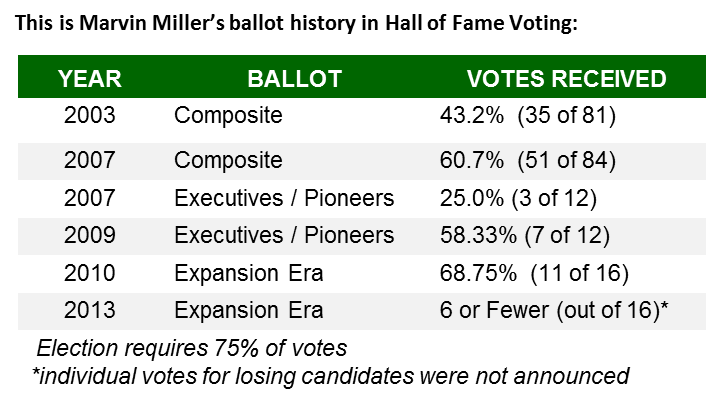 The last time Miller was rejected, 2013, the bloc of 16 voters included two owners and two management executives but no union representatives. That last group apparently has some disease that the Hall doesn’t want to inflict on anyone else when they meet in December. As it turned out, Miller died at the age of 95 a year before that election.
But Peter Miller reacted to the outcome, in which Bobby Cox, Tony La Russa and Joe Torre were unanimously elected. Before that election incidentally, among Miller’s staunchest supporters was Ray Grebey, the owners’ chief labor negotiator the last time Miller negotiated a labor contract.
In a subsequent e-mail, the younger Miller wrote:
“My father, Marvin Miller, appreciated very much the efforts of his many well-wishers to have him elected to the Baseball Hall of Fame. However, he never wished to be voted on or elected. In a 2008 letter to the Baseball Writers Association, he wrote: ‘Paradoxically, I’m writing to thank you and your associates for your part in nominating me for Hall of Fame consideration, and, at the same time, to ask that you not do this again.’ In May 2008 he said in an Internet publication, ‘If considered and elected, I will not appear for the induction if I’m alive. If they proceed to try to do this posthumously, my family is prepared to deal with that.’
“My father did his best to get a fair shake for baseball players employed by Major League clubs, with free agency, independent arbitration, and the ability to negotiate as equals with their employers. These changes resulted in a vastly more competitive game, fan interest, and increased wealth for all, including the owners of baseball clubs.
“Although he enjoyed the recognition, my father did what he did not for fame and glory, but for justice and for equitable labor-management relations. My father’s place in baseball and labor history is well-known, available in the Marvin Miller archive at New York University, in numerous on-line sources, and his portrait is at the U.S. Supreme Court in Washington DC.
“I must therefore respectfully reiterate my father’s wishes not to be considered by or inducted into the Baseball Hall of Fame.
“Let those who knew Marvin Miller and who benefit from his legacy hold him in their memories and continue to support the Major League Baseball Players Association and all it stands for.”
Despite his wishes, including his dying wishes, will Miller’s name be on the ballot when it is announced in coming days? I suspect it will be. Will Miller be elected? I would say his election will depend on the makeup of the electorate. Will it matter if he is or isn’t elected? No, it will not.
The Hall of Fame had plenty of chances to elect Miller while he and his wife, Terry, were alive. By not electing Miller, the Hall shamed itself, and that shame will live long after this and future elections.