Archive for February, 2011

SELIG STRIKES OUT

Sunday, February 27th, 2011

Two rules I must have seen on one of those clever office signs somewhere:

Rule #1: I am the boss and I make the rules.

Rule #2: I am the boss and I don’t have to follow the rules.

I have been in Bud Selig’s Milwaukee office only once and can’t say I’ve noticed that sign, but it must be posted there somewhere. Rule #2, after all, seems to have prevailed in the commissioner’s appointment Saturday of Joe Torre as baseball’s executive vice president for baseball operations.bud-selig-finger-225

It’s been obvious for a few months that Selig wanted to give Torre the job, which opened up last June when he removed Jimmie Lee Solomon from it. They kept talking and talking until Selig became satisfied that Torre had agreed to work enough days in New York to rationalize giving him the job.

Selig will probably not keep a daily log of Torre’s days at 245 Park Avenue; he won’t want to know how precisely Torre is living up to their understanding.

It was Selig’s desire to have his executive vice president for baseball operations be a daily presence in the New York office that delayed his filling the vacancy.

After leaving the Yankees and taking the job managing the Dodgers, Torre, who had been a lifelong New York resident, moved to Los Angeles and decided that’s where he and his family wanted to live. That became a sticking point in his talks with Selig about the baseball operations job.

Eventually Torre agreed that he would spend a significant amount of time in New York, and Selig said, “You’re hired.”

Torre’s hiring will be accompanied, I am told, by a major overhaul of the baseball operations department. Some long-term members of Selig’s staff, three, I was told, are expected to lose their jobs.

Torre might not know it, but there is a precedent for the frequent flyer miles he will amass in his new job. When Peter Ueberroth was baseball commissioner (1984-89), he continued to live in Los Angeles and commuted each week, flying home on Thursday generally and flying back to New York Monday.

It made for a pretty short work week in New York, and subordinates had to look and act quickly to find him there.

With Selig, that problem doesn’t exist. He lives in Milwaukee, where he remained after owning the Brewers, and stays in Milwaukee, seldom appearing at the Park Avenue address.

Frank Robinson is another L.A. guy, and if he ever had a chance for the baseball ops job, which, as it has turned out, he didn’t, the residency thing was perceived as a drawback for him, too. But in reality it wasn’t.

When I wrote about this issue last month and noted Robinson’s residency in Los Angeles, I was informed of something I had not known. In an e-mail, another baseball official wrote:

“Since Frank Robinson came to his present position he has been in the NY office just about every day with very rare exception – usually from 8AM until around 6PM. I would estimate his time away (due to business travel) has amounted to about 5% or 10% of the time.”

Selig would have known that, but it apparently meant nothing in his decision. He wanted Torre and kept talking to him until Torre, whom he has known since he was a teenager, became convinced that the job was his as long as he was willing to work a certain amount of time in New York

And what happens with senior vice president Robinson?

“In addition,” the news release from the commissioner’s office said, “Commissioner Selig also announced that Hall of Famer Frank Robinson, who had served as Senior Vice President for Major League Operations since June 2010, will now be the Senior Advisor to the Commissioner.

Frank Robinson 225“’I thank Frank Robinson, a giant of our game, for his day-to-day leadership of several key areas within our Baseball Operations Department since I called on him last June,’” Commissioner Selig said. “’I am glad that Frank will continue to be a vital source of counsel and guidance for me, especially as a member of our Special Committee for On-Field Matters, and I will consult with him on many important issues, on and off the field.’”

The release included a comment from Robinson:

“I am eager to continue in a meaningful role working for the Commissioner and Major League Baseball. The Commissioner and I have known each other for years, and I will always be available to assist him and this great game.”

That was not the kind of response I received from Robinson when I sent him an e-mail.

“I get the idea,” I wrote, “that you don’t want to talk about this stuff, but I’m writing about it and would like to be accurate, for my sake as well as yours. A month or so ago the N.Y. Daily News reported that you were livid that Bud had talked to Torre about the job but had not talked to you. I confirmed that and wrote it. Now I am prepared to write that Bud has violated his own rules by not interviewing a member of a minority for the job he has given Torre.

“I am asking if he talked to you about the job or interviewed you for it. What I don’t understand is why he didn’t name you to the position when you were already senior vice president.”

I was right. Robinson didn’t want to talk about it. “I don’t choose to comment,” he replied. A follow-up to his reply went unanswered.

Selig didn’t have anything to say either when I spoke to him by telephone after his Torre announcement in Arizona. That is, he didn’t have anything to say for publication. He had plenty to say about the questions I had raised for him in an e-mail to his spokesman, Pat Courtney, but he made all of his wrathful comments off the record.

I was able to confirm ultimately that Selig never talked to Robinson about the job.

The sense that I got from an official in the commissioner’s office was that Selig believes the rules he established for clubs’ hiring practices don’t apply to the commissioner, that he has to be free to hire the people he believes are best for executive positions and that he feels his office has a very good record in minority hiring.

That is the Park Avenue office itself.

In outlying districts last year Selig’s influence was anemic. Between managers fired and interims hired during the season and teams seeking new managers after the season, 17 managers were hired after the start of the 2010 season. Four of those were Latino. None was black.

Willie Randolph, a former black manager, was not interviewed for any of the vacancies. He was the last coach hired for a major league coaching staff. Don Baylor, another former black manager, had one interview for the 11 jobs open after the season. The Blue Jays conducted it by telephone.

Selig, who is trying to revive interest in baseball among black youngsters, interviewed no black candidates for the job he handed Torre. Message sent.

I got the sense that while Selig thinks Robinson is a good man to have around him as an advisor, he does not feel the Hall of Famer is the executive vice president type, whatever that is. Robinson has not made a fuss over being overlooked, I believe, because he likes working in baseball and will not jeopardize the job Selig has given him.

I don’t question Selig’s minority hiring. He even hired Jimmie Lee Solomon, who five years after he was named in 2005 to the position Torre just got became the first top executive Selig ever demoted.

This, however, is the second move Selig has made in recent months that makes him a man of contradictions.

In December he talked about how peaceful he expected the upcoming labor negotiations with the union to be, but he named Jerry Reinsdorf of the Chicago White Sox as co-chairman of the owners’ labor policy committee despite Reinsdorf’s history as one of the most militant and even ruthless owners on labor matters.

Now when the commissioner had an opportunity to make a positive, strong statement by naming a celebrated, capable, experienced black candidate to a visible executive position, he passes and instead names a popular white guy with no executive experiences.

But taking a closer look at Selig’s contribution to Len Coleman2diversity developments, he doesn’t deserve as much credit as he has received. Not that he’ll talk about it or take credit for what he has done, but the man behind much of the progress African-American matters have made in baseball is Leonard Coleman, the last president of the National League before the leagues were merged into the central office of Major League Baseball.
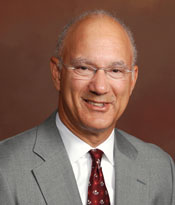
Among other things, Coleman was the driving force behind Selig’s decision to retire Jackie Robinson’s uniform No. 42.

However, Coleman, who does not have a position in baseball, works quietly behind the scenes while Selig receives tons of publicity daily through his publicity mill a.k.a. MLB.com. Here’s one example, the first paragraph of a recent article:

ATLANTA – Commissioner Bud Selig has been the driving force behind Major League Baseball’s diversity initiatives, and in a fitting tribute, the inaugural two-day business conference leading up to the May 15 Civil Rights Game – a trade fair that will also spotlight diversity on the business side of baseball – will bear his name.

While Selig is being saluted at the Allan H. (Bud) Selig Business Conference in Atlanta, a few of his former employees will be looking for jobs in New York. They will be the victims of the hiring of a new head of baseball operations.

Someone in the commissioner’s office gave me three names, but I am withholding them because someone else insisted the decisions are not final and neither is the extent of the overhaul. If that is so – and I can only take the second person’s word that it is not final – I feel it would be unfair to name the three individuals.

Details will be known soon enough, most likely in a week to 10 days.

Changes are being made, I was told, because there will be a new man at the top, and he should get the people he wants in those positions.

However, I don’t see this as similar to a new manager coming in and hiring his own coaches. Staff members of the baseball operations department don’t live together for eight or nine months, as managers and coaches do.

Furthermore, why should people who have served in their jobs capably and loyally be put out on the street, especially when jobs don’t exist? Out of compassion, if nothing else, Torre, who has made millions managing and was insulted by a Yankees’ contract offer that included bonus clauses, could take the right step by telling Selig he wants to retain everyone in his department.

HANK HONKS ABOUT SHARING REVENUE

Thursday, February 24th, 2011

Bud Selig has many stories he can tell about George Steinbrenner, but he often tells one in particular. It’s about the time the Yankees’ owner was in Milwaukee to watch his team play Selig’s Brewers.

As often happened with Steinbrenner, something was going on that the reporters traveling with the Yankees wanted to talk to him. Mickey Morabito, the Yankees’ media relations director, sought out Steinbrenner where he was sitting and told him the writers wanted to talk to him.

“Tell them I’m not here,” Selig recalls Steinbrenner telling Morabito.Hank Steinbrenner 225

The only problem with that idea, Selig always says laughing, was that Steinbrenner was sitting in Selig’s glass-enclosed box, which was next to the press box, where the reporters had a clear view of the Yankees’ owner.

Selig, now the commissioner, doesn’t have the same relationship with the sons of Steinbrenner as he had with George, and in Selig’s experience, the older one, Hank, is heard more than seen.

That was the case this week when Selig heard or read what Hank Steinbrenner said about Major League Baseball’s revenue-sharing program. Hank’s remarks to reporters at the Yankees’ spring training camp in Tampa, Fla., prompted the commissioner to call Hal Steinbrenner and Randy Levine, the club president.

Selig reportedly did not berate them for Hank’s outspoken view on revenue sharing. Nor did he direct them to literally put a muzzle on Hank. But figuratively? That’s a different story.

Selig has imposed a ban on all owners’ comments on labor matters. As negotiations for a new collective bargaining agreement get under way before the start of the season, Selig will come down hard on owners who make comments publicly about labor matters.

Selig adhered to his own ban when I asked him for comment on Hank Steinbrenner’s comments on revenue sharing. “Nothing I can tell you,” he said. “Thank you for calling.”

Selig won’t talk about revenue sharing and doesn’t want anyone else talking about it because it figures to be the most sensitive and explosive topic in labor negotiations.

However, it appears that the contentious tone on the topic will occur not between the owners and the players but among the owners themselves.

The point of contention is the amount of revenue that is shared has grown far more than ever was envisioned, and the great bulk of it falls on a handful of teams. With the Yankees being one of those teams and also paying the heaviest luxury tax, theirs is the heaviest economic burden.

The Yankees have contributed about $1.2 billion to the revenue-sharing pool and have paid $192 million in luxury, or competitive balance, tax.

“We’ve got to do a little something about that, and I know Bud wants to correct it in some way,” Steinbrenner said. “Obviously, we’re very much allied with the Red Sox and the Mets, the Dodgers, the Cubs – whoever’s in that area.”

I’m not sure where Steinbrenner got the idea that Selig wants to “correct it in some way.” Perhaps he read too much into a recent remark the commissioner made in a radio interview:

“Is the system perfect? No. I didn’t say it was perfect, but I said that I think what exists today is pretty darn good. In the next labor negotiation, we have to tweak it in some areas, and it’s significant tweaks.”

selig2I don’t know what tweaks Selig was talking about and in what direction, but the owners of some teams – Mark Attanasio of Milwaukee is one – have been vocal about the need to increase the amount of revenue to be shared. They don’t think that the Yankees’ payment of $120 million ($138 million including luxury tax) for 2010 is enough.

In the next few months some owners will lobby Selig for greater revenue sharing and steeper luxury taxes, with higher tax rates and lower thresholds that will trigger the tax.

The Yankees have always been the target of the luxury tax. It came into existence after players refused to accept a payroll cap, which exists in other sports. Clubs agreed to the tax hoping it would deter the Yankees from having outrageously high payrolls.

But the Yankees didn’t blink. They seldom shied away from a big contract if they wanted the player, figuring the tax they had to pay would be the equivalent of another player signing.

The Mets, on the other hand, have always avoided the tax, making sure their payroll didn’t exceed the threshold. Fred Wilpon, the Mets’ owner, obviously preferred giving his money to BLM than MLB.

The Mets, however, will join the Yankees, the Red Sox, the Cubs and the Dodgers in pushing for lower revenue-sharing contributions. Those five teams are the biggest payers and are said to contribute more than 80 percent of the money that goes to poorer teams.

Steinbrenner had something to say about those poorer teams, too.

“At some point,” oldest son of George remarked, “if you don’t want to worry about teams in minor markets, don’t put teams in minor markets, or don’t leave teams in minor markets if they’re truly minor. The socialism, communism, whatever you want to call it, is never the answer.”

Acting on Steinbrenner’s thinking, Major League Baseball would have maybe half the number of teams it has now. Get rid of teams like the Pirates, the Reds, the Royals, the Twins, the Marlins, the Rays and the Athletics, and the Yankees and the Red Sox, the Mets and the Cubs would have to play each other 40 times.

Many of the teams Steinbrenner was suggesting didn’t belong because they are in minor markets that served as the foundation of baseball as we know it today. Some preceded the Yankees.

In Steinbrenner’s ignorance, he failed to understand that the Yankees need someone besides the Red Sox to play.

That’s why the Yankees agreed to the revenue sharing system even though George Steinbrenner used to say, when the idea was initially proposed more than 20 years ago that he would share his revenue if Calvin Griffith, then the owner of the Minnesota Twins, agreed to let Steinbrenner help him run the Twins.

That never happened, of course, and Steinbrenner never demonstrated that he could run a team other than by throwing a lot of money on the table.

VALENTINE VEERS INTO FANTASY LAND

Sunday, February 20th, 2011

The roster of managers this spring includes 12 managers who did not hold those jobs last spring. None of the new managers is named Bobby Valentine.

Despite his return from a seven-year exile in Japan and a desire to return to the major leagues, Valentine found relatively little interest in his services in the widest-open managerial market in years. The few teams that did consider him and interviewed him obviously opted to hire others, in all instances younger and less experienced managers.

Based on developments, it appears that Valentine’s reputation has finally caught up with him and left him on the outside looking in, currently as the replacement for Joe Morgan on ESPN’s Sunday night baseball cablecasts.Bobby Valentine St Johns 225

From previous columns, you might have the impression that I am not a Valentine fan. You would be correct, although in his earlier days, when he managed the Texas Rangers, I actually liked him.

But then two things happened. I learned from a Texas writer that Valentine deliberately pitted writers against each other by dividing them into groups that determined how he dealt with them. On a more personal basis, he began doing and saying things about me that gave me good reason to dislike him because he was imagining things that weren’t real.

With no basis in fact, he told people I had a vendetta against him, and he accused me of being a hit man – his term – and doing “dirty work” for another baseball writer, with whom he had a full-blown feud.

Given that he was no longer in baseball, or at least the part of baseball I write about, I was prepared to ignore him and not write about him again. But then I learned that he could not ignore me.

In a recent speaking appearance that I learned about from a YouTube segment that someone sent me, Valentine related the tale of the fake mustache he wore so he could reappear in the dugout after he had been ejected from a game in 1999. But in Valentine’s speech at the St. John’s Baseball Bullpen Winter Banquet, I shared the stage with the mustache.

In Valentine’s telling of the story, he was managing a team that was struggling at the moment, and he told about the difficult day he was having because three of his coaches had been fired and the team had lost its sixth and seventh games in a row, though the losses were actually the Mets’ seventh and eighth in a row.

Telling about the news conference before the Sunday night game at Yankee Stadium, Valentine said:

“Murray Chass, one of the only people I think really has a black heart that I’ve ever met in my life, was sitting in the front row, was a New York Times reporter, and he wanted me to leave, he wanted me to be fired, actually he wanted me to die. None of those things happened that day.

“But he did ask me why I didn’t leave, why I wasn’t fired, what I was going to do between now and Sept. 1 to turn the team around.”

Then Valentine, told about the fake mustache, for which he was suspended for two games, and he said, “Murray Chass writes the article the next day, how much I disrespected the game. Ten thousand dollars and three-game suspension later, I’m back in the dugout.”

Not surprisingly, Valentine was wrong again. I never wrote that he disrespected the game. Maybe out of a guilty conscience he thought that’s what I thought and imagined that I had written it. But disrespect or a synonym didn’t enter my mind; goofball did.

“The Mets’ version of Inspector Clouseau, that master of disguise, could be in trouble,” I wrote the day after the mustache incident. “Bobby Valentine is under investigation by the National League for donning sunglasses and a fake mustache – or was it a strip of black tape? – and returning to the dugout after his ejection from the game Wednesday night.”

“And then came Inspector Clouseau. Ejected in the Toronto half of the 12th inning for arguing a call against Mike Piazza, Valentine reappeared on the bench in a disguise: black Mets T-shirt, baseball-type cap, sunglasses and a fake mustache.”

Bobby Valentine Disguise2 225“The television camera,” I wrote later in the column, “quickly spotted him and focused on him periodically the rest of the game, but he later tried to deny he was that masked man.

”’It was somebody else who didn’t look like me,’” Valentine said weakly.

“But just as Inspector Clouseau never tricked anyone, Valentine did not fool the league office.”

In a subsequent column, I wrote that Valentine admitted his guilt, quoting him as saying, “If I had known what the responses would be and how seriously the outside world would take it, I never would have done it.” He also said that what he did was stupid, but again, I did not write that he had disrespected the game.

What I did question Valentine about was his decision to stay on as the Mets’ manager when half of his coaching staff was fired. He always talked about his loyalty to his coaches, but he demonstrated no loyalty when his coaches were fired.

“Is there precedent in the business?” he asked when the question was raised.

“I didn’t know if anyone had ever done it,” he said later when the subject came up again, “and I wasn’t going to be the first to do it.”

But it had happened before, and the manager who put his job in jeopardy to defend his coaches was a man Valentine later maligned in an act of revisionist history.

In 1989, George Steinbrenner was set to fire four Yankees’ coaches when manager Dallas Green protested.

”That’s not the professional way to do it; that’s not the baseball way to do it,” Green told Steinbrenner, “and you’re not going to do it here. It’s only going to lead to more agitation. Why don’t you just fire the manager and then make all the coaching changes you want?”

In those days Steinbrenner didn’t readily take advice, but in that instance he did. He fired Green and the coaches.

Valentine argued for his coaches, but he didn’t put his job on the line, as Green did. The only thing he did was ask the coaches what they thought he should do. They didn’t say he should resign or put himself in position to be fired, and he didn’t.

In the same week that Valentine played Inspector Clouseau, he played history revisionist, too, in patting himself on the back for the job he had done as Mets’ manager.

”I took a terrible, disruptive situation and contained it, straightened it and made it whole,” he said. When he was asked if he was referring to the past week, Valentine said, ”I was referring to the abyss that was here two and a half years ago.”

However, Valentine’s predecessor, Green, cleared up the mess Valentine referred to before Valentine replaced him. And life under Valentine wasn’t as harmonious as he liked to portray it.

”He comes into a whole new situation and goes right after I guess the most popular guy,” Todd Hundley said of Valentine after he left the Mets for the Los Angeles Dodgers in 1999. And: ”You see him coming from a mile away. He thinks he’s working in the shadows, but he’s not. You can see right through him.”

I cite Hundley’s comments for two reasons: they are relevant, and they are at the core of Valentine’s obsessive hatred for me.

In spring training of 1999, reporters for the New York Post and the Daily News unsuccessfully tried to get Hundley to talk about Valentine. Seeing that Hundley hadn’t expressed his views about his former manager, a Times editor assigned me to go the Dodgers’ camp in Vero Beach to talk to the Mets’ former catcher.Bobby Valentine6 225

A Newsday reporter was there the same day for the same reason, and we spoke to Hundley together and wrote similar stories with Hundley’s criticism of Valentine.

The manager, however, held it against me that I didn’t call him for a response whereas the Newsday reporter did. I explained to him that I didn’t call him because he had already responded to the Times’ reporter who was in the Mets’ camp. He was unable apparently to understand that concept.

As far as Valentine was concerned, that story was the clincher. I had a vendetta against him. I heard later that spring that he was telling people about the alleged vendetta.

When I saw him after I had heard of his ridiculous accusation, I asked him why he thought I had a vendetta against him. He cited that story and one I had written in August 1997.

That story was about other teams’ complaints to the National League office that the Mets were using mini-cameras at Shea Stadium to steal signs, a nefarious practice they believed started after Valentine became the manager.

My byline was on the story and I wrote it, but it really wasn’t my story. Buster OIney, who covered the Mets for the Times, had been tipped to the story by a player on another team, but he didn’t want to write it because he didn’t want Valentine getting mad at him. So he told me about it, I developed it further and I wrote it.

A year and a half later, Valentine remembered it when I wrote the Hundley story, put the two together and concluded that I had a vendetta against him. At the same time, he accused me of being a hit man for Marty Noble of Newsday, with whom he was feuding, and doing Noble’s dirty work.

The so-called vendetta and my role as a hit man made an indelible impression in Valentine’s weird mind. In January 2003 my nephew was in the workout room at the Mandalay Bay Hotel in Las Vegas with a friend when Valentine came in.

My nephew’s friend had shared a cab with Valentine the day before and introduced my nephew to him as “Murray Chass’ nephew.” Hearing that, Valentine told my nephew that I was “a despicable human being.”

“Look on the bright side,” my lawyer nephew told me. “At least he still referred to you as a human being.”


STRIKE TWO FOR CABRERA

Miguel Cabrera 225Miguel Cabrera, Dave Dombrowski said, is “as down as he can be, he feels terrible. He’s very disappointed with himself.”

And the Detroit Tigers’ general manager? How does he feel?

“You deal with what you need to deal with,” Dombrowski said by telephone from the Tigers’ Lakeland, Fla., spring training complex. “You know it’s one of those things you have to stay on top of every day. You have to whenever you have an addiction. We’ll help him however we can.”

The Tigers thought they were helping Cabrera after the 2009 season, which he finished with a hitless three-game series against the Chicago White Sox and helped drop the Tigers into a tie for the American League Central lead. The Tigers lost a one-game playoff to Minnesota.

Cabrera’s hitless series came after he was taken to jail intoxicated but not arrested following a fight with his wife. Dombrowski retrieved his slugging first baseman from jail at about 5 o’clock Friday morning.

This time Cabrera was arrested and charged with driving under the influence after a police officer found him with his smoking broken-down car in Fort Pierce, Fla. Dombrowski told reporters in Lakeland that Cabrera, 27 years old, was driving the 2005 car to Lakeland because he planned to ship it to a family member in Venezuela.

Cabrera is scheduled to earn $20 million this year, the fourth year of an eight-year, $152.3 million contract. Last season he led the American League in runs batted in (126) and on-base percentage (.420), was second in batting average (.328) and slugging (.622) and third in home runs (38).

The total of his on-base and slugging percentages was only two percentage points behind Josh Hamilton. He also finished second to Hamilton in the A.L. most valuable player voting.

Hamilton had his own substance demons early in his career and knows exactly what Cabrera is going through.

“Miguel has been showing up for his workouts early in the morning,” Dombrowski said, “and he’s been at home in the evening with his family. He has complied with everything. We don’t know what happened, why he fell off his program.

“We all know when you deal with alcoholism it’s a daily battle. He has a problem. He knows that. We know that. We’re willing to work with him.”