Jack McKeon opted to give up his job in 2005 at the age of 75. He had managed the Florida Marlins to the World Series championship only two years earlier, but now he was ready to let someone else do the job. Did he regret his decision?
“Not until about two years later,” McKeon said. “I figured I needed a break and needed to get re-energized,” McKeon said. “I’ve been very fortunate that I’ve been successful. But I was getting bored. I was sitting watching three, four games each day on TV. You manage every game. I figured maybe there’ll be another chance, but people look at my age and I figured it was probably the end of the line.”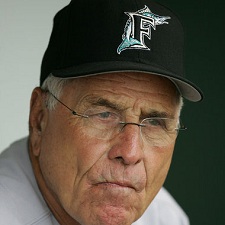
But then Edwin Rodriguez became so frustrated with the Marlins’ losing that he walked away from his job. Jeffrey Loria, the Marlins’ owner, experienced a different form of discrimination when his team played in Montreal and wasn’t about to hold McKeon’s age against him.
He directed David Samson, the team’s president, and Larry Beinfest, president of baseball operations, to contact McKeon and ask if he would come back. How long did it take McKeon to say yes? “Seventeen seconds,” he said.
McKeon’s return to the Marlins put him in a tiny historic group of managers, the only ones who managed two different teams in at least two separate terms, according to research by Major League Baseball and the Hall of Fame. McKeon is the third, the first in 55 years.
Johnny Evers, the middle man in the literarily celebrated double play combo of Tinker to Evers to Chance, managed the Chicago Cubs in 1913 and for 96 games in 1921 and the White Sox for the first 21 games and the last 103 games (with Ed Walsh and Eddie Collins in between) of 1924.
Bucky Harris, like Evers a Hall of Famer, stands alone with his managerial experience. He served three separate terms managing the Washington Senators and two with the Detroit Tigers for a total 25 years.
His career also included a year each with the Philadelphia Phillies and Boston Red Sox and two years with the New York Yankees, the first of which was the World Series-winning season of 1947. The Yankees fired him after he produced a 94-60 record in 1948 but finished third, two and a half games behind pennant-winning Cleveland.
The Yankees replaced Harris with Casey Stengel and won the World Series the next five years.
Billy Martin played in three of those World Series. He would later establish himself as unique in managerial history. Martin is the only person to manage a team, the Yankees, five different times. Danny Murtaugh managed the Pittsburgh Pirates four different times.
Bill Virdon was a link to Murtaugh and Martin. Virdon replaced Murtaugh as the Pirates’ manager for the 1972 season when Murtaugh voluntarily ended his third term with them.
The Pirates had won their second World Series under Murtaugh in 1971 and gained their third straight division title with Virdon in 1972. But with only 26 games left in the ’73 season general manager Joe L. Brown fired Virdon and brought back Murtaugh.
The Pirates were only three games behind first-place St. Louis in the weak East Division, and Brown thought they might be able to steal the division title with a boost the magical Murtaugh might give the team.
“I didn’t think it was right, but I could understand it,” Virdon said in a telephone interview last week. “Joe Brown felt he had a better chance of winning the division with Murtaugh than he did with me.”
Sally O’Leary, a long time member of the Pirates’ public relations staff, said of Brown’s penchant for bringing Murtaugh back to manage, “He just trusted him and had a lot of confidence in him.”
Virdon coached under Murtaugh and was his heir apparent.
“He set me up to manage,” Virdon said. “He was one of the best people I knew in baseball. He was capable, knowledgeable and knew how to work with people.”
Brown, however, did not get his desired effect from Murtaugh in 1973. The Pirates won only half of their 26 games with Murtaugh as their manager and finished third, two and a half games behind the surprising division- champion Mets.
The Mets’ division clinching was not the only surprising last-day development that season. Having seen enough that he didn’t like about George Steinbrenner, the Yankees’ new owner, Ralph Houk ended his second term as the team’s manager.
With the job open and Virdon available because the Pirates had fired him, the Yankees named him their manager for 1974. That put the impressively forthright Virdon in position to be fired 12 days after the Texas Rangers fired Martin July 21, 1975.
That confluence of events geared up the Martin carousel at Yankee Stadium, where Martin would be hired five times and fired four times, resigning once (chronologically, the first) after declaring of Reggie Jackson and Steinbrenner, “The two of them deserve each other; one’s a born liar, the other’s convicted.”
Martin made return engagements in 1979 (that comeback was announced only five days after he tearfully resigned), ’83, ’85 and ’88. Anytime Steinbrenner told reporters that he had seen the unemployed Martin and he looked physically fit, we knew he was on his way back, announcement pending.
There might have been yet another return, but Martin was killed in the Christmas Day crash of his pickup truck in 1989.
Just as Virdon served as a link between Murtaugh and Martin, Martin and McKeon were linked. Their connection came through an owner as outrageous as Steinbrenner, fellow name of Charlie Finley.
McKeon managed Finley’s team, the Oakland Athletics, in parts of two seasons, 1977 and ’78, lasting 53 games into the ’77 season and returning for the final 123 games of 1978.
“I took over the club after Charlie traded everybody,” McKeon said. “He decided to fire me but asked me to stay on as assistant to the general manager, which was him.
“That winter I was managing in Puerto Rico. Charlie called and said ‘I want you to be the third base coach.’”
Bobby Winkles, a former college baseball coach who managed the Angels for a season and a half in the early ‘70s, had replaced McKeon in 1977 and was starting the ’78 season as Athletics’ manager.
“You have to manage for Charlie to understand the way he operates,” McKeon said. “It’s a good thing we didn’t have cell phones in those days the way he wanted to control everything. Bobby evidently couldn’t take the phone calls and decided to quit.”
 McKeon said that he and another veteran coach, Red Schoendienst, urged Winkles not to quit but suggested that he insult Finley with a vulgar suggestion. The idea was to induce Finley to fire him so he would be paid the rest of his contract.
But Winkles left, McKeon related, and now it was 40 minutes before game time, and there was no one to make out a lineup card. “Red said ‘you better make it out,’” McKeon said. “No one wanted to do anything without Charlie saying so.”
Just then, McKeon recalled, the telephone in the trainer’s room rang. “Red answered it and said Charlie wants to talk to you. I call him and he said ‘Winkles resigned and you’re the new manager.’”
During the off-season, McKeon said, Finley was trying to sell the team and advised McKeon to take a minor league job he had been offered. As it turned out, Finley didn’t sell the team so he hired Jim Marshall to manage, fired him after a season and hired Martin, who stayed in Oakland, his birthplace, for three years before returning to the Yankees for round 3.
McKeon, easily the oldest manager in the majors, was born in South Amboy, N.J., Nov. 23, 1930, but said he doesn’t feel 80. “I feel like I’m 55,” he said, sounding that young.
A catcher, he never played in the major leagues and said he never played above Class B in the old minor league classification system. But, he said, he was told several years ago that he is the only man to manage 1,000 games in the minors and 1,000 in the majors.
The numbers could have been higher had he accepted early offers to manage. He said he was recruited to manage while he was in college (Holy Cross, Seton Hall, Elon over nine years) by several people, including Branch Rickey, who he said told him to stay in college because education was important.
WEAVER WEAVES A TALE
 A recent article about Earl Weaver’s plan to put much of his baseball memorabilia up for auction reminded me of a Weaver story I don’t believe I ever wrote.
When Weaver was preparing to retire as manager of the Baltimore Orioles in 1982, we discussed what he planned to do in the future. One thing he wouldn’t have to worry about, he said, was money. He said he had it all figured out and that he and his wife would have enough to live on.
Weaver, however, returned to manage the Orioles in 1985 and ’86, and when I asked him why he had changed his mind about retirement, he offered a simple, entirely understandable explanation.
“The economy,” he said, explaining that his financial planning had been undermined by the change in the economy. He wasn’t the only retired person to encounter that unexpected problem.
But I saw Weaver a couple of years ago and asked him how he was doing economically and reminded him of what he had said about the reason for his return.
He instantly and vehemently denied that he had ever said such a thing. Figuring I had touched a nerve of a proud man, I dropped the subject.
But I was reminded of it by a quote in the article in the Baltimore Sun.
“Weaver also dispelled any notion that he is selling his wares because of hard times,” the article said, then quoted the 80-year-old Weaver:
“Earl don’t need the money.”
A NEW RATSO RIZZO
Only 30 such jobs in the world, and within days of each other, two men walked away from those jobs last week. Edwin Rodriguez resigned from his job as manager of the Florida Marlins, and Jim Riggleman walked away from his job as manager of the Washington Nationals.
Rodriguez, in what was going to be his first full year as the Marlins’ manager, was clearly frustrated and distraught over his team’s total collapse after a promising start to the season. The Marlins lost 20 of the last 23 games Rodriguez managed.
 The Nationals, on the other hand, won 17 of Riggleman’s last 23 games.
Riggleman, a veteran manager, was also frustrated but not by his team’s play. The front office, namely general manager Mike Rizzo, drove the bus that Riggleman rode to premature evacuation.
Riggleman has an option year in his contract for next season and said he asked Rizzo several times if they could discuss it. He said he wasn’t seeking a yes or no on the option, just a discussion. Each time he asked, though, Riggleman said, Rizzo said it wasn’t the right time.
It was after he asked and got that answer the last time that he decided to leave.
Some people have criticized Riggleman for what they say was his walking out on the team. That is management mentality. That is how management would like fans to think. But refusing a simple request is what caused the walkout, and that lies squarely in Rizzo’s lap.
It seems obvious that by refusing to discuss the contract clause Rizzo was saying he didn’t plan to exercise the option and retain Riggleman for next t season. If that wasn’t Rizzo’s thinking, what would have been the harm of having a discussion?
The unfortunate aspect of the development is it could hinder Riggleman’s future employment chances. I could be wrong, but I don’t think it happens the way it did if Stan Kasten were still running the Nationals’ front office. Kasten could be a management tough guy, but he understands decency.

 A major league official said McCourt told baseball investigators he had used $182 million for his personal expenses. The official added that the amount might have been as much as $182 million and that he owed Jamie McCourt $200 million.
 I was raised by two of Clemente’s biggest fans. My mother, to put it mildly, was a fanatic Clemente fan. He was her all-time favorite. I don’t think she ever went to bed until Clemente had batted for the last time each night. And, of course, I was a huge Clemente fan until I began covering baseball professionally.