Archive for February, 2016

DETERMINING AND DETERRING DOMESTIC VIOLENCE

Sunday, February 28th, 2016

More than 20 years ago, before domestic violence became a popular, politically correct issue, I learned a lot about it because my wife was a volunteer worker for a New Jersey organization called Alternatives to Domestic Violence. This was long before professional sports leagues woke up and recognized and acknowledged the threat posed by domestic violence.Domestic Violence (2016-02-28)

Aroldis Chapman, Yasiel Puig and Jose Reyes have learned about domestic violence because they have been accused of committing it and face the prospect of being the first players suspended under Major League Baseball’s strengthened policy against domestic violence

Reyes, the Colorado Rockies’ shortstop, has already encountered discipline for violating the policy. Last week Commissioner Rob Manfred placed Reyes on paid administrative leave – in other words, he suspended him with pay – pending completion of criminal proceedings in Hawaii, where Reyes allegedly grabbed his wife by the throat and shoved her against a glass door in their hotel room.

The news release from the commissioner’s office, though, seems to be at odds with its announcement of the joint program last August. That release said the commissioner may place a player accused of domestic violence “on paid Administrative Leave for up to seven days while the allegations are investigated.” The seventh day is Monday, and it’s highly unlikely criminal proceedings will be completed by then.

I discovered the conflicting statements late Saturday night when representatives of the commissioner’s office were not available. (UPDATE: On Sunday, after this column was posted, a spokesman for the commissioner’s office said Reyes was suspended under a different provision, which permits that type of suspension.)

Onto the other accused players then.

Puig, the Los Angeles Dodgers’ right fielder, allegedly pushed his sister in a Miami bar before he got into a fight with the bar’s bouncer. Police said no charges had been filed and they considered the case closed.

Law enforcement authorities in Davie, Fla., said they have completed their investigation of Chapman’s alleged abuse of his girlfriend without filing charges because, they said, they lacked evidence.

Chapman allegedly choked his girlfriend, shoved her against a wall and fired eight shots from a pistol in his garage. That’s one version of the incident.

Another, related by a baseball official, says Chapman, who has been designated as the New York Yankees’ closer, says Chapman was on the telephone and his girlfriend, or quasi-wife, thought he was talking to another girlfriend and grabs the phone. He grabs it back, and she falls to the ground.

Chapman, the tale continues, breaks a window in his car and gets a gun from inside the car. The woman, thinking the gun is upstairs, runs upstairs to get it and calls 911. The upshot of the story, whatever version is true? Everybody recants, a typical outcome of a domestic violence case.

Another outcome: The abuser kills the woman he has abused. Sometimes he kills others. In an episode in Kansas last week, a man allegedly fatally shot three people and wounded 14 others, 10 critically, after he had reportedly been served with a protective order.

None of the baseball cases has produced fatalities. There has been alleged contact, though, and to MLB, none of the three cases is closed and will not be until its investigations are concluded. Then Manfred will decide if disciplinary action is warranted. Under the enhanced program the union agreed to last August, Manfred has sole discretion to determine discipline. The union can challenge disciplinary action through the grievance procedure.

The union’s executive director, though, spoke positively of the policy.

Tony Clark2 225“Generally speaking we had a policy in place,” Tony Clark said in a telephone interview Friday. “But we realized in the climate we were in and the challenges presenting themselves on that topic it made sense to revisit the policy we had.

“We realized that the rule we had wasn’t as comprehensive as it should have been. It had less to do with penalties and acknowledging difficulties that exist in that area and the atmosphere we were in. The discussion on domestic violence had moved more to the forefront. Some of us became more aware of the issue and challenges that existed.”

I was unable to get Manfred’s view on domestic violence or the new policy because he did not respond to a request for an interview. He had Pat Courtney, his chief communications officer, call me to ask why I wanted to talk to him and I told Courtney, but I never heard from either one.

To be candid, I didn’t expect Manfred to take or return my call because he hasn’t returned any calls since I criticized his questionable efforts on minority hiring. He thinks he’s doing a great job in that area; I think he has done a poor, ineffectual job, worse than his predecessor, who in his last years in office slipped into a slump and never recovered from it.

But this column’s subject is domestic violence, not minority hiring, and it exists in Major League Baseball, though seemingly without the prevalence found in the National Football League. The NFL’s experience with domestic violence, in fact, prompted MLB and its union to act more promptly than they otherwise might have.

Clark cited the NFL experience as a motivating factor in baseball’s action. “The NFL was one,” he said. “There were others in the other leagues.”

No domestic violence case has been as prominent or as outrageous as the Ray Rice fiasco in 2014. Commissioner Roger Goodell was responsible for turning it into a fiasco, and Manfred, you can be sure, won’t bumble his way into that circumstance.

Goodell initially suspended Rice, the Baltimore running back, for two games. Then a video emerged showing Rice dragging his unconscious fiancé out of a hotel elevator by her hair. Claiming – falsely as it turned out – that the league hadn’t seen the video before he suspended Rice, Goodell then suspended Rice indefinitely. A judge subsequently overturned the indefinite suspension and Rice was reinstated.Ravens Rice Football

And who applauded the judge’s decision the loudest? Janay Rice, the domestic violence victim herself and now Rice’s wife. One is tempted to exclaim, “Ya gotta be kidding.” But my wife saw it repeatedly those many years ago.

“It feels unbelievable,” Janay Rice told ESPN upon learning the judge’s decision. “It’s a relief. We’ve been telling the same story for months and we always had faith that we’d done the right thing. Everyone deserves a second chance. We’re excited about what the future will bring.”

The future, though, has brought Rice nothing. No one signed him last season, and he sat it out. He remains unemployed.

“Certainly you can see a pattern of aggression with domestic violence throughout the sports world, in colleges as well as professional leagues,” David Cohen, director of Alternatives to Domestic Violence in Bergen County, N.J.,” said in a telephone interview last week. “It’s very hard to turn it on and off if you’re encouraged to be aggressive. You step off the field and you’re expected to turn it off. It doesn’t always work that way.”

Cohen was by no means excusing athletes who batter their wives or girlfriends or abuse their children. He was explaining why it can happen. He also explained why battered victims recant their stories of violence or refuse to testify against their abusers.

Recalling my wife’s stories about battered women’s reluctance to take steps to protect themselves, I asked Cohen why.

“That’s really very much a part of the domestic violence process,” he said. “It is the most commonly asked question: Why does the victim stay? The better question is why is the abuser abusing?”

There are all kinds of reasons for victims staying in an abusive environment:

Fear: “Nothing will keep people in place than fear. The victim would reach out to law enforcement, but as bad as that might be, nobody knows the abuser better than his victim. The procedure with a court case, getting a restraining order, could be dangerous.”

In other words, like the Kansas killer, abusers don’t react well to restraining orders, which could inflame a situation.

Financial: “I should leave this guy for safety reasons but he pays the bills.

Children are involved. If a woman doesn’t leave the husband we don’t bring in the police.”

Testifying: “It’s similar to being a witness to a mob incident. They don’t want to testify. It goes back to that bottom line: Domestic violence is power and control.”

While victims of domestic violence are reluctant to seek their abusers’ arrest, Cohen said, New Jersey has made it easier for them, passing a mandatory arrest statute.  “There’s an automatic arrest,” Cohen said. “If police show up at a home and there’s evidence of injury, someone gets arrested. It takes the onus off the victim.”

A victim can seek a temporary restraining order, but as Cohen said, “Nothing is automatic. Police might encourage the victim to get a TRO, but the act of getting it amps up the situation. At the end of the day a TRO is a piece of paper. It is not armor, it’s not a bullet-proof vest. When someone leaves the house” – when he is forced to leave – “the abuser sees he has now lost all means of control.

“We educate victims about a TRO, but we never tell a victim what to do. It is completely her call. She knows what is likely to ensue if she takes that step. No one knows an abuser better than a victim, but some guys don’t want any part of jail.”

As Cohen said, a restraining order is only a piece of paper. My wife recalled an ADV client who had a TRO against a husband or boyfriend, and he beat her to death with a baseball bat.

“In Bergen County alone the past two or three years,” Cohen said, “we’ve had as many as 10 domestic violence homicides. In October an ex-New Jersey cop killed his girlfriend with a Rambo knife. At Christmas time a man killed his wife and child execution-style with a bullet in the back of the head. Some of these guys who commit horrific acts of violence are college and pro football players.”

Chapman, Reyes and Puig have not reached that level of abuse. It hasn’t even been determined if they are guilty of domestic violence.

Yet it’s possible that they could be cleared of domestic violence – Chapman and Puig already have been – and Manfred could still hand down disciplinary decisions. I suspect that is likely to happen so the commissioner can establish a precedent for future cases.

If any of that developed, the union could file a grievance on the player’s behalf and have the impartial arbitrator decide the case or cases.

YANKS WELCOME A-ROD, LOOK TO LINK HIM WITH BABE

The cliché is widely used in baseball: what a difference a year makes. With Alex Rodriguez and the New York Yankees, though, we need to paraphrase it: what a difference 33 home runs and 86 runs batted in make.
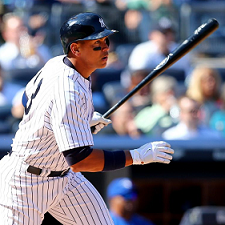
Alex Rodriguez 2015 225When Rodriguez reported for spring training last year following his season-long suspension, the Yankees treated him like an unwashed outcast. They talked as if he might not even make the team.

No one frankly gave him much of a chance to win a starting job, let alone have a productive season. But he fooled them all. And without Rodriguez’s production, the Yankees would not have reached the post-season.

Rodriguez reported for spring training last week, and his reception was 180 degrees different. The Yankees’ view of his contract is different, too.

When he hit his 660th home run last season, tying Willie Mays’ career total, A-Rod, under terms of his contract, was supposed to receive a $6 million marketing bonus. The Yankees, though, refused to pay it, saying Rodriguez’s PED suspension wiped out any realistic marketing opportunity.

The two sides wound up negotiating a settlement.

With Babe Ruth’s total of 714 next on A-Rod’s bonus list, the Yankees plan to pay the $6 million bonus if Rodriguez reaches it. With 687, he needs 27. This time the Yankees will be rooting for him to get the bonus because they expect to make a lot of marketing money linking Rodriguez and Ruth.

ILITCH AILING FOR WORLD SERIES TITLE

Sunday, February 21st, 2016

A year after Tom Monaghan bought the Detroit Tigers, they won the 1984 World Series. They have gone back to the World Series twice since but have lost both times, to St. Louis in five games in 2006 and to San Francisco in four games in 2012.

Mike Ilitch bought the Tigers from Monaghan, his long-time pizza rival, in 1992 and has suffered excruciating frustration during his 23-year ownership. Facing his 87th birthday around mid-season, Ilitch desperately wants to win a World Series before he dies.Mike Ilitch 225

That’s why he took the surprising step last August of firing Dave Dombrowski, one of the best and most highly respected general managers in the business, and that’s why he authorized uncharacteristic spending this winter to recruit players who could deliver that coveted championship.

Ilitch, one of the longest-running owners in Major League Baseball, is rarely quoted in public, and this column will not be an exception. I received no response from the Tigers’ communications department to my request for a telephone interview with Ilitch.

I reached Al Avila, long-time assistant to Dombrowski and his successor, last Friday, but after hearing my first question he said he couldn’t talk because he was on his way to the Florida governor’s dinner in Fort Myers. But he said I should contact Ron Colangelo, the team’s vice president of communications, to set up an interview for Saturday.

I did as instructed, leaving a telephone message for Colangelo and sending him an e-mail, but I heard nothing from Avila, which matched the response to my request for a telephone interview with Ilitch.

I spell all of this out because I think Detroit’s developments are intriguing and worthy of exploring. However, without input from Ilitch or Avila, I will simply conclude the explanation is obvious, citing recent history.

After winning the American League Central title the previous four seasons, the Tigers plummeted to last place last season with the league’s second worst won-lost record, which they compiled with a $164 million payroll, sixth highest in the majors.

Ilitch has not been cheap. In the last four years, the Tigers have been fourth, fifth or sixth in payroll, ranging from $141 million to $173 million. But when he saw the team struggle last season, he found it so unacceptable that he fired Dombrowski, who not only was his general manager but before that had also been the club’s president, holding that position for 14 years.

As surprising as his dismissal of Dombrowski, Ilitch created another surprise by replacing him as general manager with Avila, whom Dombrowski hired as assistant general manager five months after he became the club president. They had worked together with the Florida Marlins.

Ilitch would have surprised no one had he gone outside the organization for a general manager rather than continue on the same track. Avila, though, obviously had his marching orders and embarked on a hectic winter of activity. Avila signed free agents – expensive and cheap – and made trades.

Jordan Zimmerman IlitchHe beefed up the starting rotation, signing Jordan Zimmerman (5 years, $110 million) and Mike Pelfrey (2 years, $16 million).

He bolstered the bullpen, loading it with Francisco Rodriguez ($7.5 million for the last year of his contract plus $2 million for buyout of $6 million option) in a trade with Milwaukee); Mark Lowe (2 years, $11 million) and Justin Wilson (via trade with New York Yankees) and Bobby Parnell as a free agent.

He loaded the outfield, signing Justin Upton (6 years, $132.75 million) and trading with Atlanta for Cameron Maybin ($8 million for last year of contract, of which Braves pay $2.5 million, plus 2017 option for $9 million or $1 million buyout).

He signed assorted free agents for backup and roster depth, including catcher Jarrod Saltalamacchia, third baseman-outfielder Mike Aviles and outfielder John Mayberry Jr.

One player of note whom Avila let leave the Tigers was his son, Alex, who had lost his job as the Tigers’ catcher. The 29-year-old Avila, who played for the Tigers for seven years, signed a one-year contract with the Chicago White Sox for $2.5 million.

Last season the Tigers won 21 fewer games than the Kansas City Royals, who succeeded them as division champions and went on to win the World Series. That development didn’t help Ilitch’s frame of mind. He had to watch his division rival David Glass win it all while spending $35 million less.

Glass is 6 years younger than Ilitch and now he has a World Series championship and Ilitch still doesn’t have one. They do have one thing in common, though. Glass doesn’t return telephone calls or talk to reporters either.

STOP PAMPERING PITCHERS, HALL OF FAMER SAYS

Occasionally a player or an executive says or does something I like so much I declare him my hero. John Smoltz is my latest hero.John Smoltz3 225

I have always found the Hall of Fame pitcher to be intelligent, perceptive and articulate, but last week in an MLB radio interview he outdid himself. Maybe I thought that because he said something I have been saying for years.

The headline on the article about the interview said it all:

“John Smoltz thinks coddling players could cripple baseball”

Smoltz, the article said, “believes young pitchers are being coddled by pitch counts, inning limits and a variety of other elements in the environment of the modern pro athlete. He also thinks it doesn’t bode well for the future of the game.”

Both in private conversations and in these columns, I have criticized baseball people for pampering pitchers. These baseball people and their like-minded supporters say they employ pitch counts and innings limits to protect pitchers’ arms and prevent injuries.

Pitchers, however, continue to suffer sore arms. Tommy John elbow reconstruction surgery isn’t going away. Pitch and innings limits obviously aren’t the answer, but front-office and field personnel continue to insist on using them.

Pitchers from earlier eras have different views on the issue. They believe, as I do, that pitchers, beginning at the start of their careers, would benefit from throwing more, not less. That’s throwing, not pitching.

By throwing more, pitchers would build up their arms, and stronger arms would take pressure off their elbows. By pitching less, pitchers are jeopardizing their elbows.

In today’s pitching world, Smoltz said in the interview, the approach is a disservice to pitchers.

“We’re creating little CEOs to go out and get those mega-contracts,” he said. “I don’t blame the players per se for what they’re making. I just blame the philosophy that the injury rate is so great, the dynamic arms are so good, but we’re not extending them long enough and we’re not utilizing them right.”

“It really, in an essence, down the road is going to cripple this game I’m afraid,” Smoltz added.

It’s good of Smoltz to speak out on the subject, but unfortunately, few, if any, baseball people will listen. Everybody fears being blamed for causing pitchers to be hurt. Meanwhile, they continue to get hurt.

AND THE SIGH YOUNG AWARD GOES TO….

With pitchers and catchers in spring training, the time is probably past due for my naming the 2015 Sigh Young award winner. This eagerly awaited announcement has been delayed by the heavy load of contenders. Or I just haven’t gotten around to selecting the winner – or the loser, depending on your point of view.

Matt Garza Loses 225The award, which I created in 2010, goes to the pitcher I decide was the worst of the season. I’ve thought about forming a panel to select the winner, but if I do that, I might be inviting proponents of WAR and other initials into the process.

So this is strictly my selection, and you can blame me if you disagree. Having said that, I declare the 2015 winner of the Sigh Young award to be Matt Garza of the Milwaukee Brewers. He follows proudly in the spiked steps of A.J. Burnett (twice), John Lackey, Ricky Romero and CC Sabathia.

Garza, a 32-year-old right-hander, wins the award on the strength of his 6-14 won-lost record and 5.63 earned run average in 25 starts and 1 relief appearance. Other pitchers had more losses – Shelby Miller 17, Andrew Cashner 16, Aaron Harang, Rick Porcello and John Danks 15 each, for example – and Kyle Lohse had a higher e.r.a., 5.85.

But Garza put it altogether, adding a .293 opponents’ batting average as the clincher.

MEJIA MASTERS UNMATCHED MARK

Sunday, February 14th, 2016

The feat was so mind-boggling I didn’t know if I should be awe struck or sad. Then I thought of a constructive way of using the dates, posting them in over-sized numbers in every baseball clubhouse right next to the anti-gambling poster with the words of Major League Rule 21(d):Jenrry Mejia 225

4/11/15

7/28/15

2/12/16

Those numbers could serve as a warning to all players who see them. They could also serve as the epitaph to Jenrry Mejia’s baseball career. They are the dates on which the Dominican pitcher was declared to have tested positive for steroids use. They are the dates that made Mejia the first player banished from baseball for life for use of banned substances.

“I don’t think it’s a record he wanted to have,” said an acquaintance.

How is that possible? How can a player test positive three times in 10 months? He has to be trying, doesn’t he? It can’t happen accidentally, can it? In Mejia’s abbreviated pitching career, he had innings in which he struck out all three batters he faced. But he was trying to do that. Was he trying to test positive?

“I can honestly say I have no idea how a banned substance ended up in my system,” Mejia said after his first positive test, which resulted in an 80-game suspension.

A 162-game (full season) suspension followed three and a half months later when the exact same steroids were found to have invaded his body – accidentally and mysteriously, of course. He had 99 games left on that suspension when he tested positive a third time. By then his body must have triggered bells and whistles.

Mejia, however, stayed in character. ““It’s not like they say,” he told the news media in the Dominican Republic, where he lives and has been playing winter ball. “I’m sure I did not use anything.”

I suspect that in the dozen years MLB has been testing for performance-enhancing drugs a player or two have encountered accidental positives. But three positive tests in 10 months? Mejia would be hard pressed to make the case that they were faulty.

In an effort to find out why Mejia would relentlessly jeopardize himself and his career, I tried to talk to people involved with the pitcher or his case. However, Peter Greenberg, Mejia’s agent, did not return a telephone call, and David Prouty, the union’s general counsel, declined to comment, citing the confidentiality nature of the joint drug agreement.

I was able, however, to gain some insight by talking to others. It seems that in spite of his problems, Mejia stayed with the same trainer, who supplied him with the substances that cost him his career.

“It’s clear he’s been associated with old-style steroids,” said a baseball official who knows Mejia. “The guy he’s been associated with has a horrible track record.”

Why does Mejia keep hiring him? “Exactly,” the baseball man said. “He was pitching this winter. Is that why he did it? What was he thinking? He’s been suspended twice while being suspended.”

That someone told Mejia he wouldn’t be tested is foolish. For Mejia to believe that is even more foolish. Under the drug agreement in the collective bargaining agreement, a player who tests positive faces additional tests.

Wherever Mejia was getting advice, he was getting bad advice, and he will pay for it, not the person giving the advice. My sense is Latin players often get bad advice.

Chart (2016-02-14)revised

Without doing a complete statistical study of players who have incurred suspensions for violating the drug agreement, it seems that Latin players make the list in disproportion to their major league population.

In the last three years plus the first two months of this year, of the 26 suspensions incurred by players on 40-man major league rosters, 17 have been levied against players from Latin countries.

Part of the reason, I suspect, is that PEDs are legal in some Latin countries. I have also wondered whether the union does a good enough job educating its Latin members. I am told the union has an intensive educational program. In fact, Prouty, the chief lawyer, just happened to be in the Dominican Republic when I contacted him for this column.

“I am writing you from the Dominican Republic,” he said in an e-mail, “where I am attending the Rookie Career Development Program, the complement to the same MLBPA – MLB program in the US, and I can assure you that continued education on the Joint Drug Program continues to be a big part of the training at both.”

Despite the efforts of the union and MLB, I am told some Latin players have a more brazen attitude about PEDs, feeling they can beat the system.

Although Mejia is the only player to achieve the death penalty of suspensions, other players, mostly minor leaguers, have incurred two suspensions.

Most recent has been Zack Dodson, a 25-year-old pitcher, who until recently had been in the Pittsburgh organization. Dodson was suspended Jan. 19 for 100 games. He was suspended in 2012 for 50 games. The left-hander signed earlier this winter as a free agent with Baltimore.

Another pitcher, Troy Patton, who has played in the Orioles’ organization, has been suspended twice for use of amphetamines, for 25 games in December 2013 and for 80 games 11 months later. Patton actually tested positive three times, but there was no penalty at the time for a first-time use of amphetamines.

Cody Stanley is a catcher in the St. Louis system. He was suspended for 50 games in 2012 for PED use but persevered and reached the majors last season, playing in 9 games and batting 10 times. Two days after his Sept. 10 game, he was suspended for 80 games for an elevated testosterone level.

In 2007, Neifi Perez had an experience similar to Mejia’s. The Detroit infielder had three positive tests, incurring a 25-game penalty for the second and an 80-game suspension for the third, days before the second suspension ended. His 12-year career ended at the end of that season.

Despite Mejia’s lifetime ban, his career isn’t necessarily over. The 26-year-old reliever, who had been the Mets’ closer before steroids sent him to oblivion, can apply for reinstatement after a year off and if reinstated can return to the field a year after that.

He can spend the next year rethinking his claim of innocence. Pete Rose tried that excuse for 15 years and it didn’t work for him.

FROM SUPER BOWL L TO WORLD SERIES 50

In writing last week about brothers who played on winning World Series teams, an acknowledgement that Peyton Manning was trying to match brother Eli’s two Super Bowl triumphs, I was using that similarity as my annual Super Bowl-related baseball column.Super-Bowl-50-Logo

In doing so, I overlooked a better idea, a better similarity, and I am invoking my prerogative to call a do-over.

The idea was staring me in the face all week preceding the game, but it didn’t register because I do the best I can to ignore the National Football League’s arrogant and pompous way of promoting its championship game as special and the way the news media gullibly accepts the NFL’s hype.

The Super Bowl has become a big-time social event, no doubt about that. But it remains a game that decides the league’s championship. For years before it became known as the Super Bowl, the game was simply the NFL championship game in which two teams played for the league’s title.

It became known as the Super Bowl after the NFL merged with the American Football League. Commissioner Pete Rozelle, a former public relations man, and two aides, Jim Kensil and Don Weiss, former colleagues of mine at the Associated Press, brilliantly developed it into the social spectacle it has become.

The New York Times last Sunday ran what is called a reefer (a reference to an article) on page 1 of the paper and a cover story in the Sunday magazine:  “How Roger Goodell and the N.F.L. owners created the most powerful sports league in American history.”

Contrary to that inflated claim, Goodell didn’t create anything. He was the beneficiary of what his predecessors did. If anything, he has created problems for the league with questionable rulings on player behavior.

In my view, the NFL offered one notable development for this year’s game. Had the league remained consistent, this year’s game would have been Super Bowl L. But surely that designation would have confused fans, even those few who can count in Latin.

Instead of using the Latin designation of L, the NFL switched languages in mid-stream and used the more familiar 50. But worry not, Latin lovers. Latin has made a quick comeback. The game was hardly over when this headline appeared on the NFL website: “Way too early Super Bowl LI predictions.”  I can’t wait for LIX.

The NFL originally adopted Latin because its championship game was played in a different year from its season. League officials felt it would be confusing to talk about the 2015 season and the 2016 Super Bowl.

1953 World SeriesBaseball has never had to use Latin because the World Series is played in the same calendar year as the season. If, however, numbered designations had been necessary, which World Series was World Series 50? The Brooklyn Dodgers and the New York Yankees played it in 1953.

It went six games, and the Yankees won it. A star-studded Series, its teams had a combined nine players, five for the Yankees, four for the Dodgers, who were subsequently elected to the Hall of Fame: Yogi Berra, Mickey Mantle, Phil Rizzuto, Whitey Ford and Johnny Mize for the Yankees; Jackie Robinson, Roy Campanella, Duke Snider and Pee Wee Reese for the Dodgers.

Two other future Hall of Famers were part of that World Series. Casey Stengel was the Yankees’ manager, and Dick Williams was a Dodgers’ pinch-hitter who would later become elected to the Hall of Fame as a manager.

Will football fans be able to look back at Super Bowl 50 and say they saw 9, 10 or 11 future Hall of Famers play or coach in that game?

And will they be able to recall a performance the equivalent of Billy Martin’s. The Yankees’ second baseman registered a Series-high .500 batting average with 8 runs batted in and 12 hits, including a double, two triples and two home runs. In Latin, that would be a .D batting average, VIII r.b.i. and XII hits, including I double, II triples and II home runs.