When Carl Pohlad traveled to owners meetings, he often didn’t like the way his shirts looked when they came back from the hotel laundry. “He was upset when they sent his shirts back wrinkled,” Fay Vincent, the former commissioner, recalled. “He would get an iron and iron his own shirts. He never forgot his roots. He had grown up ironing shirts in a laundry for a living.”
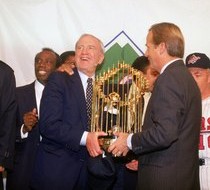
When Pohlad died last Monday at the age of 93, he was a billionaire three times over. The owner of the Minnesota Twins for a quarter century, he was ranked as the 102nd wealthiest man in the country by Forbes Magazine with a worth estimated at $3.6 billion. And he ironed his own shirts.
Pohlad, a Minneapolis banker, was unusual in another way. He was an owner who didn’t meddle with his team. He let the general manager and the manager do their jobs, and they did their jobs well. During Pohlad’s ownership, the Twins won the World Series in 1987 and ‘91, and they won the American League Central title four times in a five-year span (2002-06).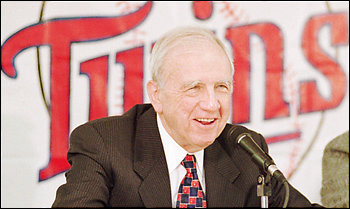
“Pohlad started out as a baseball novice,” said Clark Griffith, son of Calvin, who sold the Twins to Pohlad for $38 million in 1984. “He used to speak in football terms. He talked about head coaches and locker rooms, but he became a superb baseball man. He was very adroit in what he was doing. He was an exceptional owner.”
“We went from probably the poorest owner in baseball to the richest owner,” Griffith added. “In the end both treated the team the same way, acting in the reality of the marketplace, using scouting and player development. Carl and Calvin essentially operated the same way.”
The Twins have never received enough credit for their top-notch management, and they reached their greatest heights under Pohlad’s ownership.
“They’ve had very good management and that was no accident,” Vincent said.
“He never threw his weight around.”
Pohlad let the people he hired do their jobs without interfering. General manager Terry Ryan put together a talented team for the run of division titles, but in the two years before that run began the Twins had the lowest payroll in the majors. In their first championship season, 2002, only three teams had lower payrolls.
In the 1970s and ‘80s, Ewing Kauffman spent from his personal fortune to ensure contending teams in Kansas City. Pohlad opted not to follow that example with the Twins.
“I think he understood the great error of overspending for players,” Griffith said. “He understood that paying too much for old players hurts a team. You’re better off with young players. Young teams are better than old teams.”
But Pohlad knew the importance of scouting and player development. “When he hired Terry Ryan he really surprised me,” Griffith said. “He said, ‘Let me tell you. He’s really going to be a successful general manager. He’s a scout.’ I said this guy has become a sophisticated baseball man. Most owners in this era wouldn’t know scouts and wouldn’t look for those skills in picking teams.”
Two cases in point:
When George Steinbrenner became the Yankees’ owner in 1973, one of his first acts was to fire many of the team’s scouts. He soon discovered scouts were necessary to the operation of a baseball team and restocked his scouting staff.
When Marge Schott was the managing partner of the Cincinnati Reds in the ‘80s, she fired many of the Reds’ coaches, proclaiming, “Why should we pay all these guys for sitting around watching baseball games?”
Pohlad never minded paying his people for watching baseball games. “They still focus very heavily on scouting,” Griffith said. “They have great scouting.”
Just as he never told his general managers what to do, Pohlad never wrote out a lineup for his managers or told them whom to put in the lineup. Well, there was that one time.
“In the middle of the ‘87 season,” Tom Kelly related, recalling his first full season as the manager, “he asked me if Juan Berenguer could be a starter. I said ‘Juan’s doing good in the bullpen. He can come in and strike people out. I think that’s where we should leave him.’
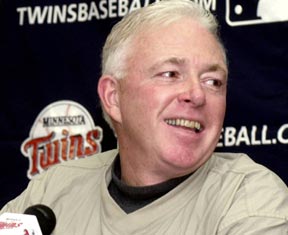 “Around Sept. 1, we’re a couple games ahead, and he said, ‘Don’t you think Berenguer could start?’ I said you’re certainly entitled to ask, but you hired me to manage and Juan is doing good where he is and we’re ahead. He never asked me another question about a player.”
Kelly recalled a different kind of experience when he was interviewed for the Twins’ job with Pohlad present.
“After a few questions I lost a little control,” related Kelly, who was then 36 years old. “I dropped a few four-letter words. They just came out. You start talking baseball. Obviously that’s not good. I remember walking down to the dome with Andy MacPhail, and he said ‘Why did you start cursing?’ I said ‘I was just being myself. That’s what you told me to do.’ He said ‘Oh my.’ But it worked out.”
Despite the success the Twins had under Kelly and then more recently, Pohlad was not an eager owner. “He was losing money and said, ‘Fay, if you offered me $40 million, I’d take it. But his wife loved baseball. While she was alive he was reluctant to sell. She saw baseball as a passion; he saw it as a business. He would say I’m only in baseball because my wife loves it.” Eloise Pohlad died in 2003.
But it was in 2001 that Pohlad appeared ready to give up the Twins. The owners, concerned about baseball’s financial troubles, were talking about folding two teams from the 30 that existed. The Twins and the Montreal Expos were the likeliest candidates, and Pohlad even volunteered to allow baseball to contract the Twins.
Skeptics saw ulterior motives in his offer. It was either a ploy to induce the state legislature to vote funding for a new ball park, or it was a way for Pohlad to get rid of the Twins for far more money, $150 million, than he could have gained by selling them.
Critics also discovered what appeared to be a serious conflict. In 1995, a financial firm headed by Pohlad made a $3 million loan to Bud Selig and the Milwaukee Brewers. Selig at the time was the Brewers’ chief executive and acting commissioner.
Contrary to a major league rule, the loan was not disclosed to and approved by the other owners. In addition, a Congressman questioned the propriety of the transaction and called for Selig to resign as acting commissioner.
However, Selig remained in office and the Twins remained in business. No team was contracted, prompting speculation that the whole idea was concocted to threaten the players ahead of the 2002 negotiations for a new labor agreement.
Pohlad was a hardliner among the owners, though it was the union, not the players, he had no use for.
“He tried to do some good for the players,” Vincent said. “He noticed players making bad investments, buying garden apartments and restaurants. He called the team together and said he noticed they were making investments and he considered himself a good investor. He wanted to offer an opportunity. He said come to me with a business proposition. I’m not interested in investing with you, but I will give you advice about the merits of the investment.”
No player took Pohlad up on his offer. “The agents tell them I’m an old white guy and owners steal from players,” the owner told Vincent. “The stereotype was too great to overcome,” he said.
As for the union, Vincent said, “He was petrified being in a business with financial risk controlled by the union. He believed baseball needed an Armageddon war to the death. He was a small-market owner who believed he couldn’t survive the way things were presently constituted.”
Vincent said he found Pohlad to be a fascinating and mostly admirable person – “he had a twinkle in his eye and a sense of perspective on life” – and didn’t resent him for winding up with the group of owners who opposed Vincent in 1992, a situation that led to Vincent’s departure as commissioner.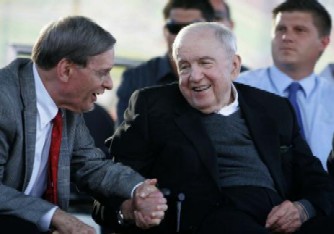
“I separated him from the Selig-Reinsdorf group,” Vincent said, speaking of the owners who led the move to oust him. “I just found him very straightforward. When he was on my side he was openly and directly on my side. When he went to the other side he was open about why he did. I liked him despite the fact he lined up with Selig and opposed me at the end. I felt that was only business.”
Two or three years after he resigned, Vincent related, Pohlad called him, said he was going to be in New York and asked if they could have lunch and let bygones be bygones. “I said sure,” Vincent said, “but it never happened.”
Pohlad had that effect on people. Randy Levine, the Yankees’ president and George Steinbrenner’s representative at owners’ meetings, said, “I loved Carl Pohlad. He was an incredibly nice, brilliant, caring man. Despite the fact that he and the Yankees were on different sides of issues, he was a good friend of George Steinbrenner.”