Of the major leagues’ six divisions the American League East is playing with the greatest payroll disparity among its teams. Two of its teams have two of the majors’ three biggest payrolls while the other three teams have payrolls that fall into the dirty dozen of payrolls, that is, they rank among the bottom 12.
Yet if you took a snapshot of the division standings entering Saturday’s games, you would find the A.L. East’s two biggest spenders, New York and Boston, occupying the bottom two spots and the three smallest spenders, Tampa Bay, Toronto and Baltimore, holding the top three spots.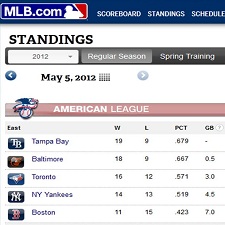
Furthermore, with a 19-8 record, the Rays had the best record in the majors, and except for Texas, the other two upstarts had the next best winning percentages in the American League.
Yes, I know that only a sliver of the season has been played, and the division could right itself in a matter of days or weeks. Poorer teams frequently start quickly and fade just as quickly, if not moreso.
By this time next month, for example, the Orioles could be back in their more familiar surroundings of last place. They began last season by winning six of their first seven games but six games later had a losing record en route to their 14th successive losing season.
Nevertheless, the ingredients for an intriguing season in the division are in place. One of those elements is the payroll differences. The Yankees and the Red Sox, the haves of the division, are paying their players a combined $371 million. The three have-nots are paying their players $221 million.
Despite the size of their payrolls, though, the Red Sox have not reached the playoffs the last two years, a development that resulted in all sorts of ramifications last October. The general manager fled to Chicago, the manager was invited to leave despite having directed the Red Sox to two World Series championships and Larry Lucchino, despite his new general manager’s wishes, hired Bobby Valentine to manage a Red Sox resurgence.
Meanwhile, the Rays, who finished in last place the first six years of their existence and nine of the first 10 years, made the playoffs three of the past four years. They and not the Red Sox played October games in 2010 and ’11.
With the addition of a second wild card in each league, the Rays and the Red Sox could both make the playoffs this year. So could the Blue Jays or the Yankees. But allow me a devilish moment to say how delightful it would be if the Rays, the Blue Jays and the Orioles made the playoffs and the Yankees and the Red Sox didn’t.
For now, that’s just a fantasy.
“I don’t want to sound like a cliché, but it’s early,” said Alex Anthopoulos, the Toronto general manager. “We’ve seen how fast it changes. In 2009 we had the best record in the league when we left home in mid-May. We went 0-9 on the road trip and wound up with 75 wins for the season. But through the middle of May we were the best team in the league.”
The Blue Jays and the Orioles are newcomers to this competitive business, if they indeed remain competitive. The Blue Jays last season finished fourth for the fourth consecutive season, struggling to stay above .500. They finished at exactly .500.
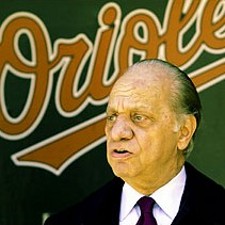 An A.L. power from the mid-1960s to the early ‘80s, the Orioles were last in the playoffs in 1997 and since have had 14 successive losing seasons, an ongoing stretch exceeded only by Pittsburgh’s record 19-year losing streak.
The Orioles’ plunge into irrelevance can be placed entirely in the hands of Peter Angelos, their principal owner since August 1993. Angelos, a successful and wealthy personal injury lawyer, is the answer to the question how did the Orioles squander their success on the field and at the gate.
In a conversation I had Friday with the Blue Jays’ general manager, Anthopoulos, he offered an observation that wasn’t about Angelos but could appropriately be applied to him. Discussing the elements that contribute to a successful team, he said, “It’s like buying stock. When you’re buying into a company you’re buying into management and leadership.”
Angelos might have built a successful law firm, but like many other successful entrepreneurs who buy baseball teams, he has failed in the operation of the Orioles. The team that drew more than 3 million fans a year for nine straight non-strike seasons had an attendance of 1.7 million each of the past two seasons.
That’s a substantial amount of lost revenue that could have paid for players who might have helped the Orioles compete for something other than fourth place. The past four seasons the Orioles supplanted the once lowly Rays in fifth place.
Dan Duquette is the latest baseball man whom Angelos has turned for improvement. A productive general manager with Montreal and Boston, Duquette is not the Orioles’ general manager because Angelos doesn’t like that title. Instead Duquette is executive vice president of baseball operations. His predecessor, Andy MacPhail, was president of baseball operations.
Not noted for organizational stability, Angelos has had seven “general managers” since he last experienced a winning season.
Not that he could afford to be choosy after a 10-year absence from a major league front office, but the 53-year-old Duquette said he was not reluctant to take on the Orioles and their recent history for two reasons: “It’s an opportunity to turn the team around, which is right up my alley, and it’s also an opportunity to work with a pro like Buck Showalter.”
“He and I have something in common,” Duquette said of the manager. “Buck is a good organization builder. He’s a good man to work with.”
In Showalter’s first full season as the Orioles’ manager last year, the team evenly split the first 48 games but couldn’t get out of May with a winning or even .500 record. The Orioles won 45 games and lost 69 the rest of the season.
When Duquette took over last Nov. 8, he had two priorities: restructure the front office and find pitching, as much as he could.
“We upgraded our pitching,” Duquette said. “Our starting pitching was the worst in the league last year so we put a lot more emphasis on our over-all program. That seemed like a good place to start. We felt we needed depth both for the rotation and the bullpen. The core of our team is pretty good, and that made us more competitive.
It’s usually easier said than done – improving a pitching staff – but the Orioles have done it, at least for the first month. Last year they had the highest earned run average, 4.89, and gave up the most runs and earned runs, allowing 5.31 runs a game.
In leading the team to an 18-9 record through Saturday, the pitching staff had the lowest e.r.a., 2.76, and had permitted the fewest runs and earned runs, giving up 3.37 runs a game. Knocking off two runs a game is one way to start winning.
Another is to import talent. Just before spring training Duquette traded pitcher Jeremy Guthrie to Colorado for two pitchers. Starter Jason Hammel has a 4-1 record and 2.09 e.r.a. Reliever Matt Lindstrom has allowed no earned runs in 11 games and 11 innings,
The Texas Rangers have contributed two effective relievers through the Orioles’ waiver claims: Darren O’Day 2-0, 0.68 e.r.a. in 11 games and 13 1/3 innings and Pedro Strop 3-1, 1.80 in 11 games and 15 innings.
Another addition to the rotation is Wei-Yin Chen (2-0, 2.76). signed in January out of Taiwan.
“Mainly we have a competitive pitching staff,” Duquette said of the team’s strong start.
The new pitchers have made life easier for Matt Wieters, the young catcher, who with second baseman Roberto Andino, center fielder Adam Jones, first baseman Chris Davis and left fielder Nolan Reimold makes up the team’s .300-hitting contingent.
Asked to compare Wieters with Minnesota’s Joe Mauer, the A.L. 2009 most valuable player, Duquette commented only on his catcher. “He’s got a lot of talent,” the executive said. “He’s got power, power from both sides of the plate and he’s a good field general. He’s a very good defender.”
The Orioles have set the tone for the common element in the early-season success of the A.L. East have-nots. Good pitching is what all three teams have had in the first month while the Yankees and the Red Sox pitchers have struggled.
In the e.r.a. rankings entering Saturday’s games, the Orioles had the best e.r.a., the Blue Jays were fifth with 3.64 and the Rays sixth with 3.69. The Red Sox staff had a 5.38 e.r.a., next-to-worst, and the Yankees were 11th with 4.38.
“The rotation has pitched well,” Anthopoulos acknowledged, then added candidly, “It’s a young rotation. Can we do this for six months? Not likely.”
Ricky Romero and Brandon Morrow have been the Blue Jays’ standouts, Romero compiling a 4-0 record with a 3.64 e.r.a., Morrow a 3-1 record and 2.38 e.r.a. Two other starters joined Morrow under 3.00, Kyle Drabek at 2.40 and Henderson Alvarez at 2.80. Each had a 2-2 record.
Offensively, two hitters stand out, Jose Bautista for his lack of hitting, Edwin Encarnacion for his lusty hitting.
Bautista, who slugged 97 home runs and drove in 227 runs the past two seasons, was hitting .177 with 5 homers and 14 r.b.i. through Friday. But Encarnacion, a career .260 hitter, was hitting .295 with 9 homers and 24 r.b.i.
 “Bautista is off to a slow start,” Anthopoulos said. “But he’s walking more (18 times) than striking out (17). It’s happened with others. For example, David Ortiz for two years got off to a slow start. Then he came around. Jose’s going to be fine. I don’t worry about him.”
Encarnacion, the general manager said, “can be streaky. He can get hot and do this for a month or two. He’s shown this before.”
Anthopoulos is not getting excited about the Blue Jays’ start. This is only his third season as a general manager, but he’s been around long enough to know good early starts can fool you.
The other day,” he related in a telephone interview, “someone, a fan, asked me where we stand in the wild card. I don’t pay attention to that now. I don’t know won-lost records now. It’s too early.”
What does Anthopoulos look at this early in the season?
“How are we playing, how does the team look,” he replied. “We’re third or fourth in runs scored. We still have some guys who haven’t performed. Our offense has room to get better. We’ve been good competitively, but we haven’t reached our peak.”
The Rays have been legitimate contenders the past four years and have a greater understanding of what to make of a good start.
“We needed to get off to a strong start to make our mark in the division,” the Rays’ manager, Joe Maddon, said.
The Yankees and the Red Sox are well aware of the mark the Rays have made in the division in recent years. In this season’s first month, the Rays swept three-game series from the Yankees and the Angels and a four-game series from Seattle. They won two of three from the Rangers and the Twins and the Blue Jays.
Their starting pitchers, perhaps the best group in the league, have worked as expected. David Price has a 5-1 record and 2.35 e.r.a., James Shields has a 5-0 record and 3.05 e.r.a. and Jeremy Hellickson a 3-0 record and 2.52 e.r.a. Jeff Niemann and Matt Moore are out of step with earned run averages over 4.00.
JETER’S DEMISE GREATLY EXAGGERATED
A comment that was prevalent early last season has not been heard this year. A year ago it was “Is Derek Jeter finished?”
In the first month of last season, in his first 26 games, Jeter batted .250, hit no home runs and drove in 6 runs and scored 14. He had 26 hits and 28 total bases, a .269 slugging percentage and .310 on-base percentage.
His critics – yes, even Derek Jeter has critics – had him a basket case and were certain he would not be seen again on a baseball field. Maybe that was wishful thinking.
In his first 26 games this season, the Yankees’ shortstop batted .404, hit 5 homers and knocked in 15 runs and scored 20. He had 46 hits and 69 total bases. His slugging percentage was .605, his on-base percentage .439.
Guess he’s not finished at the age of 37 going on 38 next month. His detractors will have to wait to bid him bye bye.