Editor’s note: The 2014 baseball season is upon us, and as baseball romantics tell us, this is an ideal time for fathers and sons (why don’t they ever say anything about fathers and daughters?). In this guest column, the writer tells about his father, too briefly a prominent baseball figure, who died at far too young an age.
This is the 25th Opening Day since my father, the former Major League Baseball Commissioner and President of Yale University, Bart Giamatti, passed away suddenly one crisp, September afternoon at the age of 51.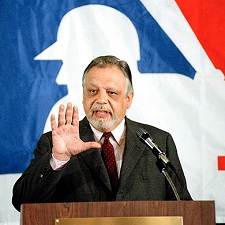
The world has changed quite a bit since then. There are those who remember him, those who have forgotten him and those who never had the pleasure to know him. So it seems appropriate on this anniversary to remind us all – and to introduce those newcomers – to who Bart Giamatti was. And what he stood for.
My father was a man of great humor. Not a day passed for him without a warm conversation on the street with a cop or a cab driver. He was a man of great insight and heart. A man from Italian immigrant and Yankee stock. A scholar. A poet. A teacher. A husband and father of three children. A baseball fan. A leader.
But most importantly, my father was a man who had genuine convictions. He stood by those convictions with courage. Without fear. Or apology. He was a man who acted. And did what he felt was right and true in his heart. Not what was populist, hip or trendy. He understood that it was his responsibility to respect and uphold the principles and laws of whatever institution he’d been tapped to steward.
With integrity. Whether it was a classroom, a university, or Major League Baseball, my father believed in his soul, unequivocally, that this function was his moral duty. For him there was no greater honor than to be entrusted with this responsibility – because these institutions mattered. They were worthy guideposts, that when properly managed, had the power to set examples for us – so that we might conduct our lives in a more productive, honest way.
For my father, the chance to lead the institution of baseball, an institution built on the back of a simple game, a game constructed on failure, with all of its Zen riddles, poetry and tradition, a game of equal opportunity for all shapes, sizes and colors, it was the perfect mirror. A mirror reflecting what was good, and what needed tweaking, in our modern society.
There is emptiness without him today. Especially in the world of sports where his voice is sorely missed. You see his was a voice that served as a reminder about the simple value of good citizenry and fair play. And coincidentally as the Pete Rose debate has been rekindled recently, I am again asked what my father might say if he were alive today. No doubt he would applaud the work that the men of law have shown as solid proof, for why Mr. Rose remains on Cooperstown’s permanently ineligible list. A list he will stay on unless removed by another commissioner.
But regarding Mr. Rose’s banishment on a different level, one pertinent to the moral level of honesty, effort and citizenry that my father held so sacred, Bart might add today that Rose still does not deserve a second chance for the sake of a second chance – without earning it.
Mr. Rose has done nothing to earn his way back into baseball. My father would seek true remorse. Of which there has been none from Mr. Rose. True remorse would lead to true reconfiguration of one’s life. Also of which there has been none.
 This dilemma isn’t about how great a player Mr. Rose was, and it also has nothing to do with today’s steroid debacle, or whether Mr. Rose thinks those accused of drug use belong in the Hall Of Fame.
It’s about a broken rule. It’s about arrogance. The arrogance to stomp on the heart of the game by committing baseball’s cardinal sin: betting on the game. And then somehow believing that you are above the game itself – and should be given a pass.
(It should be noted that my father treated Mr. Rose, a veteran star, with the same force that he would have treated a small time rookie, proving to Mr. Rose that he was not in fact bigger than the game).
Making matters more complicated, Mr. Rose chose to vehemently deny his actions for fifteen years, blaming others for his plight. And what’s really comical and obvious is that when it was suddenly convenient for him, he did an about face, sort of confessed, and expected to be coddled… and given that pass again…all the while, ironically, disrespecting the pearl that he’d been so blessed to have been handed.
True remorse would mean having the strength to get help, and turn your mistake into something positive. Like spreading the word to kids about the dangers of this disease called gambling. But all of this would take true effort. True courage.
And without those, there is no second chance. Mr. Rose’s belligerence and actions continue to stain the game, as my father said. These principles and standards of good citizenry that Mr. Rose and those who stand with him seem so oblivious to, should matter. They mattered to my father.
With the dawn of a new baseball season, we can honor my father’s legacy by recognizing the beauty and poetry that he believed made the game of baseball so special. He’d want us to focus on the hope that is baseball, and the possibility that each season, each game, each pitch and each trip to the plate embodies.
He’d surely encourage us to embrace that hope and possibility, making it a positive part of our daily lives. But perhaps the best way to honor my father’s legacy is to take in a baseball game. And when you do, celebrate that which binds us together.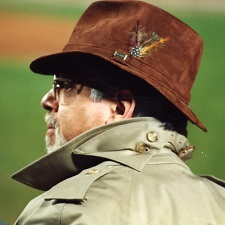
Celebrate that connection that is so unique to baseball. A connection that my father knew was a fundamental part of the American experience. A connection spanning generations. From boyhood to adulthood. From fathers to sons and daughters to grandmothers. From cities and familiar places. To simpler times. Honor him by remembering that fair play and how we treat each other does matter.
After all, my father was an idealist who loved a human game – with all of its imperfections. A game that reflected our vulnerability. A game, like life, capable of great joy and redemption. A game always, and in every way, designed to break your heart.
Marcus Giamatti wrote an afterword for his father’s 1989 book, Take Time for Paradise: Americans and Their Games. Bart Giamatti died before the book was published, but here is an excerpt from his son’s contribution to the book:
In the oblong, pocked, back yard of our house in New Haven, under a blue sky, with a warm June breeze at our backs, we played long toss. Back and forth. No sound, but the lone cadence set only by the solitary pop of a ball in a mitt. Then a sudden shift, and infield instruction became the mode.
My father fired ground balls with a passion in my direction. Always the teacher, he led a supportive tutorial in proper fielder’s techniques. Finally, came my most beloved slice of the afternoon’s adventure: with a flick of his glove, he gave me the familiar signal to assume the position of catcher.
Now, he, Luis Tiant, and I, Carlton Fisk. A sudden hush fell over the crowd, as with a weathered, buckle shoe, he toed the imaginary rubber, shrugged, and with a deep sigh, leaned in for the sign. His face, calm with focus, as he peered down at me, over his glasses.
With a nod of the head (the selection accepted) he ever so slowly arrived at the set position, checked the runner on first, (somewhere over by the garage)…and froze. Motionless. I held my breath. Pa’s oxford shirt, and red chino’s billowed in the breeze. The world’s clock closed down. And then, with a sudden kick of the leg, an El Tiante twist of the body, and a head jolt thrust heavenward, my father let loose a fastball. Right down the middle. A thunderous clap of leather shook the neighborhood as the ball arrived, and nestled tightly in my palm’s pocket. Such stillness held, as a smile eclipsed his bearded visage. My hero.
Marcus Giamatti is a writer and an actor, who has appeared in television series and films. His latest film, “Starving in Suburbia,” will premier April 26 on the Lifetime network.)