Bobby Sprowl was not at home Saturday; at least he didn’t answer his telephone. I called Sprowl because I wanted to talk to him about a game he pitched for the Boston Red Sox in 1978. It was probably the second most memorable game the Red Sox and the New York Yankees played that season, the most memorable being their playoff game for the American League East title.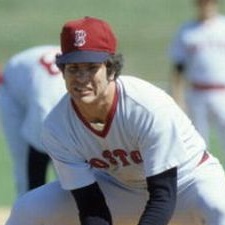
The game Sprowl started was played Sept. 10 at Fenway Park. A 22-year-old left-hander, he had started one game for the Red Sox, his major league debut, which he lost five days earlier to Jim Palmer and the Baltimore Orioles.
His start against the Yankees, though, was as critical as critical can be, not to mention controversial as the choice of manager Don Zimmer. Fifty days earlier, the Red Sox had a seemingly insurmountable 14-game lead over the Yankees, and three games of that margin had disappeared in the first three games of the teams’ four-game series.
Now the Red Sox lead was down to a mere game, and the neophyte Sprowl was being asked to protect it. By the time he was finished pitching, though, and it didn’t take him very long, it was Sprowl who needed protection.
He lasted six batters, walking Mickey Rivers and Willie Randolph (after Rivers stole second), inducing Thurman Munson to ground into a double play, giving up a run-scoring single to Reggie Jackson and walking Lou Piniella and Chris Chambliss, the last batters he faced.
A Graig Nettles single off Bob Stanley delivered two more runs charged to Sprowl, and the Red Sox lost the game, 7-4. The Yankees scored 42 runs to Boston’s nine in the series, which earned the deserved tag of the Boston Massacre.
In a newspaper interview a couple of decades later, after he had become a college baseball coach, Sprowl said, “You know what? I didn’t think I pitched that bad. Looking back, I just didn’t have good command against the Yankees. It was one of those things where we were roughed up three games in a row so they took me out after some walks. It wasn’t that I was that bad. I was missing, but I wasn’t missing by much.”
What does a 35-year-old series have to do with a 2013 race?
I think people are wrong when they refer to a series between the previous year’s World Series opponents as a World Series rematch because it’s not a rematch; they are not the World Series teams. They are different teams a year or so later, and it’s a different season.
However, this series between the Red Sox and the Yankees is intriguing because of the similarities with that series in a corresponding segment of the season in 1978.
With Sunday’s series finale to be played, the Red Sox had won the first three games, scoring late-inning comeback victories in the first two games, then outslugging the Yankees and not relinquishing the lead in the third game.
In the first game, the Yankees overcame a 7-2 deficit with a six-run outburst in the seventh inning, only to have Boston rally for the tying run in the ninth and the winning run in the 10th.
The second game saw the Yankees score two runs each in four of the first five innings for an 8-3 lead, but the view changed after that flurry. The Red Sox erupted with five runs in the seventh, four in the eighth and a 12-8 victory.
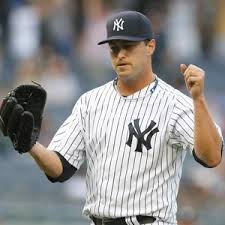 The outcome of those games set up David Huff to be the Bobby Sprowl of this series. Unlike Sprowl, Huff is not a neophyte. He turned 29 years old last month and had started 52 games for Cleveland in the past four seasons.
This season, though, the left-hander had relieved 9 times and started no games for the Yankees since they summoned him from the minors Aug. 15. Manager Joe Girardi decided early last week to have him take Phil Hughes’ spot in the starting rotation against Boston Saturday.
Huff, however, was unable to slow the rushing Red Sox any more than Sprowl could contain the Yankees 35 years ago. The Red Sox battered Huff for nine runs in 3 1/3 innings and won 13-9.
Unlike 1978, the outcome of the first three games of this September series wiped out any thoughts the Yankees might have had of making a belated takeover of the A.L. East lead. But wait, you say, there’s still the wild card.
Yes, that consolation prize remains out there. But the Yankees are one of five teams scrambling for the second wild-card spot, and entering Sunday’s games. the Yankees were 2 ½ games behind Tampa Bay, 1 ½ behind Baltimore and Cleveland and 1 game ahead of Kansas City.
It will come as little consolation to Don Zimmer, Carl Yastrzemski, Dwight Evans, George Scott, Butch Hobson, Jim Rice, Fred Lynn, Rick Burleson. Mike Torrez, Dennis Eckersley, Jim Wright, Bill Lee, Andy Hassler, Tom Burgmeier and Sprowl to know that the Red Sox triumph in this season’s September series might have derailed the Yankees’ post-season travel itinerary.
MORE POOR ANNOUNCING
In a recent column about Vin Scully, the legendary broadcaster of Los Angeles Dodgers’ games, I contrasted his fluent, literate work with that of some others of his lodge. I used New York Yankees’ announcers as examples of those will announce games in the future tense, describing plays that will happen when they have already happened.
Watching a game on MLB Network recently, I heard similar usage by Detroit Tigers’ broadcasters:
“It’ll be a 1-2-3 inning for Scott Kazmir” when the pitcher had already retired the third straight batter.
“He will strand a two-out triple” when the inning had already ended with the triple-hitting runner standing at third base.
“The Tigers will be batting around in this inning” when the ninth batter in the lineup was batting.
This one, however, is one of my favorites, no matter who says it or writes it, though it seldom seems to make print, probably because copy editors have removed the redundancy:
“The Tigers have retired the last six in a row.”
MIGGY IS MIGHTY
 Miguel Cabrera has to hit a flurry of home runs in Detroit’s last 20 games to win the American League home run title and an unprecedented second successive Triple Crown.
Cabrera entered Sunday’s games No. 1 in the A.L. in runs batted in (133 to Chris Davis’ 124) and in batting average (.356 to Mike Trout’s .338) but second in home runs (43 to Davis’ 48). Cabrera’s Triple Crown numbers last year were .330, 44 and139.
Although the Tigers’ remarkable slugger could fall short in home runs, he is in position to lead the league in on-base (.449 to Trout’s .435) and slugging (.673 to Davis’ 656) percentages. Last season Cabrera’s .606 slugging was the A.L.’s best, but his .393 on-base percentage was fourth
SEEKING RAY GREBEY, FINDING RED SMITH
Sometime after Ray Grebey became the owners’ chief labor negotiator in 1978 but before relations between the owners and the players became steamy in 1980 one of my editors at The New York Times asked me to write a profile of Grebey.
I told him I thought it would be wiser to have someone else write it. If I write everything I have learned about Grebey, I said, he will never talk to me and that could make it difficult to cover the negotiations.
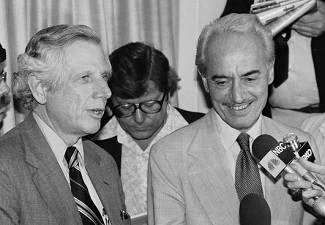 I offered to tell another reporter what I knew, and the editor thought about that alternative. Eventually, he came back to me and said I had to write the profile and they would take their chances with him. So I wrote the profile, and Grebey never talked to me again.
When I was looking for that piece after Grebey died last week I came across a column that Red Smith wrote in the Times after the 50-day players’ strike ended in August 1981 after the owners’ strike insurance ran out.
This was the first part of Smith’s column; it gives you an idea of what Marvin Miller and the players were dealing with and why the owners fired Grebey in 1983.
RED SMITH: The Fight That Nobody Won
DURING negotiations on the baseball strike, Murray Chass reported in The New York Times that there was talk of a swap. Owners would grant the players full credit for time lost during the strike if the players would agree to an extension of the basic agreement, then due to expire Dec. 31, 1983.
Ray Grebey, the one and only spokesman for the owners’ Player Relations Committee Inc., was asked to comment on ”the report in today’s Times.”
”It is an unreliable report,” he said, ”by an unreliable reporter on an unreliable paper.” When a strike settlement was announced at 6:05 A.M. Friday, it included a swap – full credit for lost time in exchange for a one year extension of the basic agreement.
Many years later, in November 2009, Grebey did talk to me again. I called him for comment on a report I heard that he had written a letter to the Hall of Fame urging Miller’s election.
This was a letter written and a stand taken by a man whom Miller had refused to meet with in the critical weeks leading to a strike settlement and pose for pictures shaking hands post-strike.
“Absolutely; I think Marvin deserves to be in the Hall of Fame,” Grebey told me. “He was a strong adversary, but I respect what he did for baseball. When you sit across the table and have disputes, it doesn’t diminish what he did.”
Grebey also admitted that he was offended when, visiting the Hall of Fame with his grandson, he saw “the rather pretentious memorial” to Bowie Kuhn, who was commissioner during Grebey’s tenure as labor chief. No love lost there for a man who had a large hand in his firing.
There’s a problem I have with people dying. For example, when I heard that Grebey had died, I would like to have been able to call Miller and recall some of his more outrageous behavior. But I couldn’t. Marvin died last November.