As the Red Sox were battering the Yankees’ relief pitchers in the middle game of their three-game weekend series at Fenway Park, I sent my son an e-mail.
“Did the Yankees get their relief pitchers,” I asked, “from some Bronx softball league?”
After that game, the Yankees’ relief corps had a 6.68 earned run average, third worst in the American League. The relievers had allowed 67 hits, 12th most, including a league-high 14 home runs, while pitching 62 innings, fourth most, and facing 283 batters, second most.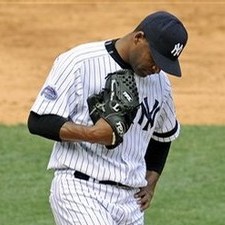
In other words, the relievers were working an abundance of innings and creating an abundance of damage.
The Boston bullpen, in contrast had a league-low 2.57 e.r.a. and had permitted 45 hits, fourth fewest, including 4 home runs, second fewest.
The bullpens epitomize the difference in the way the teams have been put together. The Red Sox have done a far better construction job than the Yankees, and the results on the field will demonstrate that view.
Yes, it’s early in the season. A three-game Fenway sweep in April can easily be wiped out through the rest of the season, 23 of the schedule’s 26 weeks, but if the bullpens are any indication, the Yankees may not be good enough to make up for early losses.
When the Yankees reached the end of April last season, they were three games from first place, and in the next five months they got no closer. In the newly designed American League East, as Yogi Berra might have said, it gets late early.
Will the first month determine the outcome of this year’s division race? Who knows? A 10-game winning streak, which the Red Sox compiled with the Yankees’ help, is a contributing factor in any month.
A bad bullpen is a contributing factor at any time, too. The Yankees did not expect to have a bad bullpen. In fact, they thought they would have a very good bullpen. They saw their bullpen as one of the team’s strengths. Starting pitching was a problem, and the Yankees spent lavishly to solve it.
The Mets had a bullpen problem last year, and they set out last winter to fix it. They did, signing Francisco Rodriguez and trading for J.J. Putz. In the early weeks of the season, the Mets have found that their starters, namely John Maine and Oliver Perez, are creating a problem, but it’s too late to do anything about it, unless they were to sign Pedro Martinez, which at the moment is unlikely.
Besides Mariano Rivera, the cast of relievers the Yankees would choose from included only pitchers who would be names in their own households. Several years ago, in 2002, the Yankees needed a long reliever and leaped at a free agent, signing Steve Karsay for $22.25 million for four years. It was a precedent-setting and absurdly high price to pay for a long reliever.
The Yankees got one healthy season out of Karsay and released him a month into the fourth year. The memory of that experience might have influenced general manager Brian Cashman in his planning for this season, though he seemed to be pleased with the group of relievers he had.
“They’re the same people we had last year when they led the major leagues in strikeouts and were seventh in e.r.a.,” Cashman said. “We had a strong bullpen on paper. But bullpens are volatile. It doesn’t always play out that way. But we believe in these guys. They have quality arms.”
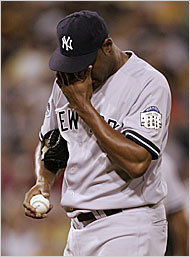 Cashman and his baseball people thought the bullpen was the team’s strength. Mariano Rivera continued to be the magical closer, and Brian Bruney and Jose Veras (at left), they felt, had demonstrated that they could handle the seventh and eighth innings, freeing Joba Chamblerlain to start.
The Yankees desperately needed to shore up their starting rotation, and Chamberlain would be one of the two by fours. The others would come from the free-agent market, where Cashman expensively placed his emphasis.
That emphasis produced CC Sabathia and A.J. Burnett, but the errant assessment of the bullpen produced Damaso Marte, Phil Coke, Edwar Ramirez, Jonathan Albaladejo, Veras and Bruney (currently on the disabled list), a collection of no-name relievers with questionable sustainable ability.
It is the only segment of the team that Cashman put together cheaply. The six relievers have a collective salary of $6,661,800, with $5 million of that going to Marte and Bruney. Nine of their teammates earn more individually.
That is not to say that Cashman should have spent more just for the sake of having higher-salaried relievers. Karsay was a bad example of that mind set, and Marte is a current bad example.
Marte, whom the Yankees signed as a minor league free agent eight years earlier, then traded him seven months later, was a free agent last winter, and the Yankees didn’t wait to see what kind of market would develop. They signed the left-handed pitcher to a 3-year, $12 million contract the first day he was eligible to sign with other teams.
The Yankees, it seem, can’t get it right. They either overpay for relievers or go cheap and get ineffective ones.
In The New York Times last month, Tyler Kepner wrote a piece about the Yankees’ relief corps. I don’t think he meant it to be critical of the Yankees, just a recitation of the facts of how they constructed the staff and where the pitchers had been. The headline: “Free-Spending Yankees Use Discount Parts In the Bullpen.”
Of the six relievers expected to join Rivera, Kepner wrote, only Coke had been drafted by the Yankees. “The others came from discount bins.”
The Yankees signed Veras after “two pitching-poor teams let him go.” Ramirez was released twice by the Angels, and he pitched in two independent minor leagues. Bruney was released by the Diamondbacks, who gave his roster spot “to a fading veteran, Kevin Jarvis.” Albaladejo was released by the Pirates, Marte as a minor leaguer by the Mariners, the first team that signed him.
Those are good reasons why the pitchers have come to the Yankees so cheaply, but it doesn’t justify their existence on a team that spends like the Yankees ($201 million payroll) and wants to return to the World Series for the first time since 2003. Cashman might want to read Benjamin Franklin, the wily old general manager of another time, on how “a little neglect may breed great mischief: “for want of a nail the shoe was lost; for want of a shoe the horse was lost; and for want of a horse the rider was lost.”
Some versions have shortened that adage to “for want of a nail a kingdom was lost,” which could apply to the Yankees this season if their relievers continue to set fires instead of putting them out.
The Yankees have two means of rescue from their predicament. Their names are Mark Melancon and Joba Chamberlain.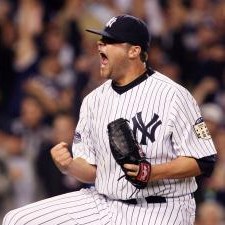
Melancon, a 24-year-old right-hander, is considered the successor to Rivera. After the debacle with the Red Sox last Saturday, the Yankees summoned Melancon from the minors – prematurely, some felt – and he pitched two scoreless innings against the Red Sox Sunday. He may never go back to the minors.
“He’s only two innings into his major league journey,” Cashman said. “He’s got quality big league stuff. He’s just inexperienced.”
Chamberlain has been at the center of a running debate within and outside the Yankees organization. Should he start or relieve? He was terrific as a reliever the last two months of his first season, 2007, and he was impressive as a starter last year.
The Yankees made the decision to keep him in the rotation this season, and that’s where he is. Will he stay there? Maybe, maybe not.
If Chien-Ming Wang returns to good health and effectiveness and if Phil Hughes pitches well in Wang’s absence, the Yankees would be free to bump Joba to the bullpen, where he would set up Rivera and perhaps make life easier for the other relievers.
The Yankees, however, face one problem in pondering that decision. Chamberlain has not been the same pitcher, especially with his velocity, since he injured his shoulder last August. If he can no longer overpower hitters, can he be as effective out of the bullpen as he was at the start of his major league career?
A decision or even a discussion on Chamberlain’s role is far off. In the meantime, Cashman might want to think about the kingdom and the nail that lost it.
