The mother of my youngest grandson had been reading reports of the Mets’ dismissal of Omar Minaya as their general manager and was curious about the part that said he might remain with the team in a lesser capacity.
“Why would he do that?” she asked. “Wouldn’t that be embarrassing?”
Good question, and the simple answer is “that’s baseball.” Once you’re in it, you never want to leave it. With some exceptions, baseball people are baseball lifers. Pride doesn’t enter the equation.
If a team offers a job – in the front office for a fired general manager, in the dugout for a fired manager – more often than not he says yes.
That doesn’t mean Minaya will be with the Mets next opening day. It’s more likely that if he is in baseball, he will be with another team. But he also could be in television, or he may still be taking time off to consider his next move.
Former managers are more visible than former general managers. Fifteen former major league managers were on major league coaching staffs this year. Some were there to stay visible to other teams and hope that another managing opportunity would come along, even with the teams they’re coaching for, though no one would be foolish enough to express that desire.
Twenty-five former general managers work for major league clubs (see list). The total doesn’t include Pat Gillick (Phillies) and Bill Stoneman (Angels), who retired but remain with their clubs as senior advisers.
Most former general managers who have remained in baseball are in scouting, some in administration.
Many are happy to be free of the responsibility, the pressure, the intensity and the hectic pace that go with the general manager’s job and the arduous work it entails. Others, though, are eager to get a second chance.
“A lot of them, like me, are hoping to get another opportunity,” said Wayne Krivsky, former general manager of the Cincinnati Reds. “It’s the love of the game, the allure of the game. This is our lives. In a lot of cases it’s the only thing we know. It’s what you know and what you’re comfortable doing.”
Krivsky, 56 years old, worked in baseball front offices for 29 years, primarily in scouting and player evaluation, before the Reds named him general manager in 2006.
After only two years and with the Reds showing some improvement, Krivsky became the victim of an unexpected move 350 miles away. The St. Louis Cardinals inexplicably and unfairly fired Walt Jocketty as their general manager.
Robert Castellini, the Reds’ principal owner, had previously been a minority partner in the Cardinals’ ownership group, knew Jocketty from St. Louis and hired him as a special advisor. Not long into the 2008 season, Castellini fired Krivsky and named Jocketty general manager.
 Krivsky went to work for the Mets as a special assistant to Minaya for the remainder of the 2008 season, switched to Baltimore in 2009 and returned to the Mets this year with a two-year contract.
Barring a change with the new regime under the new general manager, Sandy Alderson, Krivsky will be part of a crowded front office. John Ricco, whom Minaya brought in as assistant general manager, remains in that position, and Alderson has added Paul DePodesta and J.P. Ricciardi.
It would seem that Alderson has all of his bases covered, leaving no room for Minaya, who had said he didn’t know if he would continue to work for the Mets but would wait and see what and who developed.
Now he can collect the more than $1 million a year the Mets owe him for the last two years of his contract. He can also sit back, relax and wait until he feels like working again before calling one of the many general managers who have called him and told him they have an opening if and when he is ready to go back to work.
Meanwhile, the Mets, even without Minaya, have three former general managers in their front office. Krivsky was in Cincinnati, DePodesta in Los Angeles and Ricciardi in Toronto.
“The time in Cincinnati was a lot shorter than I hoped it would be,” Krivsky said. “I waited 29 years for my shot. I don’t know what I would do. It’s all I’ve known since I got out of college.”
Alderson, who went from general manager of the Oakland Athletics to president of that team and then of the San Diego Padres, has returned to the role of general manager 13 years after he last worked that job.
In hiring DePodesta as vice president for player development and scouting, he has brought in an executive who was the Dodgers’ general manager in a stormy two-year term in 2004 and ’05 and since he was fired had been in the San Diego front office for four and a half years, first as special assistant, then as executive vice president.
Ricciardi was the Toronto general manager for eight years and was fired after failing to deliver on the claim that got him hired: He could do better and spend less. He did neither. Now, after a year as a television analyst, he will be a special assistant to Alderson.
Jocketty and the Reds had three former general managers in their front office before Alderson and the Mets:
Jerry Walker was Detroit’s general manager in 1992 and ’93 and is now a Reds’ vice president and special assistant to Jocketty, with whom he worked a long time in St. Louis.
Bill Bavasi, a two-time general manager with the Angels and the Mariners for a total of 10 ½ years, is the Reds’ vice president for scouting, player development and international operations.
Cam Bonifay, one of three former Pittsburgh general managers working for other teams in jobs with reduced authority and responsibility, is a Reds’ special assistant to the general manager.
Walker, one of the Orioles’ “baby birds,” as their good young pitchers were called in the late 1950s, was a general manager so long ago it’s easy to forget that he was a general manager. He did not get a second chance, not that he wanted it.
“When Detroit let me go,” he recalled in a telephone interview, “I came home and did not go to spring training. It’s a situation that most guys want to step back for a while, look at it and see what they really want to do.”
When Walker decided he was ready to go back to work, he became a special assignment scout for the Blue Jays. The reduction in status was not a problem for him, he said.
“It wasn’t for me,” he explained, “because I didn’t have any designs on being a G.M. When Bo Schembechler approached me about it, I enjoyed the work, but when I was let go I had no trouble stepping back because I never wanted to be a G.M. to begin with.”
Bavasi, on the other hand, grew up with a general manager for a father, Buzzie, and also had a baseball executive older brother, Peter. He left his job as the Angels’ general manager in 1999 before he could be fired and became the Mariners’ general manager in 2004.
In between those jobs, he ran the Dodgers’ player development department, and now he’s working under Jocketty with the Reds.
“I’ve done it twice” he said. “Both have been jobs I’ve enjoyed. Player development is something I’ve always enjoyed. I don’t like not working. I like working. We have great responsibilities at home so we have to work. I don’t like sitting around.”
And taking a job with less status than one has grown accustomed to?
“That’s the job that’s there,” Bavasi said. “If there was another general manager’s job, anybody who’s been a G.M. will pursue it. In some respects they like it; in some it’s the siren’s call. I like the job. I don’t understand anyone who says they want out.”
“All of us who do this are pretty picky,” he acknowledged, referring to the post-G.M. job. “I wouldn’t do this for just anybody. I talked to other clubs.”
A person seeking a lesser job doesn’t have to swallow his pride. “You did that the first day you walked out of your house after you were fired. I think the majority of G.M.s in any sport have a strong sense of esteem and pride in what they do.
“At the same time you couldn’t survive in this world if you took yourself too seriously. There might be a guy who says if I can’t be a G.M. I can’t do any job; that’s foolish.”
Not all former general managers want to get the job again somewhere else.
“I think Hunsicker is happy doing what he’s doing,” Bavasi said. He referred to Gerry Hunsicker, Tampa Bay’s senior vice president for baseball operations. Previously Houston’s general manager, Hunsicker left the Astros because he had grown weary of interference from the owner, Drayton McLane Jr.
Hunsicker recently confirmed Bavasi’s assessment that he is happy doing what he is doing, opting not to be a candidate for the Mets’ vacancy.
Gene Michael, the Yankees’ general manager in the first half the ‘90s who changed the culture of the organization while the owner was suspended, clearly enjoys and prefers his position as a special advisor and has no desire to become a general manager again.
Terry Ryan relinquished his position as general manager of the Twins in 2007 but, like Michael, has remained with the organization as a senior adviser and does a lot of scouting on all levels.
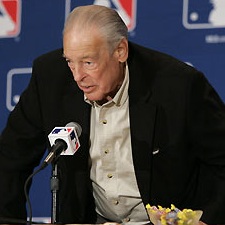 Bill Lajoie hasn’t been a general manager for 20 years after a seven-year term with the Tigers that ended following the 1990 season. He left that job voluntarily, and he has passed up subsequent offers to become a general manager again. In the meantime, he has worked for five other teams, currently the Pirates.
“I didn’t want to be the Detroit general manager,” Lajoie recalled, “but I did interview four other jobs and I was offered three of the jobs but I turned them down. So I obviously didn’t want to be a general manager. My wife had died the year before and my kids were in school. There was a lot of stress in that job.”
Lajoie said that two veteran general managers, Pat Gillick and Andy MacPhail, kept recommending him for general manager vacancies, and he asked them to cease and desist.
Lajoie said he was prepared to take the San Francisco job when Peter Magowan was in the process of becoming their principal owner before the 1993 season.
“I had my stuff ready to go,” he recalled, “and then Magowan told me three things I had to do. I told him you don’t have to pay me $400,000 to answer the phone.”
Lajoie, who is one of the most principled baseball men I have ever met, gave up his Detroit job because “I couldn’t get along with Jim Campbell anymore.”
John Fetzer, the Tigers’ owner and the man Commissioner Bud Selig calls his mentor, “took the job away from Campbell and gave it to me and made Campbell president.”
Lajoie is a senior advisor with the Pirates, who need all the help they can get. Before landing in Pittsburgh Lajoie worked for the Braves, the Brewers, the Red Sox and the Dodgers.
Roland Hemond was a general manager before some of today’s general managers were born. Eighty-one years old, Hemond was the White Sox general manager from 1970 through 1985. He was also the Orioles’ general manager from 1988 through 1995.
Both between G.M. tenures and since the second, he has held other front-office positions with other teams. He currently is special assistant to the president of the Diamondbacks.
“You understand that you had your day as G.M.,” Hemond said. “It’s time for others to do the job.”
Major League Baseball does not have many active 81-year-olds, but Hemond has stayed active because “I love the game, I enjoy every day, I love the challenge. Every day is a new adventure. Every day is exciting. That’s why I’m stuck doing it.”
Has he considered retirement? “Not really,” he said. “I can’t break the habit. I’m usually there by 8 and I’m there till the last out.”