Brad Ausmus has finally jumped off the catching carousel, Luke Carlin has never known anything but the carousel and Miguel Olivo took a spin on it this winter that would have left an ordinary man dizzy.
This is the life of a major league catcher, and Ausmus, Carlin, Olivo and all of the others are willing to live it because the catching carousel makes regular stops throughout the major leagues, and that’s where they want to be.
It used to be that if a pitcher was left-handed and breathing, he could always find a job. Now it seems that backup catchers are in demand, and they often move from team to team.
Nineteen catchers have changed teams this winter, and free-agent Bengie Molina will make it an even 20 when he signs with someone.
Ausmus won’t be signing with anyone, new or old, for the first time in two decades. He has decided, at the age of 41, to end his ride on the merry-go-round.
“It was time; it was time to be home more often,” said Ausmus, alluding to his wife, Liz, and their two daughters. “I could feel and see my skills eroding so I decided to walk away.”
Selected by the Yankees in the 48th round of the 1987 amateur draft, Ausmus was taken by Colorado in the 1992 expansion draft, then traded five times (twice each to Detroit and Houston) and was a free agent five times, signing with the Astros three times and the Dodgers twice.
Through all of those moves, he played for the Astros for eight successive seasons and 10 seasons in a 12-year stretch.
“I think he actually had long stints compared with others, his agent, Peter Mrowka, said.
Carlin, for example. A 30-year-old belated bloomer, Carlin in the past three seasons has played a total of 46 games for three major league teams – San Diego, Arizona and Cleveland.
That roster of employers doesn’t include Detroit, which drafted him in 2002, and Pittsburgh, which signed him as a free agent a year ago and traded him to the Indians in August. He played in six late-season games for the Indians, batting .357 (5 for 14).
Carlin is not on Cleveland’s 25-man roster or even its 40-man roster. But he didn’t have to move anywhere this winter. He is scheduled to be in spring training with the Indians under a minor league contract. Carlin, in fact, has had a restful winter compared with the veteran Olivo.
A 32-year-old veteran of eight major league seasons with six teams, Olivo has returned to one of those teams, Seattle, as a free agent. But look at how he got there.
The Rockies had a $2.5 million option in Olivo’s contract for 2011 and would have to pay him $500,000 if they didn’t exercise the option. They didn’t want to pay the buyout so they concocted this unusual solution.
On the day of the deadline by which the Rockies had to let Olivo know about the option, they traded him to Toronto. Within an hour and a half, the Blue Jays declined the option. That meant the Blue Jays owed Olivo the $500,000 buyout, and he had the right to file for free agency, which he did promptly.
Why did the Blue Jays make the trade and relieve the Rockies of the $500,000 obligation? Once they offered Olivo salary arbitration, which he declined, the Blue Jays qualified to receive a draft choice as compensation for losing Olivo. In other words, the Blue Jays decided the draft pick was worth $500,000 while the Rockies did not value it that highly.
What was unusual about the trade was that players about to file for free agency are rarely traded. Olivo was able to be traded because of the delay in the option deadline.
Five weeks after the trade and Olivo’s filing, he agreed to a two-year contract with Seattle for $7 million
Olivo has been one of the best defensive catchers in the majors. In 2010 he threw out 33 runners, second in the National League in both the number of baserunners caught and percentage (42.3).
He was also second in the American League in caught-stealing percentage in 2008 with the Royals, nailing 42.4 percent of would-be basestealers.
 However, the new catching resident who will be most closely watched is Russell Martin, who signed a one-year contract with the Yankees for a $4 million salary plus a possible $1,375,000 in bonuses based on the number of games caught (maximum 120 for all bonuses).
Martin, a National League all-star in 2007 and ‘08, played his first five seasons with the Dodgers and wanted to continue playing for them, but they couldn’t reach agreement on a contract and the Dodgers didn’t tender him a contract, making him a free agent.
It just so happened that the Yankees were in the market for a starting catcher because they had decided that Jorge Posada was past the point of being an everyday catcher and had designated him to be their designated hitter most of the time. Of all of the catchers available, Martin seemed to be the best despite his underachieving performances the past two seasons.
“He wasn’t in our plans going into this, but when he became available we focused on him” Brian Cashman, the Yankees’ general manager, said. “He’s in the top six of everyday catchers.”
Martin fractured a hip last August, but the Yankees aren’t concerned. Cashman said the injury wasn’t similar to what forced Alex Rodriguez to have hip surgery in 2009.
“The hip checked out,” Cashman said. “It’s completely different from what Rodriguez had. Martin had a fractured hip socket and the fracture healed. It was like an N.F.L. injury. There’s no damage around it.”
When Martin was rehabilitating his hip, he suffered a knee injury, but Cashman said the knee “isn’t an issue.”
If nothing else, Martin will serve as a bridge to the Yankees’ coming catchers.
“I’d say we have the deepest catching in the industry,” Cashman said.
Jesus Montero, 21; Austin Romine, 22, and Gary Sanchez, 18, are all among the Yankees’ top prospects, with Montero expected to become the team’s catcher next year.
Francisco Cervelli split the team’s catching with Posada last season, but he also tied for the most errors (13) by a catcher in the league.
“We let Molina go because Cervelli emerged,” Cashman said, referring to Jose Molina, the Yankees’ backup catcher for two and a half years.
This winter the Yankees signed another catching Molina, Gustavo, to a minor league contract, but he is not one of the trio of catching Molina brothers. He is, on the other hand, a carousel regular, having served with the White Sox, the Orioles, the Mets and the Red Sox, playing in a total of 23 games over three seasons.
“There are a whole bunch of reasons,” Cashman said, discussing the frequent rotation of catchers. “The catching position is very thin in the industry.”
Of the catchers who have moved this winter, Henry Blanco has worn the most uniforms: Dodgers, Rockies, Brewers, Braves, Twins, Cubs, Padres, Mets. Now the Diamondbacks are in his immediate future.
Yorvit Torrealba has moved from the Padres to the Rangers after having also played for the Giants, the Mariners and the Rockies. Kevin Cash is in Texas following sojourns in Toronto, Tampa Bay, Boston, New York (the Bronx), Houston and Boston again.
Among other catchers who will play for new teams this year are Victor Martinez, who has moved from Boston to Detroit, and John Buck, who has switched from Toronto to Florida.
Among catchers staying put is Jason Varitek, 38, who will play season No. 15 with the Red Sox, the only team he has played for.
Rod Barajas has resigned with the Dodgers, with whom he finished last season after having played for the Diamondbacks, the Rangers, the Phillies, the Blue Jays and the Mets.
Then there is 33-year-old Paul Phillips, who will be out to extend his streak with a new team, the Indians. Playing for the Royals, the White Sox and the Rockies, Phillips has played in the majors each of the past seven seasons, catching in a total of 73 games.
YOUNG THE UNSELFISH
When some players sign multi-year contracts, their agents negotiate no-trade provisions. The purpose of such provisions is to ensure that a player will stay where he wants to be or he will extract extra money from the team to get his approval to be traded.
Michael Young has a no-trade clause in his $80 million contract with Texas, but he should have a provision covering position switches. What Young has done for the Rangers makes him unique in major league baseball.
 For the third time in seven years, Young has agreed to a position switch.
Before the 2004 season, when the Rangers acquired second baseman Alfonso Soriano for Alex Rodriguez, Young agreed to move from second base to shortstop.
Before the 2009 season, when shortstop Elvis Andrus was major-league ready, Young moved to third base.
Now, with the Rangers’ $96 million signing of third baseman Adrian Beltre, Young has agreed to become the team’s designated hitter. Manager Ron Washington has said that he will also use Young at all four infield positions when he wants to give his starting infielders half a day off at d.h.
No other player has willingly made the sacrifices Young has made in his 10-year Texas career. No player with Young’s playing credentials has made such moves.
A six-time All-Star and a six-time .300 hitter, Young earns $16 million a year, which certainly makes for a nice paycheck. But he deserves a bonus for his unselfish approach to the team concept. You’d have to look long and hard to find an equivalent situation.
WAR REVISITED
Last week I raised a question about selections for the Hall of Fame and post-season awards. With the proliferation of statistics, such as wins above replacement (WAR), was it time to pick award winners and Hall of Famers with these statistics and tell baseball writers their votes are no longer needed?
I posed the question in an e-mail to Sean Forman, creator of Baseball-Reference.com, where many of the statistics appear. He was away from his office and wasn’t able to respond in time for the column, but he has since replied.
“I would not expect nor want awards to be given on the basis of a single statistical number,” Forman wrote. “In my pieces for the (New York) Times, I present the sabermetric cases for players and attempt to educate the reader as to what the most advanced measurements tell us about a player’s real impact on wins and losses.
“Presumably every voter is attempting to make the same call themselves, but just using their own predispositions to make those judgments.
“I’ve never argued for automated selection of players, but rather presented to the reader, ‘here are what the most advanced numbers say about the player’s value.’ And in the case of the HOF I also tried to put those numbers in the context of the previously inducted.”
In the e-mail I recalled that baseball writers were criticized for naming Justin Morneau the American League most valuable player in 2006. Forman replied:
“Regarding 2006, I would have voted for Mauer (even though Sizemore had a higher WAR). The BBWAA has done (IMO) a horrible job of valuing the relative offensive contributions along the defensive spectrum (DH,1B,LF,RF,3B,CF,2B,SS,C). If a middle infielder or catcher hits even in the same ballpark as a 1Bman the middle infielder is much more valuable to his team. They also do a very poor job of valuing players who do a little bit of everything well (Raines/Walker/Edmonds vs. Gwynn). And don’t get me started on RBI.”
I thank Sean for offering his views, but I don’t agree that writers do a poor job. Some writers have begun buying into the statistical evaluation – I see it as going over to the dark side. I think the results of the voting for the Cy Young award the last two years demonstrate that change.
But writers who vote for most valuable player can have their own definitions of value. They don’t have to be statistically based. Sure, statistics of some sort figure in a voter’s thinking, but he might have other criteria as well, some intangible.
But that approach violates the statistical credo, and any writer who is guilty of that crime incurs the wrath of the metric men. But writers who use their own judgment, whatever their criteria, continue to have our support. And Justin Morneau can keep his m.v.p. award.
PIAZZA FANS ON PATROL
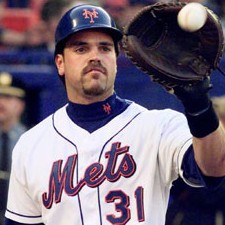 The Piazza patrol must have an early warning system. When his name appears in this column, the patrol responds vehemently. How dare I suggest that their hero, Mike Piazza, used steroids. Isn’t this America, they ask. Isn’t Piazza innocent until he is proved guilty? When did he ever fail a drug test?
A few sample responses:
“Won’t you hurry up and die old man?” Tom Lucas wrote.
“If any players used steroids before the ban…who cares?” Bruce Picton asked.
The only active player believed to have been playing before steroids were banned in 1990 was Jamie Moyer, who has never been suspected of using steroids.
“You, like many other sportwriters are complete hypocrites,” Patrick McKenney wrote. “You played down andro when McGwire was caught using it. Yet you are crucifying everyone who was big and hit home runs.”
When Mark McGwire used androstenedione, it was legal.
“Have you talked to a Doctor about the acne issue with Piazza? I can tell you that I get patients all of the time with this. It’s totally normal,” wrote Scott Michael Gibbs.
I didn’t mention Piazza’s back acne in the recent column, but the Piazza patrol has good memories because I did mention it in an earlier column. What Gibbs and others ignore is that others who had back acne didn’t have it disappear when baseball began testing for steroids, as Piazza did.
The Piazza patrol should also know that in a book titled “The Rocket That Fell to Earth,” the author, Jeff Pearlman, quoted a former player, Reggie Jefferson, as saying, “He’s a guy who did it, and everybody knows it. It’s amazing how all these names, like Roger Clemens, are brought up, yet Mike Piazza goes untouched.”
Once before when I received a raft of e-mail about a Piazza column, a reader who called himself a roommate and baseball teammate of Piazza at the University of Miami wrote that Piazza was “a hard worker and a great hitter with tremendous power.”
Miami baseball records show that Piazza played only one season and had 1 hit in 9 at-bats, not much evidence of “a hard worker and a great hitter with tremendous power.”
I eagerly await the book that Piazza is writing (with an $800,000 advance) and hope he addresses the steroids issue. In an e-mail, Lonnie Wheeler, who is writing the book with Piazza, said he didn’t know the publication date for the book.
Replying to my question about whether Piazza would address the steroids issue, Wheeler wrote, “I think your question about the steroids issue is a fair one, but Mike, the agent and the editor all feel that we should not be discussing content at this point.”