They will most likely live in baseball history as memorably as Athos, Porthos and Aramis in literature and Larry, Curly and Moe in television: CC, A.J. and Tex.
The Yankees signed the free agents CC Sabathia, A.J. Burnett and Mark Teixeira in the space of less than three weeks last winter, and now, 10 months later, they are World Series champions.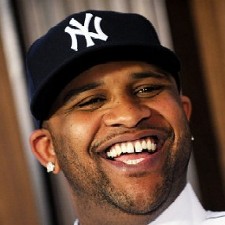
Other free agents signed long-term contracts with the Yankees, but Mike Mussina, Jason Giambi and Carl Pavano don’t have World Series rings and Hideki Matsui and Alex Rodriguez didn’t win World Series rings until Sabathia, Burnett and Teixeira joined them.
The three players cost the Yankees $423.5 million, an unprecedented amount for a trio of free agents signing with the same team at the same time, and their 2009 salaries ($52,410,714) inflated the Yankees’ season-ending payroll to a record $220 million, according to figures distributed to all clubs by the commissioner’s office.
Money, however, has never been a deterrent for the Yankees. Believe it or not, they would prefer spending less than they do, but they will freely spend to achieve their goal, which is getting to and winning the World Series. Other teams dream of that goal and dream of having the money to spend to get there, but only the Yankees can and will do it.
Asked if they had concern about the cost of signing the three free agents, a senior Yankees’ official said, “There’s always concern – it was over $400 million – but we just knew these three players would be good. Good enough to win the World Series in their first year? No.
“But every scout in baseball said Teixeira is a complete player; he’s Derek Jeter. Everyone said CC was great on the mound and in the clubhouse. The knock on A.J. was he can’t stay healthy. But we talked to people who said he was different. Roy Halladay had become a mentor to him in Toronto and he changed.”
Pitching was the team’s top priority. Mike Mussina was retiring, and Andy Pettitte hadn’t decided his future. The Yankees had not made the playoffs in 2008 and knew they had to shore up their pitching if they were to get there in the first year at their new $1.5 billion stadium.
In the previous winter the Yankees eschewed the chance to trade for Johan Santana. They were criticized, by me among many others, for not making the trade that was available to them. When the Yankees failed to reach the post-season, the criticism was rekindled. Santana, the critics said, would have been enough to put the Yankees into October baseball.
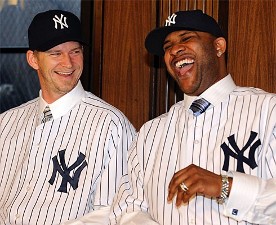 Brian Cashman, the Yankees’ general manager, took the criticism stoically. He knew why he didn’t trade for Santana, but he kept his plan to himself. He knew that Sabathia could be a free agent after the 2008 season, and his acquisition would cost the Yankees only money and not a collection of young prospects.
Cashman was patient, and when the time came to pursue Sabathia, he did it aggressively and confidently. He ignored the popular talk about Sabathia’s desires – that he didn’t want to play in New York but wanted to play in California.
Meanwhile, Cashman juggled his other quest with his other hand. Seeking a second new starter because he wasn’t sure about Pettitte, he targeted Burnett and Derek Lowe. An organizational discussion ensued, and the Yankees settled on Burnett, who was three and a half years younger than Lowe and was a strikeout pitcher, whom the Yankees could use to counter their questionable infield defense.
Burnett made it clear to the Yankees that if the money was right, he would sign with them. The Braves were also pursuing Burnett and were prepared to give him a hefty four-year contract for $16.5 million a year. But they balked at a fifth year, which the Yankees agreed to for the same annual average.
The Braves then signed Lowe to a four-year, $60 million contract. Burnett agreed to the Yankees’ offer the same day, Dec. 18, as Sabathia accepted a $23 million-a-year deal.
Teixeira joined the Yankees almost by default. They had obtained Nick Swisher from the Chicago White Sox in November, intending to use him as their first baseman, but Teixeira became available when the Boston Red Sox unexpectedly dropped out of the bidding at about $170 million.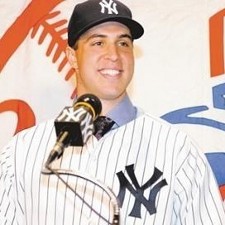
Cashman had met Teixeira in Washington, D.C., and liked him, but the first baseman’s agent, Scott Boras, was seeking a contract in the area of $200 million, and the Yankees balked at that price. The Angels and the Red Sox were negotiating with Boras, but first one and then the other withdrew from the talks.
Before the Red Sox bowed out, Boras hinted to the Yankees that he was going to sign with the Red Sox. Teixeira, however, as it turned out, didn’t want to play in Boston and his wife didn’t want to live there. Teixeira, on the other hand, did want to play in New York and instructed the agent to make a deal.
The Yankees offered $180 million, and Teixeira accepted on Jan. 6.
Cashman was not finished. Pettitte was still out there, and the Yankees were waiting for his response to a $5.5 million offer for one year. He accepted it on Jan. 26, and the Yankees had the three pitchers who would start all of their post-season games.
ONE-SIDED SALARIES
 The combined 2009 salaries of Mark Teixeira, A. J. Burnett and CC Sabathia ($52,410,714) exceed the entire season-ending payrolls of three teams – Florida, San Diego and Pittsburgh. Add the salaries of Alex Rodriguez and Derek Jeter, and the total of $107,010,714 surpasses the entire season-ending payrolls of 21 of 29 teams.
When Andy Pettitte signed with the Yankees last winter, he took a huge pay cut from $16 million to $5.5 million. However, he recouped some of the lost salary in bonuses. He earned a total of $5 million in bonuses based on innings pitched ($3 million) and time spent on the roster ($2 million).
THE FINAL TALLY
End-of-season payroll figures compiled by the commissioner’s office show, as expected, that the team with by far the biggest payroll won the World Series. However, they also show that three of the five highest-paid teams – the Mets, the Cubs and the Tigers – did not play in the post-season.
In place of those three losing teams were the No. 12 Cardinals, No. 16 Rockies and No. 23 Twins. The Twins were less than $2 million from being No. 26. These are the payroll figures for all 30 teams: 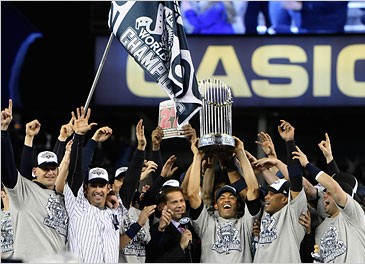
| Yankees | $220,142,951 |
| Mets | 141,905,336 |
| Cubs | 141,427,914 |
| Red Sox | 140,406,585 |
| Tigers | 139,204,408 |
| Phillies | 138,061,499 |
| Dodgers | 131,529,538 |
| Angels | 121,672,524 |
| Astros | 108,034,086 |
| White Sox | 105,262,384 |
| Mariners | 102,146,293 |
| Cardinals | 101,803,475 |
| Braves | 99,904,880 |
| Giants | 95,202,185 |
| Brewers | 89,821,980 |
| Rockies | 84,400,797 |
| Blue Jays | 84,080,513 |
| Royals | 81,740,669 |
| Orioles | 79,066,130 |
| Rangers | 77,208,810 |
| Indians | 77,045,438 |
| Diamondbacks | 73,794,352 |
| Twins | 72,843,407 |
| Reds | 72,693,206 |
| Rays | 71,115,532 |
| Nationals | 69,196,137 |
| Athletics | 61,688,124 |
| Pirates | 47,991,132 |
| Padres | 43,160,258 |
| Marlins | 37,432,482 |