New York Yankees fans, if not the Yankees themselves, became instantly distraught recently when Mariano Rivera, the team’s legendary closer, suffered a season-ending knee injury. Their sickened feeling grew even more anguished a few days later when his designated replacement, David Robertson, squandered a 1-0 lead over Tampa Bay and lost the game.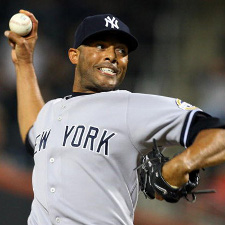
Obviously in 15 years as the Yankees’ unparalleled closer, Rivera spoiled the team and its fans. He was especially revered for his post-season work, which was significantly responsible for the Yankees’ World Series triumphs.
Without him, of course, the Yankees’ chances of reaching this year’s World Series are reduced. But does all have to be lost? Rivera might be irreplaceable, but why can’t he be replaced?
For guidance or inspiration, the Yankees might want to look to the Tampa Bay Rays. They might as well, considering that they have been looking up at the Rays virtually the entire first five weeks of the season.
The Rays have been in the playoffs three of the past four years, and in each of those seasons they used a different closer. This year they planned to let Kyle Farnsworth repeat his 2011 role, but the incumbent closer developed a strained elbow and began the season on the disabled list, where he remains.
What to do?
“When we knew Farnsworth was down, it was a matter of evaluating the people who had been in that role before,” said Gerry Hunsicker, senior vice president of baseball operations, then speaking of manager Joe Maddon added, “As Joe usually does, he goes night to night. (Fernando) Rodney had a power arm and experience at closing so he was going to get the ball at least occasionally. Then he just went with the hot hand.”
Rodney’s right hand was hot from the start of the season. In the Rays’ season-opening series against the Yankees, Rodney was the winning pitcher with one inning of hitless relief in the first game, then earned saves in the next two games by securing the final out in each game.
The 35-year-old right-hander entered that series with 96 saves in 133 save opportunities during his nine-year major league career. In the minor leagues, he started 10 games each in his second and third years and only one other game since. He has made no major league starts.
“Most of the time,” Hunsicker said, “unlike starters, closers usually come out of being developed; they are not developed by design.”
Rodney, he added, “is the classic example of guys we try to find every year, guys that everybody gives up on. But they are looking for jobs and come to our team for an opportunity. Rodney was on a successful team in Detroit and pitched meaningful innings.”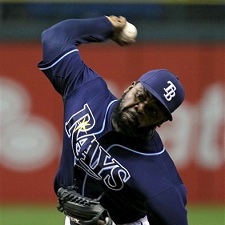
Rodney also came at the right price – $2 million for one guaranteed year and an option for a second year. That amount is more than a third less than the major league average salary.
All Rodney has done for that paltry salary is save nine games in nine chances, win two games in relief and compile a 0.57 earned run average.
Rodney has reminded Hunsicker of Rafael Soriano, whom the Rays acquired from Atlanta before the 2010 season.
“Soriano was in the same situation as Rodney,” Hunsicker said. “He was going to set up for us but got a chance to close and he did a good job.”
Soriano became the Rays’ closer when J.P. Howell, who finished the 2009 season as the closer, suffered a shoulder injury, subsequently had surgery and was out for the season. Soriano filled in more than capably, gaining a league-leadings 45 saves in 48 chances.
It was the most propitious development of Soriano’s nine-year career. A free agent after that season, Soriano signed a three-year contract with the Yankees for $35 million – not to be their closer because Rivera had that job, but the Yankees signed him anticipating Rivera’s eventual retirement.
Meanwhile, he would be the closer in waiting. The Yankees, however, soon discovered that they had a far cheaper closer in waiting. Robertson has a $1.6 million salary this season, and the Yankees have him for two years after this before he can become a free agent.
While on the subject of closers, I asked Hunsicker about the off-season movement in the closing business
“It’s almost a revolving door unless you’re talking about the elite guys like Rivera,” Hunsicker said. “We know probably every year we’re going to have to rebuild our bullpen. Rodney has the physical ability to close. Certain things prevented him from holding that job in the past. A lot of people didn’t have confidence to put him in that role. We decided to roll the dice.”
Each time Rodney has been on the mound for the Rays, he has rolled a seven.
CLOSERS COME AND GO…AND COME AND GO
The revolving door that Hunsicker mentioned was worn out from overuse this past off-season. In fact, the general managers who were operating it found extra need for it as a result on injuries.
The Red Sox, for example, had to replace Jonathan Papelbon, who defected to Philadelphia. They obtained Andrew Bailey from Oakland, only to have him disappear indefinitely following thumb surgery. Suddenly, they were back in the hunt for a closer.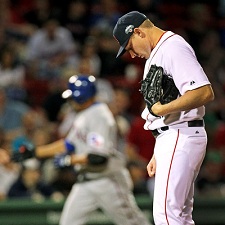
This time they stayed in-house, giving the job to Mark Melancon, whom they acquired from Houston two weeks before they got Bailey. But in his first four games, Melancon was the losing pitcher in two, squandered a save and had a 49.50 earned run average. How does a pitcher get a 49.50 e.r.a.? Easily – by allowing 11 earned runs in 2 innings.
Since his demotion last month, Melancon has allowed no runs of any kind in 10 games and 10 innings for Pawtucket. Still shell-shocked perhaps, the Red Sox have opted to let him stay at Pawtucket.
Closer No. 3 anybody? Yes, he is Alfredo Aceves, whose career saves counted two for the Red Sox last season and one each the previous two seasons with the Yankees. In his current role, he has six saves in eight chances and a 6.59 e.r.a. That’s better than 49.50.
The Red Sox, Rays and Yankees have not been the only teams to lose their closers to injuries. Joining Bailey, Farnsworth and Rivera on the list – the disabled list – are Brian Wilson of San Francisco, Drew Storen of Washington, Huston Street of San Diego, Ryan Madson of Cincinnati, Joakim Soria of Kansas City and Sergio Santos of Toronto.
Bailey, Street, Madson and Santos were added to their teams to be their closers. Some closers with new teams have actually survived spring training and the early weeks of the season. They are Joe Nathan of the Rangers, Hector Santiago of the White Sox, Papelbon of the Phillies and Frank Francisco of the Mets.
Some of the teams with injured closers have found suitable replacements at no great cost financially.
Jonathan Broxton, formerly the Dodgers’ closer, has filled in well in Kansas City (1.54, 7 for 8). In Washington, Henry Rodriguez has a 2.45 e.r.a. and 8 saves in 10 chances. Santiago Casilla, who filled in when Wilson was hurt last September, is reprising that role this season. He has a 1.38 e.r.a. and 7 saves in 8 chances.
The suddenly flush Marlins added Heath Bell for three years and $27 million, and he has survived physically. Artistically is another matter. He has converted only 3 of 7 save opportunities, he has a 9.28 e.r.a., he has lost three games and he has temporarily lost his job.
Meanwhile, in San Diego, before Street, Bell’s replacement, went on the disabled list, he had converted all 4 of his save opportunities, and had a 0.93 e.r.a.
Ozzie Guillen, the Marlins’ manager, decided to give Bell some time off from closing to get his head and his arm straight. He said Bell’s closing role will be filled by Steve Cishek, a 25-year-old right-hander, who has a 4-0 record and a 1.17 e.r.a. but no save opportunities. Last season, however, he had three chances and emerged from all three with saves.
Three other closers have temporarily lost their jobs – Javy Guerra of the Dodgers with a 5.14 e.r.a. and 8 saves in 11 chances (replaced by Kenley Jansen), Carlos Marmol of the Cubs with a 6.35 e.r.a. and 2 saves in 4 chances (by Rafael Dolis) and Jordan Walden of the Angels, who has a 4.50 e.r.a. and 1 save in 2 chances (by Scott Downs).
Finally, there is the Toronto Blue Jays unenviable experience. During the winter the Blue Jays traded with the White Sox for Santos to be their closer and signed free-agent Francisco Cordero, who had been the Reds’ closer, to serve as Santos’ setup man.
Santos got hurt two weeks into the season, and Cordero assumed the closing role but was ineffective.
Casey Janssen then drew the short straw and became closer No. 3. He was successful in two of his first three save chances.
HOW TO SPELL NUNEZ: OVIEDO
Juan Carlos Oviedo has lost his job, 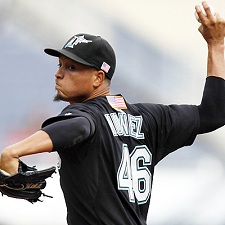 maybe his career. He earned 92 saves for the Marlins the past three years, but you wouldn’t know it from looking at statistics from those seasons. You would have to look under the name Leo Nunez.
That was the name the reliever played under, but late last year major league officials discovered that Nunez really was Oviedo (pronounced oh-vee-AY-doh).
The Marlins list the Dominican native under that new name in their 2012 media guide. They also list a different birth date. Nunez, last year’s guide says, was born Aug. 14, 1983. This year’s guide says Oviedo was born March 15, 1982. That’s only a difference of 17 months.
Oviedo is now on the restricted list, meaning he can’t play. He was placed on the list last September but four months later signed a one-year $6 million contract with the Marlins for this season.
The way I see Oviedo’s plight he has a new argument to appeal his residence on the restricted list. Developments close to home have given Oviedo/Nunez the argument:
Why can’t he change his name if his team has changed its name?
UNLIKE LIGHTNING, HARDY HOMERS STRIKE TWICE
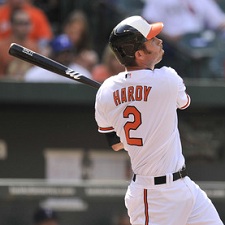 Location, location, location.
That’s a well known slogan about real estate, but now it pertains to J.J. Hardy as well.
The Baltimore shortstop had to be in the right location to achieve what he has done twice in his baseball career.
On Sept. 9, 2007, Hardy batted second in the Milwaukee Brewers’ lineup. In that hitting slot, Hardy cracked a home run that was the second of three consecutive home runs with which the Brewers began what would become a10-5 victory over Cincinnati.
Last Thursday Hardy, having been traded twice, from Milwaukee to Minnesota and Minnesota to Baltimore, batted second in the Orioles’ lineup. As he did in 2007 with the Brewers, Hardy hit what would be the second of three successive home runs at the start of Baltimore’s first inning.
That long-ball trick has been executed only four times in major league history. The Milwaukee episode was the third and most recent time it has been done in the National League. The Baltimore barrage was the first time it had been done in the American League.
BRYCE BRACES FOR ATTACKS
Bryce Harper’s introduction to Major League Baseball has, shall we say, onot been low-key. Within days, Harper was hit in the back with a pitched ball and in the face with a swung bat. In the first instance, Cole Hamels of the Phillies said he hit Harper deliberately. In the second, Harper hit himself.
A bad day at the plate frustrated the 19-year-old Washington Nationals outfielder, and he swung his bat against the dugout wall. Dugout walls, though, don’t like being hit in anger and sent the bat flying back at Harper. It struck him in the face and caused a gash that required 10 stitches to close.
The first thought in many peoples’ minds was probably Harper needs to grow up. He might be a major leaguer, they would say, but he is immature.
That might be true, but players older and more mature than Harper have committed similarly stupid acts. Players have broken their hands punching the dugout wall, as if the wall ever did anything to them.
Water coolers and light bulbs in the runway leading to the clubhouse are frequent targets of frustrated players’ wrath. The toilet just off the dugout is popular, too. These incidents occur often enough that home teams sometimes bill the visiting team for damages.
Probably the most recent example of a dumb player trick was the cut hand suffered by the Knicks’ Amar’e Stoudemire when he angrily punched the glass enclosure of a fire extinguisher after an N.B.A. playoff game.
Stoudemire is 29 years old and has played major league basketball for nine years. Harper is 19 and has played major league baseball for two weeks.
Obviously, he did a really dumb thing and could have suffered a far more serious injury. But he’ll learn; he already has. Dugout walls fight back.
But what about Cole Hamels? Has he learned anything? Yes. Don’t broadcast the fact that he threw at a hitter deliberately.
As long as everyone just thinks a pitcher threw at a batter, the pitcher is not likely to be fined. But say you did it, and you’re inviting disciplinary action.
What I question is why Hamels threw at Harper at all. Was he offended by Harper’s demeanor, his youth, his elevation to the major leagues so quickly? Whatever Hamels’ reason, there was no excuse for what he did.
The problem is the pitcher feels empowered because he’s holding a baseball in his hand. Anytime a player has gone after another player with a bat, the bat wielder is scorned. A pitcher, though, can throw a ball at a batter’s head, and it’s part of the game.
I don’t have a problem with pitchers knocking batters down or driving them off the plate. Nor with a baserunner sliding hard into a base and the fielder playing it. But any pitcher who deliberately hits a batter should spend the rest of the game groveling in the batter’s box dirt when he bats.
What if it’s the American League where pitchers don’t bat? Pick out the other team’s best player or players and let them play in the dirt. They’ll deliver the message to the offending pitcher soon enough.