The 23rd grand slam of Alex Rodriguez’s career quickly gained a lot of attention early this week because it tied Lou Gehrig’s career major league record. It caught my attention for the same reason but with a twist.
Tying a significant record held by a great player is noteworthy, but it also is controversial and raises the primary question of the time in which we live:
Should we give Rodriguez the credit a record holder would deserve if he were free of the taint of performance-enhancing substances?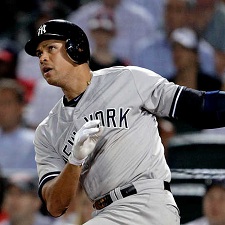
Yes, Rodriguez’s grand slam in Atlanta was clean, as far as we know, as were probably most of the other 22 grand slams he has hit. But the three grand slams he hit when he played for Texas presumably were linked to steroids.
Whether or not he was actively using steroids when he hit those three grand slams, Rodriguez has acknowledged using them during that three-year period. There are skeptics who suspect he used them during a more extended period.
For purposes of this column, though, the extent of his use doesn’t matter. What matters is that he used, admitting it three years ago, when faced with reports of a positive test in 2003. His active pursuit of some of the best known hitting records puts the problem in perspective.
How should Rodriguez and others of the steroids squad be viewed as they rise in the ranks of the great hitters?
“It’s a very good question,” said Fay Vincent, the former commissioner, who is among the most moral men baseball has known.
“You can’t ignore the record; it takes skill,” he added, speaking of A-Rod’s feat. “But nobody can compare his achievement to Gehrig’s without acknowledging his use of steroids. We can’t measure the taint produced by substance use, but it’s a substantial taint.”
Vincent was not suggesting that steroids enhance performance. “It’s never been tested,” he said, recalling a conversation he had with Dr. Frank Jobe, the legendary Los Angeles Dodgers’ orthopedic surgeon.
Even before steroids were outlawed, Vincent said Jobe told him, it would be improper to conduct a study of the effects of steroids on baseball players because no one knew if their use could be detrimental to players’ health and two groups of players would be required, one the test group, the other the control group.
To Vincent, though, it’s not how much better steroids might make a player but how much cheating undermines a player’s character.
In judging players for election to the Hall of Fame, Vincent said he would never support players who tested positive for performance enhancing substances or even players who were strongly suspected of steroids use.
“I wouldn’t vote for anyone who cheated,” Vincent said. “I wouldn’t have voted for Gaylord Perry; he cheated. What are you going to say? He cheated a little?”
Vincent agreed with the results of the voting in recent years in which the Baseball Writers Association did not elect Mark McGwire and Rafael Palmeiro. Palmeiro tested positive, and McGwire admitted his use of banned substances several years after refusing to answer questions about substance abuse from a Congressional subcommittee.
He waits with interest to see what the writers do with Barry Bonds and Roger Clemens, neither of whom ever tested positive for substance abuse but both of whom have been tried in Federal court on steroids-related perjury charges.
Then there’s Mike Piazza, who will appear on the Hall of Fame ballot for the first time later this year, joining Bonds, Clemens and Sammy Sosa as controversial candidates.
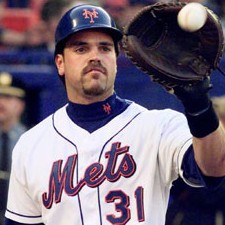 “There’s a real problem,” Vincent said of Piazza. “What do we do with him? He’s the big problem. He might be a really serious problem. What if he is elected to the Hall of Fame and then it’s discovered that he used steroids?”
Piazza never tested positive for steroids use, and that has been his defense against charges that he used steroids. But within baseball he has long been a steroids suspect. All of his teammates and anyone else in his teams’ clubhouses saw his acne-covered back, a tell-tale sign of steroids, until baseball began testing for steroids, and then the acne magically disappeared.
When I have written in the past couple of years that Piazza was a steroids suspect, especially when I have mentioned the acne, his legion of fans have been outraged.
One reader said he was a teammate of Piazza on the University of Miami baseball team and that he was such a good, strong hitter that he didn’t need to use steroids. After checking Miami statistics, I figured the reader must have had Piazza confused with another teammate. In his sole season at Miami, Piazza was 1-for-9.
More incriminating is a comment from a former major league teammate that appears in a book titled “The Rocket That Fell to Earth.” The author, Jeff Pearlman, quotes a former player, Reggie Jefferson, as saying, “He’s a guy sho did it, and everybody knows it. It’s amazing how all these names, like Roger Clemens, are brought up, yet Mike Piazza goes untouched.”
For nearly three years, Piazza has been said to be writing a book about his career. It appears to be taking him longer than Tolstoy needed to write “War and Peace.”
Aides to the Simon and Schuster editor handling the book, Bob Bender, and the agent who put the project together, David Black, said they would find out the status of the book and let me know, but neither called with information. Another publishing source said he believed the book would be published next year.
“It’s taking a long time,” I remarked to Vincent.
“You can imagine why,” he responded.
If the timetable calls for publication next year, Piazza and Simon and Schuster would both get their cake and eat it, too.
The Hall of Fame election results would be known, which means Piazza could be elected, and then the book could come out with Piazza’s admission that he used steroids during much of his career, thus justifying his $800,000 advance.
Piazza would be in the Hall of Fame with the writers having no recourse to unelect him. Just as he did in his playing career, Piazza would have fooled the voters and the fans. This time, though, he would have a major publishing house as his co-conspirator.