As the baseball commissioner basks in the glow and glory of the third consecutive negotiation of a labor contract without a work stoppage, let’s remember that Bud Selig, first as a club owner, then as commissioner, played an integral role in most of the eight work stoppages that preceded this prolonged period of peace.
Before he became commissioner, Selig, as owner of the Milwaukee Brewers, was chairman of the Player Relations Committee, which set and directed the owners’ labor policy and strategy. The policy was generally misguided and the strategy almost always flawed.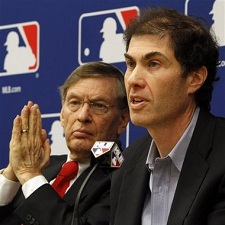
But Selig’s worst mistake in judgment of labor matters came just before he became the acting commissioner and just afterward. As owner of the Brewers and chairman of the P.R.C., Selig was determined to get a payroll cap, and if the owners could whittle the union down to the size they preferred in the process, all the better.
But Selig and his chief cohort, Jerry Reinsdorf of the Chicago White Sox, had a problem. His name was Fay Vincent, and he was the commissioner, As commissioner, he was moving in the direction of improving relations with the players.
Some owners didn’t like Vincent’s approach, One owner, Douglas Danforth of Pittsburgh, objected to Vincent’s practice of being on the field before World Series games and talking to players. “You shouldn’t be talking to players,” Vincent said Danforth told him. “That’s not your job.”
Given Vincent’s view on relations with the players, the war-bent owners knew he would interfere with their planned attack on the union. A group of owners set out to oust Vincent from the commissioner’s chair.
Another owner called them the Great Lakes Gang because the primary members were owners whose teams resided or they lived in cities abutting the Great Lakes: Selig, Reinsdorf, Stanton Cook of the Chicago Cubs and Bill Bartholomay, the Atlanta Braves’ chairman, who lived in Chicago.
They succeeded in ousting Vincent, and the anti-union plan had clear sailing with Selig in the commissioner’s chair. Negotiating hard for their covered payroll cap, they provoked the players to strike. When the players walked out Aug. 12, 1994, the owners reacted with figurative high fives joyfully delirious that unlike other times, they had stuck together and forced the players out.
This was the regime of Bud Selig, the man who at a news conference announcing the new agreement Tuesday said, “Nobody back in the ’70s, the ’80s, and the early ’90s would ever believe that we’d have 21 years of labor peace. It’s really remarkable. Clearly it’s the longest period of labor peace that this sport has ever had.”
One reason for labor peace is that Selig and his fellow owners woke up to reality and realized they weren’t going to get their payroll cap, but even more important they looked at the bottom line and saw that once they recovered from the disastrous strike they provoked they were realizing record revenue. Suddenly there was enough money for everybody.
In fact, there was so much money the wealthy clubs found they could afford to share some of their money with their poorer relations. The revenue-sharing system has worked so well no one made any noise about it in these negotiations. There is little change in the percentage of revenue to be shared.
According to the joint news release, “Net transfer amounts will continue to grow with revenue and changes in disparity.”
The new agreement includes changes but nothing to approach the players’ acceptance of blood testing for human growth hormone, a step the union had vehemently opposed. It was such a stunning development that Marvin Miller, the union’s first leader, reacted with surprise when I told him about it last Saturday.
“Oh boy,” he exclaimed. “What did they get for it?” And he added, “It’s an unproven test. We don’t know the basis for this. I haven’t heard any rationale for this and there is no rationale for it.”
On Tuesday Michael Weiner, the current union chief, explained the rationale.
“The players felt it important to be in front of this subject,” he said, making it clear that this was what the players wanted. “We discussed it with the members starting in spring training, getting to the bottom of HGH testing. We continued to explore various aspects of the testing.”
The union had balked at HGH testing because the testing hadn’t been proved to be trustworthy. The National Football League and its players agreed earlier this year to HGH testing, but the program hasn’t begun because they haven’t agreed on methodology.
The baseball players haven’t agreed to complete testing. They will be blood tested for HGH during each spring training, beginning next year, and they will be subject to testing for reasonable cause “at all times during the year.”
Starting with the 2012-2013 off-season, players will be subject to random, unannounced testing. The two sides also agreed on a process for a joint study of the possibility of expanding the program to in-season tests
Positive tests will automatically be challenged on an expedited basis, and the players and the union will have the right to challenge the science behind the testing.
“We didn’t agree to in-season testing now,” Weiner said. “We have to be satisfied that the testing is legitimate. The players balanced all the factors and decided this is the place to be. We’ll continue to explore it.”
The players, he explained, had one specific concern about in-season testing. “Playing every day,” Weiner said, “you have to think about the quantity of blood needed and how players will react.”
As for Miller’s question about what the players got in return for agreeing to HGH blood testing – much of labor negotiations is about tradeoffs and compromises – Weiner said the union achieved two goals they had sought for years:
Most of the compensation for lost free agents has been eliminated, and more players with two to three years of major league service will be eligible for salary arbitration.
In 1985 the players made a major concession to the owners, agreeing to a change in eligibility from two years to three years. In response to an outcry from young players, in 1990 the union negotiated an agreement that 17 percent of the players with the most service between two and three years of service would be eligible.
The Super Twos, as they came to be known, will now be 22 percent of the 2-to-3-year group. That should convert to about six or seven additional players, Weiner estimated.
In recent years, teams have used the Super Two cutoff, about two years and 140 days, as a way of determining when to bring up promising players from the minor leagues. They often keep them in the minors to save a year on eligibility for salary arbitration and free agency.
“It became relatively predictable where the cutoff would be,” Weiner said. “This makes it harder for a club to keep a major league ready player in the minors,” Weiner said.
The union leader called Miller Tuesday morning before the news conference to brief him on the details of the new agreement, which will run until Dec. 1, 2016. Weiner, however, omitted one major detail.
On the subject of HGH blood testing, Miller said, “he said he understands how I feel so he wasn’t going to get into it.”