Once upon a time, Bobby Cox was a general manager.
“I remember those days,” Cox said. “Ted asked me. He asked Toronto for permission. I lived in Atlanta so it was a pretty easy family decision to pull out of Toronto, which I hated to do. I loved it up there. I loved Beeston, Gillick, the team, the organization, the people were outstanding. But it was a chance to be home with your family, too.”
Cox managed the Toronto Blue Jays from 1982 through 1985 and became fond of the club president, Paul Beeston, and the general manager, Pat Gillick. But before he went north, he spent four years (1978-1981) managing the Braves, who were owned by the flamboyant Ted Turner, media mogul, yachtsman, sportsman.
But Turner was the reason Cox was available to go to Toronto. He fired him after three losing seasons and a barely winning one (81-80). Why did he hire him four years later? “I don’t know,” Cox said of the man no one ever claimed to be able to figure out. “We had a great relationship.”
As he begins the last two weeks of his brilliant 29-year managerial career (plus perhaps some extra time for playoffs) it can be said that Cox made it easy for people to have great relationships with him. He never let his job or his success change him or the way he treated people, and no player has ever been heard to speak critically or disparagingly of him.
But what if he had remained in the front office and not returned to the dugout in 1990? “I don’t know,” he said in an interview in the visiting manager’s office at Citi Field. I just know John did a great job for us. He did a great job getting players in.”
John Schuerholz succeeded Cox as general manager. He came from Kansas City, where he produced one World Series championship, two American League pennants and six division titles. Had he and Cox remained in their respective jobs, might baseball history, as we know it, been altered?
“You’ve got to find Obi-Wan Kenobi and ask him,” Schuerholz said of the Star Wars character. “The reality is we do know the results.”
And they have been good: an unprecedented 14 consecutive division titles, five National League pennants and one World Series championship.
According to Stan Kasten, who was the Braves’ president during the run of division titles, at least one of the basics would have remained the same, “I think Bobby would have been the manager,” said Kasten, who bears no resemblance to Obi-Wan Kenobi. “I heard repeatedly around the game that Bobby was such a good manger. We hoped that Russ Nixon would work out, but it didn’t happen. I thought about Bobby being the next manager, but I was concerned that we were doing it too early, before the team was good enough, but we had some building blocks.
“I told Bobby he would remain general manager and take the whole thing. John Mullin would handle the paperwork, but at the end of the year it’s likely you’ll be one or the other.”
But, Kasten added, “I had my mind pretty much made up. All of the candidates liked Bobby as manager.”
Schuerholz said Kasten told him in their interview that they planned to keep Cox as the manager (he had replaced Russ Nixon during the season and did both jobs).
“How do you feel about that?” Schuerholz said Kasten asked him.
“I said if he wasn’t the manager I might not take the job,” Schuerholz said he replied.
“We knew each other well,” Schuerholz said in our telephone conversation. “We had met and talked at meetings. We had a personal relationship and were comfortable with each other and felt good about it.”
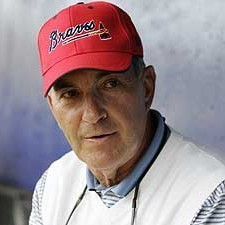 How did Schuerholz wind up in Atlanta when he had signed a lifetime contract with the Royals and the new 50 percent owner of the team, Avron Fogelman?
“The landscape began to shift; the ground beneath our feet began to move,” Schuerholz said. “A lot of people weren’t comfortable with what was happening. It was uncertain who Avron Fogelman would be. I became one of them. I was Avron’s guy. He had picked me to be the voice and face of the administration. But it became more and more bothersome.”
Fortuitously for Schuerholz and the Braves, his disenchantment with the Royals was growing around the time Kasten was looking for a general manager.
The two men were serving on a baseball committee (of which George Bush was also a member) and met during the summer of 1990. They got to know and like each other.
“We went to a game at Yankee Stadium and spent the afternoon talking about baseball,” Kasten related. “I felt really good about John. We met more throughout the summer.”
Kasten asked Schuerholz for recommendations for the job he wanted to fill.
“I thought about it,” Schuerholz recalled, “and almost like a cartoon, a light went on over my head. I decided I would be interested in pursuing it.
“The first week of September John asked me more questions,” Kasten recalled, “and I said, ‘John, is this something you’re thinking about?’”
Schuerholz was definitely thinking about it but ultimately told Kasten he couldn’t take the job. Two days later, a Sunday, Kasten got home from a morning workout, and his wife said that Schuerholz had called.
“Stan, I made a mistake,” Schuerholz told him when he returned the call. “If the job is still available, yes, I’ll take it.”
That was 20 years and 14 straight division titles ago. Now Kasten is president of the Washington Nationals, Schuerholz is president of the Braves and Cox is retiring.
“I always liked the uniform a lot better, a lot better,” Cox said of his job preference. “It’s a lot more fun. Being a general manager is a lot of work these days. It’s not like it was 50 years ago where after the winter meetings you went your way. It’s a 12-month, year-round job for these guys. It’s tough. It’s not easy any more. I love the guys, the field. There’s nothing better than when the game starts.”
Fay Vincent, the former commissioner, offered another reason for Cox’s preference for managing. “Cox would not be going to the Hall of Fame if not for the change,” Vincent said. “Not many general managers go to the Hall.”
BOOM BOOM BAUTISTA
With 49 home runs at the start of the next-to-last week of the season, Jose Bautista was poised to become  the 26th major league player to hit 50 in a season. If this were a few years earlier, skeptics would be suggesting his possible use of steroids or other performance-enhancing drugs, but the Toronto outfielder has not come under suspicion as some others have.
Nevertheless Bautista’s performance has been puzzling, not to mention rare. Before this year, Bautista’s 16 home runs for Pittsburgh in 2006 were the most he had hit in a season. How many players have gone from 16 to 50? One.
Before Cecil Fielder slugged 51 home runs in 1991, he had played in parts of four seasons and had hit 14 in 1987. That was his best pre-51 performance. None of the other 24 players who have reached the 50 plateau hit fewer than the 21 Brady Anderson hit in 1992 before he stunningly swatted 50 in 1996.
Prince Fielder joined his father in the 50 club in 2007, making them the only father-son duo at that level, connecting for 50 after he had hit 28 the previous year, his first full season in the majors.
Three players came closest to 50 before hitting 50, each hitting 49: Mark McGwire in 1987 (52 in ’96), Ken Griffey Jr. in ’96 (56 in ’97 and Jim Thome in 2001 (52 in ‘02). Note the years for Griffey and Thome, indicating a consistency, unlike McGwire, who needed nine years and perhaps chemical assistance to get there.
FLASH: HE WALKS, TALKS AND GETS HIT
Biggest discovery of the week: Aroldis Chapman is actually human. The 22-year-old Cuban pitcher whose fastball exceeds 100 miles an hour, relieved for Cincinnati in a game against Houston, threw 12 pitches, got no one out.
With the game tied 3-3 in the seventh inning, Jeff Keppinger stroked a pinch-hit single, Anderson Hernandez drew a pinch-hit walk, Michael Bourn beat out a bunt single and Angel Sanchez rapped a two-run single for what became a 5-3 Houston victory.
HELPING TEAM BUT NOT TEAMMATE
 His teammate is undermining Carlos Gonzalez’s chances of winning the National League most valuable player award. Gonzalez has been having a productive and most valuable season for Colorado, but now Troy Tulowitzki comes along and seems intent on carrying the Rockies on his bat right into the playoffs.
Tulowitzki, the Colorado shortstop is having a stupendous September. He whacked 14 home runs in 15 games and has driven in 34 runs in 18 games.
Opting to use my own thinking and not the mathematical formulas of the new wave of statistics zealots, I have always felt that the more good, or m.v.p. type, players, a team has, the less valuable each one is. Tulowitzki has certainly made a significant contribution to the Rockies’ late-season surge, meaning Gonzalez has had help in a big way.
Adrian Gonzalez of San Diego, Joey Votto of Cincinnati and Albert Pujols of St. Louis have not had Tulowitzki-type help this month. With the month he has had, Tulowitzki himself will receive consideration himself.
FIRST-TIME ZEROES FOR NEW YORK TEAMS
On the evening of Sept. 13 the Mets played the 7,789th game in their history and the Yankees played their 7,785th game since the Mets began life in 1962.
That night, for the first time in all of those games, according to Elias Sports Bureau, the Mets and the Yankees went into extra innings in scoreless games. In July 2001 the teams played into the 10th inning of a scoreless interleague game, and the Mets won in the 10th.
In their separate scoreless games last week, the Yankees lost to Tampa Bay, 1-0, in the 11th inning, and minutes later the Mets ended their rain-interrupted game in the 10th inning with a 1-0 victory over Pittsburgh.
Those were the 54th and 55th 1-0 games of the season. The next night Los Angeles edged San Francisco for No. 56 and the seventh 1-0 game in five days, the busiest flurry for 1-0 games this year.