George Brett summed up his view of Zack Greinke’s 7-1 record and 0.60 earned run average this way: “You wouldn’t have thought it possible if you saw him pitch in spring training. He threw fastball/change, nothing else. He got hit around.”
Brett saw Greinke throw all those fastballs and changeups because he was in the Royals’ camp pitching batting practice and hitting fungoes. Greinke, it turned out, threw all of those changeups because he wanted to refine the pitch and he wanted to have a better change than fellow starter Kyle Davies.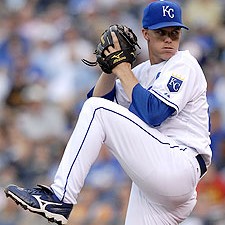
“He and Davies would have a contest to see who was going to throw the best change,” Brett said. “He realized he doesn’t get paid for what he does in spring training so he worked on his change and got the feel for it.”
The Greinke that Brett saw once the season started was as different as the Greinke he sees now compared with the one he saw at the start of his Royals career.
“He lived with me and my wife and kids the first four months of his first year,” Brett said, referring to the 2004 season. “He didn’t say two words to us. He’d come and go without saying anything. Now he starts conversations. He’s matured a lot. Getting married in November helped. Emily is good for him.”
But even before he married Emily, Greinke had undergone a transformation. In 2006 Greinke had suffered from an anxiety problem and left the Royals, planning to quit baseball. But he returned in June and with two weeks left in the season was pitching for the Royals again.
“Zack got that under control,” Brett said. “He’s more outgoing, he has fun, he enjoys his time at the ball park where before he didn’t. Now he looks forward to going to the ball park. He’s opened up. Guys love being around him; he loves being around them. Before, he didn’t like his job.”
Greinke did not leap to success. He had a 7-7 record and 3.69 e.r.a. in 2007 and a 13-10 record and 3.47 e.r.a. in 2008. This season has been his leap to success.
He has won seven of his eight starts, losing his game against the Angels, 1-0, despite pitching a complete-game four-hitter. He has pitched three other complete games and has permitted a mere five runs (four earned) in 60 innings. Those numbers have rarely been seen a month and a half into the season.
After seeing Greinke throw nothing but fastballs and changeups during spring training, Brett said, “It’s amazing to see him throw sliders that start out in the middle in and wind up in the dirt. His slider is so wicked right now.”
American League batters would readily attest to how wicked Greinke has become.
TWO PITCHERS, ONE FINED $750, ONE $5,000
Major League Baseball demonstrated recently that words are more costly than baseballs thrown at batters at a velocity of about 95 miles an hour.
Bobby Jenks, the Chicago White Sox closer, was fined $750 for throwing a pitch behind Ian Kinsler of Texas. Jamie Walker, a Baltimore reliever, was fined $5,000 for comments that, the commissioner’s office said, impugned the integrity of an umpire.
 The Jenks fine was standard. If a pitcher is deemed to have thrown at a batter, he is fined $750. The Walker fine was for these comments that appeared in the Baltimore Sun after he was called for a balk in a 7-5 loss to the Angels:
“No way in hell did I balk on that pitch. I don’t know if the guy has something against me or what, but no way in hell did I balk. It changed the whole damn game. I may get screwed in the long run, but that’s just unacceptable at this level. … I don’t know if he had money betting on the game or what, but that’s a horses- – call. I don’t even have a damn pickoff move. I think that might be my first career balk.”
If Walker wasn’t guilty of questioning the integrity of an umpire, he was guilty of gross exaggeration (the balk changed the game), though if that were a finable offense, players would be fined every day.

According to the letter notifying him of the fine, Walker’s “accusations are inflammatory” and “struck at the heart of public confidence” in the game.
If there’s any justification at all for the fine, it’s that Walker’s suggestion that the umpire had bet on the game could actually be believed by some fans. All sports leagues are sensitive to such charges because of the National Basketball Association’s experience with a crooked referee.
Walker has appealed his fine so Bob Watson, the baseball executive in charge of discipline, said he couldn’t talk about the case.
Speaking about the Jenks fine, Watson acknowledged that when he played (1966-84) and earlier, players settled “beanball” incidents themselves. That practice has changed and not because pitchers don’t bat in the American League.
“The rules have changed,” he said. “That came from ownership. Players were being hurt and they wanted it taken away.”
The owners’ concern grew in direct proportion to the average salary.
“When I came along the average salary was $100,000,” Watson said. “It went to 3 or 4 million. When you have that kind of money invested and the benches clear and you have 50 players on the field, that’s a lot of assets.”
Based on the Jenks fine, John Lackey can expect to be fined $750. Making his first start of the season last week, the Angels’ pitcher was ejected after throwing only two pitches. Lackey threw the first pitch behind the batter’s back and hit him with his second pitch. What links Lackey and Jenks, besides the fines, is that they threw at the same batter – Kinsler, the Rangers’ leadoff hitter. In Lackey’s case, Kinsler had hit two home runs against the Angels the night before.
TWO ROOKIES ARE NOT YOUNG
 Chris Coste, the Philadelphia Phillies’ backup catcher, knows better than anyone how Bobby Scales and Matt Palmer feel. Coste played in the minor leagues so long that when he finally reached the major leagues he was 33 years old. Scales is a 31-year-old rookie with the Cubs, and Palmer is a 30-year-old rookie with the Angels.
Scales did not play in the majors until this season. Palmer started two games for the Giants last August 10 days apart.
Palmer has started four games for the Angels and won them all. Scales hasn’t played much, but his offensive production when he has played has been impressive. He has started three games at second base and two at third and has played in two other games.
He has 8 hits in 21 times at bat for a .381 batting average, and he has driven in 5 runs. Included in his 8 hits are a home run, a triple and a pair of doubles, giving him a .714 slugging percentage to go with his.435 on-base percentage.
WILL IT BE CUBS OR YET ANOTHER STAND-IN?
When last Wednesday’s games had been played, Milwaukee, Cincinnati and St. Louis were tied for first place in the National League Central and Chicago was half a game behind them. Twenty-four hours later Milwaukee and St. Louis each had one more victory and remained tied for first while the Cubs and idle Cincinnati were tied half a game back.
Less than a quarter of the season has been played so there’s plenty of time for the look of those standings to change and for stronger teams to stretch out division leads and shed hangers on. But who are the stronger teams? Are there any strong teams in the N.L. Central? The same questions can apply to the American League Central.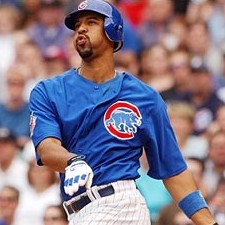
The answers to those questions depend on one’s point of view. Officials of the teams themselves will say that the divisions are strong and well balanced. They are not about to discount their levels of talent nor acknowledge that their divisions are weak. Officials of teams in other divisions, meanwhile, will say privately that those divisions are weak, and the teams are bunched at the top because of parity on the weak side.
Last season only two teams in the N.L. (the Phillies and the Cubs) and three teams in the A.L. (Angels, Rays and Red Sox) won more than 90 games. Two of those teams (Cubs and Angels, the teams with the best record in each league) did not last beyond the first round of the playoffs.
The Cubs were the N.L. favorite to reach the World Series last year, but they didn’t get there, extending their streak without a World Series championship to 101 years. To have a chance to get there this year they will have to get everyone healthy and hitting.
Carlos Zambrano, their best pitcher, and third baseman Aramis Ramirez, one of their most dangerous hitters, are on the disabled list. First baseman Derrek Lee (above) isn’t on the disabled list, but a bulging disk in his neck has limited his playing time and production.
Entering the Cubs’ Sunday game with Houston, Lee was hitting .198, and right fielder Milton Bradley was a few points worse at .194. Catcher Geovany Soto was hitting .202, which was 83 points below his average as a rookie last season.
The Brewers, the Reds and the Cardinals have been happy to fill the void created by the Cubs’ shortcomings.
“We’re just trying to prove people wrong,” Doug Melvin, the Brewers’ general manager, said. “Everybody made a big deal out of us losing CC Sabathia and Ben Sheets. We’re just trying to play good baseball and we have. Our younger guys have developed patience at the plate.”
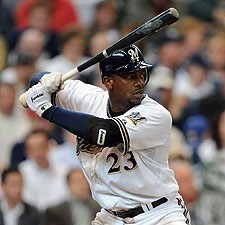 Ricky Weeks (at left) is one of those younger guys, and he is developing patience, hitting .274 this season after two seasons of .235 and .234. He also leads the team with 9 home runs and is third with 24 runs batted in behind Prince Fielder (32) and Ryan Braun (28).
“He’s just matured,” Melvin said. “People expected so much out of him. He was the second pick in the draft and got here fairly quickly. I compare him to Orlando Hudson and Brian Roberts and he’s ahead of where they were at his age. He’s more aggressive at the plate and has a lot more hits.”
Weeks has also benefited from having Willie Randolph as a coach.
“Willie has helped him defensively,” Melvin said. “He’s rated as the best second baseman in the majors. Willie made him feel like he doesn’t have to rush everything. He still has to be aggressive but he slowed his actions down, helped him defensively. Dale Sveum helped him hitting wise.”
(Editor’s Note: Subsequent to the posting of this column, the Brewers learned that Weeks would miss the rest of the season following surgery for a torn tendon sheath in his left wrist. Weeks had the same surgery on his right wrist in 2006.)
Weeks, though, is not the only player who has made an offensive transformation. Melvin pointed out that the Brewers have four players with .400 on-base percentages, and “the Brewers have never had a player in their history to walk 100 times in a year. The younger guys are learning to be more patient.”
As for the Brewers’ pitching, losing Sabathia is not easy to deal with, but the Brewers played virtually all of last season without Yovani Gallardo, who suffered two disabling knee injuries but is healthy, has a 4-1 record and 3.09 earned run average and could develop into another Sabathia. In addition they signed Braden Looper as a free agent, and he has a 3-2 record and 4.70 e.r.a.
Walt Jocketty, the Reds’ general manager, set out to build the Reds around the pitching staff, and early returns show his plan is working.
“The best thing we have going for us is our starting rotation,” Jocketty said of Aaron Harang, Edinson Volquez, Bronson Arroyo, Johnny Cueto and Micah Owings.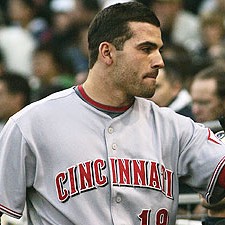
The general manager noted that the Reds have some other good things going for them – first baseman Joey Votto (at right) and right fielder Jay Bruce, in particular, and center fielder Willy “Taveras has picked it up as our leadoff guy.”
Based on early results, the division appears to be wide open with four teams having a chance to win. “I think it is,” Jocketty said. “I still think we have a number of teams that could win our division.”
Melvin said the Cubs cannot automatically be considered the team to beat. “The Cubs have a bunch of injuries and they don’t have the depth they’ve had in the past,” he said.
As for the strength of the division, he said, “I think people underestimate the division. The division is tougher than people give it credit for.” Melvin pointed out that four N.L. Central teams won 86 or more games last season, a result not matched in either of the other N.L. divisions. In fact, the N.L. West didn’t have even one team that won 86 games.
