Cliff Lee has become baseball’s Paladin. For the second time in a year, the left-handed pitcher has been traded from a team out of the pennant race to a team in the race. No other prominent starting pitcher has been traded during the season in consecutive years in at least 30 years, if ever, according to Elias Sports Bureau research.
After the Phillies obtained him from the Cleveland Indians last July, Lee did his best imitation of Paladin, the gun for hire of “Have Gun, Will Travel,” by beating the Yankees twice in the World Series for Philadelphia’s only victories.
Now the Texas Rangers have acquired Lee from the Seattle Mariners, hoping he can solidify their American League West lead over the Angels, then help them get to their first World Series.
Lee has played for so many teams in the past year it’s impressive that he knew what uniform to wear in the All-Star game last week. It’s a good bet that he he’ll add another uniform in the winter when he can be a free agent.
The talented left-hander would not have been in this position had the Phillies not so foolishly traded him to the Mariners last December. The Phillies said they traded Lee to recoup some of the minor leaguers they had to give up in trades for Lee and Roy Halladay. I didn’t believe that explanation then, and I don’t believe it now. I believe the Phillies didn’t want to have to sign both Halladay and Lee to big contracts.
With Halladay and Lee, the Phillies would have been in great position for the season and especially the post-season. They had no guarantee that the dynamic pitching duo would produce a second World Series title in three years, but they have no guarantee either that the minor leaguers they got for Lee will produce anything in subsequent seasons.
Right about now, when the third-place Phillies are engaged in a surprising division struggle, maybe they’ll allow themselves a moment to wonder what might have been had they kept Lee. If things break right for the Rangers, the Phillies will get a chance to watch Lee pitch in the World Series again, this time from a distance.
As soon as the Mariners started struggling early in the season, speculation about Lee’s status began. It evolved into not if the Mariners would trade him but where. As often is the case, some members of the news media professed to know where Lee was headed but were wrong. Lee did not join his former Indians teammate CC Sabathia in New York with the Yankees.
Lee may yet do that as a free agent, but it won’t happen this season. When the Mariners traded for him, they knew he could be a free agent after this season, but they were willing to give up three minor leaguers because they believed that he would be a key ingredient in their quest to contend for the A.L. West title.
As developments quickly demonstrated, they did not have a contending team so the trade was for naught. The Phillies, on the other hand, could have benefited mightily from his presence in their starting rotation. As their developments have demonstrated, they are short on starting pitching. But they made their niggardly choice, and they have to play with it.
If Lee pitches as expected for the Rangers, he may never get out of Texas as a free agent. Although the team’s ownership status has become a fiasco and remains unsettled, the Rangers may try to sign Lee to a new contract because Nolan Ryan, the Hall of Famer who is the club’s president and an integral part of the group that believes it will be successful in buying the Rangers, wants to improve the pitching and knows a good pitcher when he has him.
Lee, on the other hand, could wait for free agency to bestow on him the kind of contract the Yankees gave Sabathia (7 years, $161 million). The Rangers won’t give him that kind of deal.
 Pitchers of Lee’s quality have not been traded often during a season. When they have been and they have been eligible for free agency, they have more often than not moved on the following season, lured by contract offers.
Sabathia is the most recent example. Traded by the Indians, he had an 11-2 record for the Brewers, who tried to sign him to a new contract. But he rejected their offer, knowing more money would be available, and he left them for the Yankees.
The Indians seem to trade good pitchers more than anyone else. Besides trading Sabathia and Lee a year apart, they traded Bartolo Colon to Montreal in 2002 and going back a little farther, they traded Rick Sutcliffe to the Chicago Cubs in 1984.
The Colon trade is linked to Lee. He was part of the package of players the Indians received for Colon. The Indians also got second baseman Brandon Phillips and outfielder Grady Sizemore, making it one of the most one-sided trades ever.
However, Omar Minaya, the Expos’ general manager at the time, had a good reason for his willingness to give up those young players. He wanted Colon to enhance the Expos’ chances of making the playoffs, and the future didn’t matter because it appeared at the time that the Expos would be eliminated as part of the owners’ plan to contra ct two teams.
As it turned out, the Expos didn’t make the playoffs, and they weren’t contracted.
Colon, however, did his job for the Expos, matching the 10-4 record he had for the Indians and becoming the second former Indians pitcher to become a 20-game winner after being traded. Sutcliffe did it in 1984, winning 16 of 17 decisions with the Cubs after having a 4-5 record with the Indians.
Sutcliffe did not leave the Cubs as a free agent but continued to pitch for them for seven more years. Colon left the Expos by being traded the following winter to the White Sox.
Joe Blanton was not eligible to leave the Phillies after Oakland traded him to them in 2008.
Most others, though, have gone elsewhere in the winters following their trades. In 1998 Randy Johnson, who had been traded by Seattle to Houston and won 10 of 11 decisions for the Astros, signed with Arizona the following winter.
David Cone was traded twice in pennant races. The Mets traded him to the Blue Jays in August 1992, and the Blue Jays traded him to the Yankees in July 1995. He had a 4-3 record for the Blue Jays and a 9-2 record for the Yankees.
After his brief time with the Blue Jays, Cone left as a free agent and returned to Kansas City, where he began his career, for a contract that included a $9 million signing bonus, at the time the biggest signing bonus ever given to a player. After his tour with the Yankees, Cone became a free agent but signed to remain with the Yankees.
One of the most significant pennant-race trades ever made was the August 1987 deal that sent Doyle Alexander to Detroit. Alexander compiled a 9-0 record for the playoff-bound Tigers, justifying the trade. But the Atlanta Braves, who traded Alexander, didn’t do badly. In return for Alexander, the Braves got a young John Smoltz.
Eleven years earlier, in 1976, the Yankees made two pitching-loaded deals on what was then the trading deadline, June 15. They received Alexander and Ken Holtzman in a 10-player swap with Baltimore, and they bought Vida Blue from Oakland for $1.5 million.
Blue, however, never pitched for the Yankees. Commissioner Bowie Kuhn vetoed the deal as well as one in which Charlie Finley, the Athletics’ owner, sold Joe Rudi and Rollie Fingers to Boston for $1 million each. Kuhn said the deals were not in the best interests of baseball and successfully defended Finley’s lawsuit challenging his ruling. Finley called Kuhn the village idiot but lost the lawsuit.
An even older in-season trade produced the most interesting result. On May 15, 1956, the Indians – there are the Indians again – sold Sal Maglie to the Brooklyn Dodgers, whose fans hated Maglie from his many years with the New York Giants.
The 39-year-old right-hander was instrumental in the Dodgers’ edging the Milwaukee Braves for the National League pennant by a game. Maglie, who produced a 13-5 record for the Dodgers, pitched a no-hitter against Philadelphia in his next-to-last start, keeping the Dodgers half a game behind the Braves, then pitched a six-hitter against Pittsburgh that put the Dodgers half a game in first.
The Dodgers clinched the pennant the next day, the last day of the season.
Maglie then started the first game of the World Series against the Yankees, beating them, 6-3, with a complete-game, and then pitched even better in Game 5. But the Dodgers lost, 2-0, because Don Larsen pitched a perfect game.
“BEST OF THE BLUSTER” BACKGROUND
In its coverage of the death of George Steinbrenner last week, The New York Times ran the “Best of the Bluster,” a compilation of five notable comments uttered by the Yankees’ owner over the years. I enjoyed seeing those comments because Steinbrenner made three of them to me. Here they are with the circumstances that produced them:
“Kenny Clay is a morning glory. He spit the bit.”
In a Saturday afternoon game against Kansas City at Yankee Stadium Sept. 1, 1979, the Yankees scored five runs in the first inning, only to have Ken Clay, their 25-year-old right-hander, give up four runs in 2 1/3 innings. A two-run home run by George Brett knocked him out of the game, and the Yankees went on to lose the game, 9-8.
Not long after Billy Martin removed Clay from the game, the Yankees’ public relations man came to me in the press box and told me Steinbrenner wanted to see me in his office.
As soon as I walked in, Steinbrenner, seated behind his desk, said gruffly, “Ask me about Ken Clay.”
“What about Ken Clay?” I asked innocently, not sure where this was going.
“Clay has continually complained about not getting a chance to pitch,” the owner said, “but he has refused any of our suggestions to help his pitching. I’ve heard people tell me what a great arm he has, but I question his heart.
“In horse racing we have what we call a morning glory. The horse works a great three or four furlongs in the morning workout and looks sensational. Then when the race comes he starts sweating during the parade to the post, and when he gets in the gate and the race starts, he stinks the place out. He spits the bit.
“Kenny Clay is a morning glory. He spit the bit. He doesn’t have the courage. That may be harsh, but that’s the way I feel. He goes one good outing and three putrid ones. This was putrid. He looks great in the bullpen, but he gets on the mound and he chokes. He gets five runs, and he does that to his teammates.
“I can’t accept that. He’s one of the biggest disappointments I’ve had since I’ve had the Yankees.”
Clay started only one more game for the Yankees that season, then lasted only two more seasons in the majors, pitching infrequently for Texas and Seattle.
“Where is Reggie Jackson? We need a Mr. October or a Mr. September. Winfield is Mr. May.”
Contrary to frequent misconception, including at other times in the Times, Steinbrenner did not christen Winfield Mr. May because of his poor performance in the 1981 World Series.
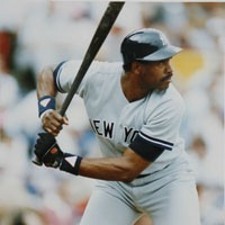 Steinbrenner uttered the derogatory comment during a game at Yankee Stadium against the Toronto Blue Jays. It was a Saturday night game on Sept. 14, 1985, and the Yankees, losing, 7-2, were on the verge of falling 3 ½ games behind the Blue Jays in the American League East race.
As I hurriedly wrote my report of the game that would soon end, a body not familiar in the press box plopped down in the seat to my left. The first seat in the first row, it was usually unoccupied so it was easy for Steinbrenner to sit down and deliver his message.
He criticized Winfield, Ken Griffey and Don Baylor for their lack of production in the series, then said, ”We have been out-ownered, we have been out-front-officed, we have been outmanaged, we have been outplayed. I blame myself as much as anybody.”
Then waving a sheet of statistics showing Griffey 0 for 8 in the series, Baylor 0 for 7 and Winfield 3 for 11 with only two runs batted in, one on a ground out, Steinbrenner said, ”Where is Reggie Jackson? We need a Mr. October or a Mr. September. Winfield is Mr. May. My big guys are not coming through. The guys who are supposed to carry the team are not carrying the team. They aren’t producing. If I don’t get big performances out of Winfield, Griffey and Baylor, we can’t win. If I don’t get pitching from Cowley, Whitson and Bystrom, we’re not going to win.”
While I initially didn’t appreciate the interruption, I realized that Steinbrenner was writing my story for me. Not a bad thing on a Saturday night with early deadlines.
“Columbus, here I come.”
On March 27, 1986, the Yankees and the Texas Rangers played an exhibition game at the Rangers’ aging spring training site in Pompano Beach, Fla. Dennis Rasmussen, a 26-year-old left-hander was pitching for a spot in the Yankees starting rotation, and weather conditions were not on his side. Brisk winds were blowing out on this day, just as they often did at the old ball park.
Steinbrenner was watching the game from a seat behind home plate so he had a good view of the pitch that Curtis Wilkerson slugged for a wind-aided three-run home run in the second inning.
In the middle of the fourth inning I moved into the stands from the press box and sat down next to Steinbrenner so I could ask him a question. While I was there, Tom Paciorek hit another Texas home run. The wind was really strong now, and Steve Buechele, the next batter, drove another Rasmussen pitch over the left field fence.
Steinbrenner had seen enough. As far as he was concerned, Rasmussen had decided his fate. “Columbus, here I come,” the owner said, referring to the Yankees’ AAA minor league team in Ohio.
Rasmussen, however, never made that trip. He won the starting job, remained with the Yankees all season, made 31 starts and led the staff with an 18-6 record, the only pitcher to win in double digits.
EGG, NOT CREAM PIES, ON THEIR FACES
The All-Star game suffered a double-barreled blow last week:
- It got the lowest television ratings ever for a baseball All-Star game, making a mockery of Commissioner Bud Selig’s reason for linking the outcome of the game to homefield advantage in the World Series, that is, improving Fox’s ratings for the game.
- A major part of the reason for the low ratings was the unusually poor showing in the home area, making a mockery of Arte Moreno’s reason for hijacking the designation of Los Angeles for his Anaheim team, the Angels, that is, improving his revenue by pretending to be part of Los Angeles.
The 7.5 national rating fell below the previous low of 8.1, which was the rating for the 2005 game. Last year’s game had an 8.9 rating.
Particularly damaging to Fox was the game’s 8.6 rating in the Los Angeles area. That was remarkably lower than the average rating of 22.8 for the home areas of the previous five games.