With much gnashing of teeth and shaking of their heads, baseball fans in the United States bid adieu to the second World Baseball Classic their team didn’t win. There’s nothing wrong with their reaction except that it demonstrates their provincialism. But at least they care.
Because the Classic has arrived late on the baseball scene, it has been dismissed by many fans as unimportant, irrelevant and unnecessary. I disagree. I have long liked the idea of a world baseball tournament, like soccer’s World Cup, and I believe it was overdue.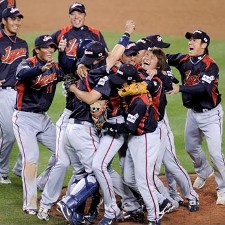
Commissioner Bud Selig has been accepting, if not taking, credit for the WBC, but the credit is misplaced. The Players Association was well out in front of Selig and the other club owners in proposing and pushing for such an event. Union officials recognized long before the owners the potential benefits of a world competition.
“I think that was true if you go back a long period of time,” Donald Fehr, head of the union, said Tuesday. “We were out front on these international issues, but they’ve flip-flopped on it. We’ve been working on it together for six, seven years. Bud deserves credit for getting the owners to go along with the idea.”
When the other professional leagues went global and showed the economic benefits that were out there, baseball club owners belatedly awoke and said us, too. I don’t know what Selig’s view was on a world tournament when the union initially proposed it – I’m sure he would say today that he always favored it – but he didn’t do anything to arouse interest among his fellow owners.
So maybe one or two Classics were missed because the owners weren’t interested and didn’t recognize the potential revenue to be generated, one or two Classics that could have enabled the union and the commissioner’s office to iron out the kinks that still must be smoothed out. However, better late than never.
That Japan has won both Classics that have been played and that South Korea was the other team in the championship game are nothing to disdain. Their success says a lot about the quality of Asian baseball, which apparently has been kept secret from the U.S. of A.
Korea’s showing should have come as no surprise. Though they are less well known than the Japanese because of the paucity of their nationals in the major leagues, the Koreans demonstrated strong performances in the inaugural Classic in 2006 and won the Gold Medal in the 2008 Olympics in Beijing.
Furthermore, on a personal note, they remind me of one of the liveliest tunes in the Broadway musical “1776:” “Here a Lee, there a Lee, everywhere a Lee, a Lee.” Their roster is filled with players named Lee: pitchers Jae Woo Lee and Seung Ho Lee, infielders Bum Ho Lee and Dae Ho Lee and outfielders Jin Young Lee, Jong Wook Lee, Taek-Keun Lee and Yong-Kyu Lee.
The experts and fans in this country who are willing to recognize that Americans are not the only talented baseball players in the world would most likely have thought the most serious challenge to United States supremacy would come from Latino teams, most probably the Dominican Republic and Venezuela.
But little Netherlands, technically the Kingdom of the Netherlands because the team included players from Aruba and Curacao, beat the stronger Dominican team not only once but twice and knocked it out of the tournament.
Unknown to all but Bert Blyleven, their Dutch-born pitching coach, the Netherlands pitchers were terrific, winning games in spite of a weak hitting team. Blyleven’s blazers won’t catch anyone by surprise in 2013 in the next Classic, but they will go in to the tournament far more highly respected than this year.
The Dominicans will approach that Classic more seriously than they did this year. Healthy players will be less likely to sit it out, knowing that their country was embarrassed and their baseball reputation disgraced this year. The Venezuelans went further than the Dominicans, but they again didn’t reach the finals and will want to restore their reputation as well.
Who knows what the United States will do? They had more non-injured players who shunned the Classic than any country. There seemed to be an unappetizing arrogance that undermined Team USA, players not wanting to depart from their spring routine, deciding they were more important to their major league teams.
Of course, they are important to their major league teams. But so are the Japanese players Ichiro Suzuki and Daisuke Matsuzaka, among others, important to their major league teams.
Ichiro collected four hits and drove in the winning runs in the championship game, and Matsuzaka was named the Classic’s most valuable player for the second time. Matsuzaka followed his first m.v.p. award by signing with the Red Sox, then winning 15 games for them in 2007 and Game 3 of their four-game sweep of Colorado in the World Series.
Matsuzaka was one of three Japanese players named to the Classic’s all-star team this year. Korea placed four players on the 12-man team, Cuba two and Venezuela, Puerto Rico and the U.S. one each. Perhaps in that makeup is where the questions should be asked.
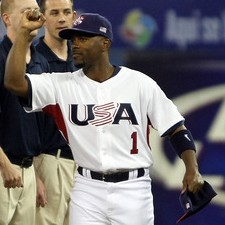 Jimmy Rollins (at left) was the only American selected for the team. Surely there is more than one American major leaguer who could perform well enough in the Classic that he would be named an all-star. To be named to the Classic all-star team, though, a player has to play in the Classic.
Much can happen in the ensuing four years. Some American players who are among the best now will still be among the best in 2013, but the “best” will include many new players.
David Wright, the Mets’ third baseman, figures to be among the former group. He was one of the players who was most passionate about playing in the Classic. Maybe he can spend some time before 2013 instilling some of that passion in his fellow American players.
The players who didn’t want to play this year and the general managers who didn’t want their players to play had a variety of excuses for their stance. Forget the excuses next time and play ball.