What people have been saying (not all of it intelligently):
On the eve of Hall of Fame weekend, one inductee used his new status to comment on the status of steroids-tainted candidates. In my opinion, Tony La Russa would have been wiser to keep his thoughts to himself.
“Treat them all the same,” La Russa said in an interview in Cooperstown with Willie Weinbaum of ESPN, speaking of players suspected of having used performance-enhancing substances.
“If you were a Hall of Famer during that period as far as your pitching and playing, I would create some kind of asterisk, where everybody understands that, ‘Look, we have some questions, but you were still the dominant pitchers and players of your time.’
“We have to acknowledge that that period for about 10 or 12 years, somewhere around the early ’90s to the early 2000s, was a black spot, a negative mark in our history.”
Put aside for a moment the problems inherent in La Russa’s idea and think about the background of the man proposing the idea.
In March 2005, when McGwire was scheduled to appear before a Congressional committee looking into steroids use in baseball, La Russa, who had managed the first baseman in Oakland and St. Louis, defended McGwire before the hearing. “I believe in Mark for a ton of reasons,” he said.
And he continued defending him after his curious testimony.
“I’m not here to talk about the past,” McGwire said repeatedly in response to Congressmen’s questions about him and steroids use. He sounded like a mob figure taking the Fifth Amendment against self-incrimination in the Kefauver hearings in the 1950s.
McGwire had obviously been instructed by his lawyers to use that reply to avoid admitting steroids use while at the same time avoid lying to Congress. No one, however, was fooled; no one, that is, except perhaps for La Russa, unless he was being disingenuous.
Asked a couple of days after the hearing what he thought of McGwire’s approach, La Russa said, “I was surprised by it. He’s made a statement where he’s denied it. I thought it was a great time for him to make that same statement. He had the biggest stage of all to say it and it looked to me like he was coached in the other direction and it surprised me.”
The manager added, in a spring training interview, “A couple of key comments were not made. He repeated that one thing over and over again like he had been coached that that was a smart thing to say.”
I suggested that perhaps McGwire had not repeated his earlier statement because he was speaking under oath.
“In my opinion,” La Russa, a lawyer, said, “being under oath wouldn’t have changed what he would have said. I don’t take that conclusion; I believed him when he made the statement.”
But did he think the possibility of perjuring himself was the reason McGwire had not repeated his earlier denials? “No, that’s not what I think,” La Russa said. “I just think he was overcoached. That’s what I think.”
I suppose I’d rather believe that La Russa was being naïve and not dishonest, but it’s hard to believe that a man of his worldly experience and legal training could be naïve about drug use, especially when it was somewhat rampant in his clubhouse.
As for his idea of admitting suspected steroids users into the Hall of Fame, it’s clear that the electorate has no interest in electing candidates like Barry Bonds, Roger Clemens, McGwire and Rafael Palmeiro. Members of the Hall of Fame don’t want them either. Some, perhaps, many members have said they would not attend induction ceremonies if any of these questionable candidates were elected.
If, however, La Russa’s idea were accepted and implemented, who would decide which players fell into the asterisk category: The players themselves might object, especially if they had never been accused of using steroids by anything stronger than circumstantial evidence.
Some may suggest that someone like La Russa would be a reasonable choice, but he was certain that McGwire never used performance-enhancing drugs. That misjudgment alone would disqualify him.
TWO GUYS NAMED COLBY PLAY DIFFERENT GAMES
One of the only two major league players named Colby made what was probably the most bizarre comment of the past week. Making it even more bizarre was that it was provoked by the other Colby.
 Colby Lewis is a Texas pitcher, Colby Rasmus a Toronto outfielder. They crossed paths July 19, and Lewis took exception to a bunt single Rasmus executed in the fifth innings with two out and no one on base.
Was Lewis angry because the Blue Jays were leading by a bunch of runs and a bunt was poor form? No, the Blue Jays were ahead by only 2-0, and the Rangers had plenty of time to catch up.
According to MLB.com, Lewis said “I didn’t appreciate it” and told Rasmus, “You’re up by two runs with two outs and you lay down a bunt. I don’t think that’s the way the game should be played.”
Let me pause here to make a point. Managers and players don’t appreciate a bunt or a stolen base when the bunting/stealing team has a huge lead in the last couple of innings. But a 2-0 lead in the fifth inning?
Another point:
The Rangers were playing a shift against Rasmus, with only one infielder on the third base side of the infield. With players often deployed in such shifts, observers and fans ask why teams don’t bunt more for easy hits. So Rasmus bunts, and he’s wrong?
“I felt like you have a situation where there is two outs,” Lewis said, “you’re up two runs, you have gotten a hit earlier in the game off me, we are playing the shift, and he laid down a bunt basically simply for average.”
Proof that Rasmus was just thinking of his batting average, Lewis added, was that he “didn’t steal within the first two pitches to put himself in scoring position.
“That tells me he is solely looking out for himself, and looking out for batting average. And I didn’t appreciate it.”
I can only imagine that if Rasmus had stolen second with a 2-0 lead in the fifth inning, Lewis would have had a lot more to say, and most of it would not have been printable.
At the time Rasmus bunted, he was hitting .152 (7-for-46) in his last 16 games and had 2 hits in 5 career at-bats against Lewis. He said after the game he was trying to help his team and didn’t understand why Lewis was offended.
“I’m just trying to help my team and he didn’t like it – so sorry about it,” Rasmus told MLB.com. “I’m not here to try to please the other side, I’m here to help my team, and I had an opportunity where I could, and I took advantage of it.”
PAP LOOKING TO GO BUT STAYING IS OK, TOO
Early this month Jonathan Papelbon saved three consecutive Philadelphia victories over National League Central leader Milwaukee, and with the non-waiver trading deadline approaching in a few weeks, it was only natural to speculate that the last-place Phillies might trade the closer to a contending team and save a few million dollars, or more like $30 million over the next two and a third seasons.
Papelbon has a provision in his contract by which he can block a trade to 17 teams, but when reporters asked him after his success against the Brewers about his view on a trade, he made it clear he was ready to go.
“Some guys want to stay on a losing team?” he asked. “That’s mind-boggling to me.”
Did that mean he would approve a trade? “Yeah,” he said. “I think that’s a no-brainer.”
He wasn’t seeking a trade, a way to escape a last-place team, but he wasn’t exactly expressing loyalty to a team that gave him a $50 million contract when he was a free agent.
Loyalty isn’t the No. 1 sentiment these days on the list of clubs or players, but I have a problem with the free agent who will grab the best offer he gets, then be eager to jump ship if the team falters and something better comes along.
In Papelbon’s case he heard about his comments from Phillies fans, and the next time he addressed the topic he expressed a different view.
Asked if the booing bothered him, he said, “No, I enjoy it. I just think that it’s fun. It just brings a little bit of energy and life to the park, and gives me a little bit of something to look forward to do every day … You’ve got to be able to take it if you want to dish it out, right? I think that goes both ways for me.”
The 33-year-old right-hander is having a better season than his team. He has a 1.87 earned run average and 24 saves in 27 opportunities.
YANKEES SPEAK SOFTLY, CARRY SOFTER STICKS
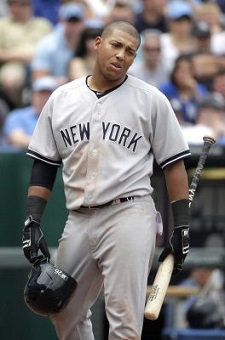 It’s not what the New York Yankees said verbally last week that said a lot about them but what their bats didn’t do that showed how feeble they are offensively.
They were playing a four-game series against Texas at Yankee Stadium, and in the second game of the series they couldn’t score in the first 13 innings despite batting against the worst pitching staff in the American League.
When the game began, the Rangers had a 4.90 earned run average, the league’s worst, and had allowed the most runs and earned runs. And for a staff that didn’t allow the Yankees to score for 13 innings, the Rangers had pitched only two shutouts, fewest in the league.
The Yankees didn’t score in 5 1/3 innings against Nick Martinez, a member of the starting staff whose 5.15 e.r.a. was the A.L.’s worst and which had given up the most runs and earned runs in the league.
The Yankees also didn’t score in 6 2/3 innings against six relievers who were members of a relief corps that ranked next-to-last in e.r.a., runs and earned runs permitted.
The Yankees scored two runs in the 14th against two relievers, including the Texas closer, Joakim Soria, after the Rangers scored a run in their half of the inning. The Yankees won three of the four games despite scoring only 10 runs in the series.