Lou Brock and Rick Sutcliffe blossomed probably more brightly than any other players after they were traded at the in-season trading deadline. Cory Lidle died. Literally.
The Philadelphia Phillies traded Lidle, a 34-year-old right-handed pitcher, to the New York Yankees July 30, 2006 with Bobby Abreu for four minor leaguers. Ten weeks later, after the Yankees lost their division series of the playoffs with Detroit, Lidle was killed when his single-engine plane crashed into a Manhattan apartment building.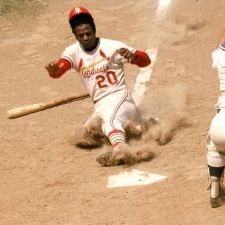
Brock and Sutcliffe lived to tell better stories about their post-trade experiences. Brock was traded by the Chicago Cubs to the St. Louis Cardinals June 15, 1964, primarily for a right-handed pitcher, Ernie Broglio, who in 1960, his second season, 1960, won 21 games and added 18 wins in 1963.
Brock’s production had not been impressive. For the Cubs that season he had a .251 batting average with .300 on-base and .340 slugging percentages. For his new team the rest of the year he batted .348 with equivalent .387 and .527 percentages.
The fleet left fielder, spending the rest of his career with the Cardinals, broke Ty Cobb’s major league stolen base record (Rickey Henderson has since surpassed it) and was elected to the Hall of Fame.
The Cubs acquired Sutcliffe from Cleveland June 13, 1984, at which point he had a 4-5 record. For the Cubs, he reeled off a 16-1 record. Like Brock, he was instrumental in spurring his new team to the post-season.
Unlike the Brock trade, the Sutcliffe deal was complicated by a Cubs’ foul-up. Under the rules at that time, for a team in one league to make a trade with a team in the other league, all of the players in the trade had to have cleared waivers.
The Indians had obtained waivers on Sutcliffe, but the Cubs had failed to do so on two critical players in the deal, Joe Carter and Mel Hall.
“I didn’t do my homework,” Dallas Green, the Cubs’ general manager, acknowledged at the time.
The Cubs, however, subsequently secured the waivers, and the trade was completed as originally structured.
Under the current rules, waivers are not needed through July 31. Players can be traded within leagues or between leagues without them.
Before July 31, there was June 15, the in-season trading deadline. The trading was more restricted then because teams needed waivers on players to be able to trade them to the other league. That requirement was eliminated when the deadline was changed to July 31 in 1986.
The current system has created such a fan-friendly environment I suspect if baseball officials could design a way to pull it off, they could sell tickets to a July 31 event showcasing trades that are made that final day.
Much of the frenzy leading to the deadline is created by the news media. Most reporters have never heard a rumor they didn’t run with. Pre-deadline time is rife with names of players whom reporters tell themselves it’s only logical that teams would consider trading them.
Usually, most of the players who are mentioned in the weeks leading up to the deadline are not traded and many who are traded haven’t been mentioned.
Nevertheless activity has picked up with the escalation of player salaries. Teams that have players with expensive long-term contracts but that are not contenders often look to shed the contracts in deadline trades. Teams that have players who can be free agents after the season and are not contenders seek to trade them to get something for them rather than wait for the draft picks they will get as compensation when they sign with other teams.
When teams trade top-flight players, they seek the best minor league prospects they can get from teams interested in their players. In most instances, though, even the best prospects are never heard from.
On the other hand, probably the most memorable prospect acquired in a deadline deal, though the trade was actually made 12 days after the deadline (with waivers) was the prospect Atlanta received from Detroit for Doyle Alexander in 1987.
He was a young minor leaguer named John Smoltz, who went on to have a Hall of Fame career. Alexander, however, helped pitch the Tigers into the playoffs with a 9-0 record in 11 starts. A game and a half in second place when they acquired Alexander, the Tigers won the division title by two games.
More recently, in July 2006, Texas traded with Milwaukee for slugging outfielder Carlos Lee and gave up their closer, Francisco Cordero. The Brewers threw in a 26-year-old outfielder who had played eight and a half seasons in the minors and only eight games in the majors. Today Nelson Cruz is the Rangers’ right fielder who has hit 79 home runs in the last three seasons.
At that same time Seattle obtained first baseman Ben Broussard from Cleveland for a player who in two brief appearances with the Mariners batted .069. In becoming the Indians’ right fielder Shin-Soo Choo has been a .300 hitter the past three seasons.
But there was also a disaster- in- waiting at that season’s deadline. The New York Mets acquired reliever Roberto Hernandez from Pittsburgh to replace the injured Duaner Sanchez and also took a young developing pitcher, Oliver Perez. The Mets released the enigmatic Perez earlier this year, owing him $12 million for the season.
On deadline day in 2007 the Braves obtained slugging first baseman Mark Teixeira and Boston traded for the once-dominating closer, Eric Gagne. Among the five players the Braves gave the Rangers were Elvis Andrus, who has been their shortstop for three years, and Neftali Feliz, who as their closer has 61 saves the past two seasons.
Gagne turned into a disaster for the Red Sox, but David Murphy, one of three players the Rangers received for Gagne, has become a useful member of the team’s lineup.
Obviously, time needs to pass before the trades can be judged. Prospects don’t blossom overnight. But follow these names of minor leaguers who were traded last week for more established players and see what (and who) develops:
RHP Alex White, RHP Joseph Gardner, INF/OF Matt McBride (Ubaldo Jimenez); OF Thomas Neal (Orlando Cabrera), 1B Aaron Baker (Derrek Lee), INF Zachary Walters (Jason Marquis), RHP Zack Wheeler (Carlos Beltran), 1B Jonathan Singleton, RHP Jarred Cosart, RHP Josh Zeid (Hunter Pence).