Some teams go for the quick fix. They need a starting pitcher or two, they see names of established pitchers (established doesn’t have to mean good) on the list of free agents and they leap. Millions here, millions there, and they have filled their gaps.
The Yankees hit the lottery two winters ago following that formula, spending more money on two pitchers than other teams spend on entire teams. Their signing of CC Sabathia and A.J. Burnett helped produce a World Series championship.
Not every team is that successful. Not every team has the opportunity to sign pitchers of the quality of Sabathia. Never mind Burnett; he remains an enigma. Often the free-agent market doesn’t have star pitchers for the bidding.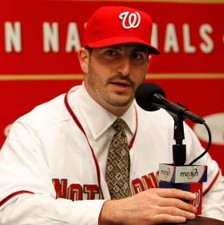
Yet teams spend anyway. Somehow, they figure, if they pay a mediocre pitcher enough money, it will turn him into a star. Those clubs will say they are only paying the going rate, but they create the going rate with their often outlandish offers.
But with increasing frequency teams are resisting the lure of costly free agents and opting for home-grown talent. Last winter, for example, the Mets clearly needed a fifth starter (not that most of their first four were Cy Young candidates; the group, after all, included Oliver Perez), and their fans urged them to sign one of the free agents.
Jason Marquis was a name heard often. A veteran starter, he had a six-year run of double-digit victory totals, including 15 last season. The Mets, however, were not intrigued. Marquis, they learned from scrutinizing his career, pitched well the first half of the season but disappeared in the second.
His teams reached the playoffs every one of his 10 major league seasons, but he had started only three post-season games. He was often left off his team’s post-season roster.
The Washington Nationals, eager to upgrade their last-place status by improving their pitching, grabbed Marquis with a two-year, $15 million offer. The Mets were not willing to spend that kind of money for a fifth starter, a questionable one at that. They would give the job to a home-grown youngster, Jonathan Niese.
While Niese has compiled a 6-3 record for the Mets, Marquis didn’t make it out of April with the Nationals. After giving up 19 earned runs in 8 1/3 innings in three starts (0-3, 20.52), Marquis went on the disabled list and on May 14 had bone chips removed from his elbow.
He is not the only free-agent pitcher who has lost time to injury.
Brad Penny, who is earning $7.5 million this season with St. Louis, was 3-0 with a 0.94 e.r.a. in his first four starts, then lost his next four starts with a 5.67 e.r.a. Shortly afterward a strained muscle in his arm sent him to the disabled list, where he remains.
Doug Davis, earning a guaranteed $5.25 million with Milwaukee, had a 1-4 record with a 7.56 e.r.a. and made it through only seven starts before he was diagnosed with pericarditis, an acute inflammation of the lining around the heart, a potentially problem if not treated promptly.
Texas guaranteed Rich Harden $7.5 million, and he had a 3-3 record and 5.68 e.r.a. in 13 starts before straining his gluteus muscle and leaving for the disabled list. Vicente Padilla, who got a $5 million deal from the Dodgers, missed eight weeks with an irritated nerve in his right forearm. Todd Wellemeyer, working for San Francisco for $1 million, had a 3-5 record and 5.52 e.r.a. when he strained a quadriceps covering first base a month ago.
Like Marquis, Justin Duchscherer of Oakland (2-1, 2.89 in 5 starts) didn’t pitch beyond April. A congenital hip problem, which previously required surgery on his right hip, attacked his left hip and ended his season in May, ensuring that he won’t be able to earn any pitching bonuses to supplement his $1.75 million salary.
Pitchers who were signed as free agents aren’t the only pitchers who suffer physical setbacks, but their injuries hurt a little more because they were signed with the expectation that they would help win games.
 So it goes, too, for free-agent pitchers who don’t pitch up to expectations, the ones whom money doesn’t turn into Hall of Fame candidates.
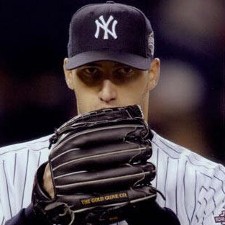
As the season reaches the All-Star break, Andy Pettitte has clearly been the best starter who signed last winter as a free agent, and appropriately he is on the American League All-Star team, though as an injury substitute.
Pettitte, who has an 11-2 record and 2.70 e.r.a., was a free agent in the sense that he was free to sign with any team, but he wasn’t going anywhere, unlike his 2003 free agency when he defected to Houston and took Roger Clemens with him. It was clear this time that Pettitte either would sign with the Yankees or retire.
For their $11.75 million, the Yankees have received more than they could have expected from the 38-year-old left-hander. Pettitte is headed for his third 21-win season and could lose fewer games than the eight he lost in each of the other two 21-win seasons (1996, 2003).
Carl Pavano is the biggest surprise of the pitchers from last winter’s free-agent class. He has a 9-6 record and 3.58 e.r.a. and has become the No. 1 pitcher for the Minnesota Twins, who signed him for $7 million for the season.
At the age of 34, Pavano probably has one lucrative multi-year contract in him, though the last time he got a multi-year contract, in 2005 at the more desirable age of 29, he was a complete bust. The Yankees gave him $39.95 million for four years (he supposedly fired his agent for not getting $40 million), and a series of injuries limited him to 26 starts and 146 innings in four years, one of which he didn’t pitch at all and another in which he pitched two games.
John Lackey was last winter’s Exhibit A of how a pitcher can benefit from the perception of being the best pitcher available in the free-agent group.
Lackey was 31, not too old, and had a history from earlier in his career of pitching more than 200 innings a season. However, the most games he had won was 19, and that had been three seasons earlier. In the two seasons since then he had won a total of 23 games.
Nevertheless everything is relative, and Lackey was rated No. 1. The Boston Red Sox pursued that distinction aggressively and gave the right-hander the type of contract the Yankees had given Burnett the year before for being No. 2 to Sabathia, $82.5 million for five years.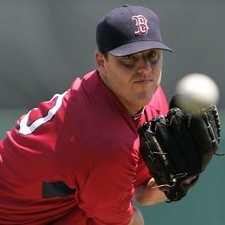
For that average of $16.5 million a year, Lackey has given the Red Sox basically what they wanted, a 9-4 record despite a 4.40 e.r.a. Jon Lester and Clay Buchholz have more wins and e.r.a.’s under 3.00, but the Red Sox are pleased with 9-4 and 4.40.
Randy Wolf benefited from the theory of relativity as well. Left-handed and 33 with winning records more often than losing records in his 11-year career, Wolf was attractive to enough teams that to get him Milwaukee had to give him $29.75 million for three years plus an option for a fourth year.
But with a 6-8 record and a 4.49 e.r.a., Wolf has been part of the Brewers’ problems instead of becoming part of the solution to those problems. Brett Myers could probably have a better record than his 5-6 and 3.57 if he were pitching for a better team than Houston, but the Astros guaranteed him $5.1 million for a year and an option.
Joel Pineiro (2 years, $16 million) has a 9-6 record and 3.96 e.r.a. for the Angels, and Jon Garland ($4.7 million) has an 8-6 record and 3.56 e.r.a. for San Diego.
That leaves the biggest bargain of last year’s market. The Nationals signed 35-year-old Livan Hernandez to a contract guaranteeing him only $900,000. If he pitches 200 innings, he can earn an additional $1 million, and he has already gained his first $100,000 installment.
Hernandez won four of his first five starts and had a 0.99 e.r.a. Until his last five starts he still had a good record at 5-3 and 2.28. In two of his last five starts he allowed only two runs in 14 innings. The other three starts weren’t so good as he gave up 17 runs in 19 2/3 innings. Over-all, in only 2 of his 17 starts has he failed to pitch at least six innings, and eight times he has pitched seven innings.
In other words, he would have made a contending team a solid, reliable pitcher and at a bargain rate. That is a rare commodity these days.
DESIGNING PLAYERS
 When Marvin Miller assumed command of the players’ union in 1966, he could not have imagined it. When he led the players through strikes and lockouts and negotiations for new labor agreements, he could not have visualized it. The idea would never have penetrated his consciousness.
“Good lord, designer shirts,” he said, his mind clearly boggled over what he had just heard. Baseball players, members of the union Miller turned into the most powerful labor force in the world, were designing and selling shirts.
“I think it’s funny,” Miller said. “Maybe the players are building something for after they retire.”
Had he not heard about the project?
“I’ve talked to people at the association and no one has mentioned this to me,” he said.
So he didn’t know about it? “Let me say thank the lord I don’t,” he said.
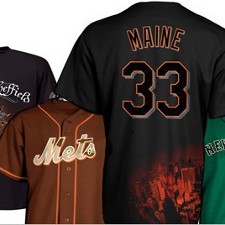
According to Players Association news releases, players from four teams – Twins, Phillies, Yankees, Mets – have designed jerseys, T-shirts and caps for public sale. The apparel is part of the Players Choice Signature Series. The products, the union says, express the players’ “unique personalities and attitudes.”
The union identified the would-be Ralph Laurens as Joba Chamberlain, Curtis Granderson, Andy Pettitte, CC Sabathia, Nick Swisher and Mark Teixeira) of the Yankees; Jason Bay, Carlos Beltran, Jeff Francoeur, Jose Reyes and Johan Santana of the Mets; Cole Hamels, Raul Ibanez, Jimmy Rollins, Shane Victorino and Jayson Werth of the Phillies and J.J. Hardy, Justin Morneau, Joe Nathan, Nick Punto and Kevin Slowey of the Twins.
The Signature Series products are actually not new, the union said. Production began last year when Mets players designed items for sale at the union’s retail store at Citi Field. “The overwhelming success of that program led the MLBPA to expand it in 2010,” the union said.
Miller obviously has never shopped at the store.
PERILS OF PEAVY
When the Chicago White Sox traded for Jake Peavy at the 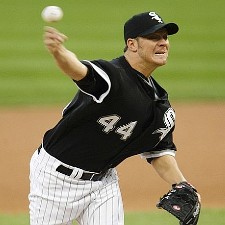 trading deadline a year ago, he was on the disabled list with an ankle injury, and many people wondered how the White Sox could make the deal. Then Peavy made three starts at the end of the season, won them all and did so with a 1.35 earned run average. Great trade, people said, commending the White Sox general manager, Ken Williams.
Now the critics are wondering again.
After struggling with a 7-6 record and 4.63 e.r.a., Peavy is finished for the season, suffering an unusual injury. He is scheduled to have surgery Wednesday to repair a detached muscle near his right shoulder
The injury comes just as the White Sox have reasserted themselves in their division race. Peavy pitched and won two of the games in the team’s 11-game winning streak that catapulted the White Sox into the race. Now that they are right there, they are deprived of Peavy’s services.
There will be no late September comeback for the 29-year-old right-hander this season.
The White Sox can’t even be certain about a comeback next season. Peavy has spoken confidently about coming back, but the injury and the operation are rare enough that doctors apparently aren’t certain what will develop.
THE Z MAN RETURNS
The human eye chart is back.
 Marc Rzepczynski rejoined the Blue Jays last week and emerged with no decision in his start against Minnesota. The 24-year-old left-hander started 12 games for the Blue Jays last season and came away with a 2-4 record. One of his problems last season was home runs. He allowed 9 in 67 innings. In his return last week, the Twins hit two in 5 2/3.
Home runs are not my problem with Rzepczynski. Spelling his name is. I think if I ever encounter the young man, the first question I would ask him is how long did it take him to learn to spell his name. The second question would be whether he ever misbehave in school and had to write his name on the blackboard 100 times.