Where have all the starting pitchers gone? Look quickly and closely, or you may miss them. This has been probably the most unusual post-season ever, marked by manager after manager rushing from the dugout to the mound to summon relief pitchers with the games still in the early innings.
The managers can’t seem to wave their arms, left or right, quickly enough in the directions of the bullpens to call for new pitchers. Joe Girardi, the Yankees’ manager, set the tone in the very first post-season game, yanking Luis Severino only one out into the American League wild-card game with Minnesota. Other managers quickly followed suit.
Through Thursday night’s National League division series final game, 38 pitchers had started post-season games, and fewer than half pitched long enough to qualify for a winning decision.. All of the starters – 38 in number – averaged 12.7 outs a start. Fifteen outs constitute five innings, the number needed to be the winning pitcher.
That 12.7 average is significantly below the average number of outs starters have recorded in recent post-seasons, according to Elias Sports Bureau, though it follows the trend of starters being removed from games earlier than ever:
- 2016 15.3 outs per starter
- 2015 16.5
- 2014 16.7
- 2013 17.3
In a concurrent development, starting pitchers have been showing up in relief roles regularly. Justin Verlander, Chris Sale, David Price, Jon Lester and Jose Quintana all relieved in division series games, creating this economically interesting development: six pitchers with contracts totaling $815.5 million have pitched in relief, and that total includes Quintana’s meager $21 million.
That’s a lot of money to be paying relief pitchers, but clubs are paying a lot of money to have starters pitch fewer innings than ever. The game, to be sure, has changed.
“It’s a changing of the guard,” said Jack Morris, a former pitcher, who was notorious for refusing to come out of games prematurely. He very likely would have throttled a manager right out on the mound if he tried to remove him from a post-season game after an inning or two. “Smoltz and I were talking about it the other day.”
Morris and John Smoltz will forever be linked in post-season baseball legend for their classic duel in Game 7 of the 1991 World Series, one of the most memorable and electrifying games in World Series history. Smoltz pitched 7 1/3 innings for the Braves, departing after two singles in the eighth. Morris didn’t leave until the 10-inning game was over and the Twins had won, 1-0.
I found Tom Kelly at home in Minnesota Saturday and asked him if he had considered taking Morris out.
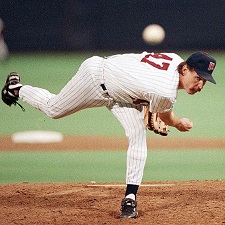 “After the ninth,” the former Twins manager recalled, “I told Jack ‘That’s enough, Jack.’ Three times in 10 days I thought it was enough. He looked up at me. The pitching coach said ‘I think he’s OK.’ Jack said he was OK. After he has pitched the game of his life, how could I take it away from him? The 10th was probably the easiest inning he had. The 10th, not third or fourth.”
Kelly, who managed the Twins to World Series crowns in 1987 and ’91, has been removed from the front lines long enough that he has no insight into why managers are yanking starters as quickly as they have been and doesn’t necessarily agree with the practice.
Refering to comments made by Smoltz, a television analyst of the playoffs, Kelly said, “I agree with Smoltz. He’s pretty much right on. He professed if you’re going to be successful in these games someone has to pitch longer games for as long as you can. I’m all for keeping them out there for as long as you can.”
That philosophy, though, has not been followed this post-season. “Apparently, they have no faith in them,” Kelly said, meaning the starting pitchers, “and have more faith in the bullpen.”
Kelly’s prize pitcher, Morris, said, “Teams have more relievers. They figure if they have them, they should use them.” Morris, who like Smoltz is a post-season analyst, said the two pitchers have talked about the managers’ use of starters and have joked about it, too.
“We’ve said it’s getting close,” Morris said. “We’ve joked about it. But it’s getting closer to starters going through the lineup once and then they’re out.”
The Red Sox offered a good example of what can happen to a team that doesn’t follow Kelly’s and Smoltz’s advice, keeping starters in the game as long as possible. Of their four post-season starters, Doug Fister pitched 1 1/3 innings, Drew Pomeranz two innings and Pat Porcello three. Sale survived the longest but made it through only five innings.
Verlander and Sale crossed paths both as starters and relievers in their teams’ recent division series. The Astros obtained Verlander from Detroit Aug. 31, the last day he would be eligible for the post-season.
Verlander was the starting and winning pitcher in Game 1 of the division series. Sale was the starting and losing pitcher in that game. The pitchers hooked up again, this time as relievers, in Game 4, the one that sent the Red Sox home for the winter and their manager, John Farrell, to the unemployment office.
As in Game 1, Verlander was the winning pitcher, Sale the loser. The Red Sox scored a run against Verlander in 2 2/3 innings while the Astros scored two runs against Sale in 4 2/3.
Price, who earns $31 million a year, was in the Boston bullpen because he spent much of the season nursing an elbow injured and was deemed not to be ready to start a post-season game.
The Yankees’ post-season trendsetter, Severino, lasted briefest of all post-season starters, given the exit after getting only one out. He began the wild-card game by giving up home runs to two of the first three batters, Brian Dozier and Eddie Rosario, with a walk tossed between them. Twenty-three pitches into the game, Severino and the Yankees were down 3-0 in a game they had to win to advance to the division series.
Taijuan Walker of Arizona had the next briefest start, lasting one inning against the Dodgers in their division series opener. He allowed four runs, three on Justin Turner’s homer.
Home runs were not good things for starting pitchers to allow. Corey Kluber, who gave up two to Didi Gregorius in the first three innings, was removed after 3 2/3 and the Indians lost to the Yankees.
GIVE RUNNERS A BREAK
As much as I am not a fan of replay challenges, I have refrained from commenting on them. There was, however, a play near the end of Game 5 of the division series between the National and the Cubs that I believe cries out for correction.
Maybe it cost the Nationals the game and advancing to the league series, maybe it didn’t. Whether or not it did, it’s a ridiculous rule. It affects baserunners, and the rules changes have hurt runners more than anyone else, and it’s time they got something back.
The rule I refer to is the ability of an infielder to tag out a runner if his little finger or toe comes off the base for an instant when he has already slid in safely. Because umpires make the out calls, the fielders will attach their gloves-with-ball to the prone runner until the umpire declares the play over.
Having a runner’s foot or hand come off the base for a second has always been a natural result of a slide, feet or head first. Maybe I’ve missed it these many years I have been watching and covering baseball, but I don’t think so. Certainly no big deal was ever made of it with fielder poised to strike if the runner should breathe wrong and his hand or his foot loses contact with the base for an instant.
Runners can be called out for running over a catcher or taking out a middle infielder improperly to break up a double play. Give the runner something. Not only would that change be right and fair, but it would – note to Commissioner Rob Manfred – also speed up the pace of game.
All of those valuable seconds could be saved because fielders would abandon the base sooner and return to their positions, being in place for the pitcher to throw the next pitch sooner.
On the play that prompted this reaction, a Nationals baserunner, Jose Lobaton, had just singled, giving Washington runners at first and second with two out in the eighth inning and the Cubs ahead 9-8. The Nationals, however, lost the chance to score the tying run because Lobaton was “picked off” first.
That, at least, was the ruling made by the indoor umpires at Chelsea Market in Manhattan, home of MLB Advanced Media. Lobaton had dived safely back to first, but his finger came off the bag for an instant just long enough for the Cubs’ first baseman, Anthony Rizzo, to tag him and have the Chelsea crew call him out for the final out of the inning.
It shouldn’t have happened; it never should happen and it can easily be fixed before next season.