Mike Rizzo spoke the magic words. After watching Stephen Strasburg pitch in a Class AA minor league game last week, the Nationals’ general manager told Washington reporters that Strasburg “certainly needs more work down in the minor leagues.”
Maybe he does, maybe he doesn’t. Maybe Rizzo’s remark was just the latest use of a general manager’s favorite euphemism. Based on developments in recent years, when a general manager offers that observation about a young player, he often means don’t expect to see him until late May or early June. By keeping the player in the minors until then, the team gains additional reserve time, delaying his eligibility for salary arbitration and free agency for a year.
Clubs don’t acknowledge the practice, but the union has been watching it with a questioning eye.
“We are paying attention to that and I would expect arbitration eligibility will be an issue in collective bargaining,” Michael Weiner, head of the union, said. “It has become so obvious.”
The practice does not violate the clubs’ labor agreement with players. As Rob Manfred, the clubs’ top labor executive, said, “Just because a kid has a good spring it doesn’t mean from a long-term development perspective the best thing is to start him in the big leagues. Clubs make decisions for immediate and long-term reasons in the best interests of the club.”
And, he added, “They do have the right to make decisions.”
Weiner doesn’t question the clubs’ right to make personnel decisions, but he is concerned with the way he feels they “manipulate” service time for players before they reach the two-to-three-year level of major league service.
The players in the top 17 percent of that two-to-three class are called “Super Twos.” The category was created as a compromise in the 1990 negotiations that produced a lockout.
“Going to Super Twos was supposed to be a floating threshold that wouldn’t be easy to manipulate,” Weiner said, “but it has become so obvious that this is happening so it will be a part of collective bargaining.” He referred to the bargaining that will take place to replace the agreement that expires in December 2011.
How can clubs affect service time by keeping a player in the minors for the first two months or so of his rookie season?
For service time purposes, a full year is 172 days, 11 days fewer than a full season. That means if a player isn’t called up in the first 12 days of the season, he can’t get a full year’s service time for that season.
Even if he is added to the roster on the 13th day of the season and remains in the majors the rest of the season, a player would finish that season with less than a year of service time. That means he would need six more years to qualify for free agency and three more for salary arbitration instead of five and two.
The exception to arbitration eligibility is the Super Two category so if clubs are intent on affecting a rookie’s service status, he has to miss more than a month of the season. If a team keeps a player in the minors for the first two months of a season, it can assume the player won’t have enough service time to qualify as a Super Two.
The least amount of service time a Super Two has had was two years and 128 days in 1991. In two of the last three years, three of the last five and four of the last seven, the cutoff has been two years and 140 days. This year it was one year and 139 days.
General managers can deny manipulating players’ service time, but just look at the influx of minor leaguers into the majors in late May and early June of last season. Tommy Hanson (Braves pitcher), made his major league debut June 7; Gordon Beckham (White Sox third baseman) June 4; Andrew McCutchen (Pirates center fielder) June 4; Matt Wieters (Orioles catcher) May 29; Sean West (Marlins pitcher) May 23; Kris Medelin (Braves pitcher) May 21.
 David Price, who was sensational for the Rays’ in their 2008 post-season venture, didn’t reappear with the Rays until May 25, 2009. Even with 31 in-season days from 2008, the young pitcher began this season with 164 days of service time, not enough for a year of service.
Price’s teammate, third baseman Evan Longoria, had a similar experience a year earlier, and as a result began this season two days short of two years in the majors.
Longoria’s eligibility for salary arbitration and free agency won’t be affected, however, because the Rays have him under contract, with two option years, through 2016.
Strasburg, the Nationals’ budding ace, also has a multi-year contract, but his is for only four years. Unless the Nationals sign him to an extension, he will be delayed in his eligibility for arbitration and free agency. But the club president, Stan Kasten, said that’s not the reason Strasburg is in the minors instead of the majors, where many people feel he belongs.
“Sometimes that’s a consideration,” Kasten acknowledged of service-time strategy. “But in this case we said let’s be careful and take our time. We don’t want to make a mistake and bring a player up and have to send him back down.”
Strasburg, Kasten said, still has things to learn, “all the things relating to men on base,” for example. “He just didn’t have much experience in college with them.” He mentioned a slide step with runners on base. “Most important you’ve got to become used to pitching on a five-day schedule. In college you pitch once a week.”
“Could he pitch up there today? I’m sure he could, but there are important things for him to learn. We are being careful with him. The emphasis is on the long term.”
Anyway, Kasten added, “How do you know if he will be a Super Two two or three years from now? It’s the same with Drew Storen. How many people thought he was ready?”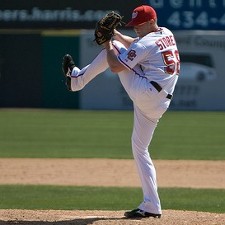
Storen is a closer in the Nationals’ system who, like Strasburg, was selected in the first round of last June’s draft. But while Strasburg signed too late to pitch last year, Storen signed the day of the draft and quickly moved up the chain, finishing the season at Class AA Harrisburg, where he gained 9 saves and allowed no runs in 10 games.
“Then he had a terrific Arizona Fall League,” Kasten said. “He’s been out of college 10 months.”
Kasten’s point was the Nationals chose to let Storen start the season in the minors despite his impressive credentials, but they had reasons for their decision other than service time. Maybe. Not everyone is convinced of that. No one will be surprised if Strasburg and Storen, along with a bunch of other rookies, materialize in the majors in the next month to six weeks.
Watch for these names in boxscores to come:
- Pitchers Phillippe Aumont (Phillies), Aroldis Chapman (Reds), Aaron Crow (Royals), Kyle Drabek and Zach Stewart (Blue Jays), Tanner Scheppers (Rangers), Drew Storen and Stephen Strasburg (Nationals).
- Catchers Jason Castro (Astros), Jesus Montero (Yankees), Carlos Santana (Indians).
- Catcher/first baseman Buster Posey (Giants).
- Infielders Chris Carter (Athletics), Freddie Freeman (Braves), Logan Morrison (Marlins), Dustin Ackley (Mariners), Pedro Alvarez (Pirates), Josh Bell (Orioles), Starlin Castro (Cubs), Lonnie Chisenhall (Indians), Todd Frazier (Reds), Mike Moustakas (Royals).
- Outfielders Desmond Jennings (Rays), Fernando Martinez (Mets), Mike Stanton (Marlins), Michael Taylor (Athletics).
Not all teams play the service game. It would be hard to imagine the Yankees or the Red Sox, for example, keeping a player in the minors for two months if they thought he could help them win games. About halfway through spring training I asked Frank Wren, the Braves’ general manager, if service time would be a factor in their decision on Jason Heyward.
“Not for us,” he said. “If you think you have a club that has a chance to win and he’s ready to be part of that, he’ll be our right fielder.”
Heyward has been the Braves’ right fielder since opening day.
By leaving players in the minors longer than they have to be there, teams can be cheating themselves and their fans. If a player can help a team win but his team keeps him in the minors, it is not doing everything it can to win. That goes to and undermines the integrity of the game.
HALLADAY’S PERSONAL PLAYGROUND
 National League teams are quickly turning into Roy Halladay’s play toys. Four starts, four wins, 3 earned runs in 33 innings, a 0.82 e.r.a. If this keeps up, he may actually become bored and ask for a bigger challenge.
Or the Phillies’ ace may just feel he is entitled to a life of ease after fighting furiously in the American League East for 11 years.
Three of Halladay’s four victories have come over N.L. East teams, Washington, Florida and Atlanta, indicating that the N.L. East will be a little easier to deal with than the A.L. East.
Actually, Halladay fared well with the Yankees, beating them 18 times and losing 6 times. The Red Sox and the Rays, on the other hand, were difficult for Halladay. He has a 14-14 record against the Red Sox and a 12-11 record against the Rays.
The way Halladay has started this season his stiffest competition will come from Tim Lincecum, the Giants’ reigning two-time Cy Young award winner, who is off to a strong start in his bid for No. 3. Like Halladay, Lincecum has won his first four starts, allowing three earned runs in 27 innings for a 1.00 e.r.a.
THE Z’S HAVE IT
Livan Hernandez and Barry Zito are two other pitchers worth watching closely.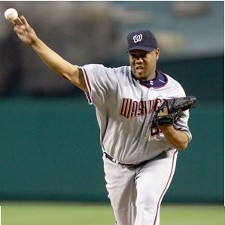
So many teams need pitching, and Hernandez was available to all of them twice in a three-month span, the first time after the Mets released him last August, the second time after he became a free agent last November.
Both times the Nationals signed him. They signed him the second time despite his poor performance for them in eight starts at the end of last season. He had a 2-4 record and a 5.36 e.r.a.
But the 35-year-old right-hander has rewarded them for their faith in him. Hernandez allowed no runs in his first two starts and two runs in eight innings in his third start, giving him a 0.75 e.r.a.
Zito was a major disappointment in the first three years of his seven-year, $126 million contract with the Giants, struggling with a 31-43 record. However, he has begun this season in a remarkably dazzling way. He has won three of his first four starts and compiled a 1.32 e.r.a.