In the first week of June, the Mets embarrassed themselves by putting on sale tickets for up to $50 to a game that had already been played, the first no-hitter in their 51-year history. In the second week of June, the Mets embarrassed themselves by trying to get Major League Baseball to change an official scorer’s call and manufacture the second no-hitter in their history.
Terry Collins, the Mets’ manager, took credit (blame would be more accurate) for the idea of appealing the decision by official scorer Bill Mathews in the first inning of the June 13 game at Tampa Bay. But it turns out that it was suggested to him by Jay Horwitz, the Mets’ vice president for media relations.
The play in question was third baseman David Wright’s fielding of a slow grounder hit by the speedy B.J. Upton. Familiar with Upton since their childhood in Norfolk, Va., Wright knew what he had to do to try to get Upton. He attempted to snag the ball with his bare hand but failed to execute the play successfully.
Mathews called the play a hit, which no one seriously questioned because this was the first inning, the inning, incidentally, in which more no-hitters are broken up than any other inning.
However, eight innings later, when R.A. Dickey had allowed no additional hits, Horwitz, whose job is to make the Mets look good, not bad, suggested to Collins that they could appeal the scorer’s ruling to the commissioner’s office.
“We’re probably not going to win it,” Collins told reporters. “But what the heck? What have you got to lose except to have somebody say no?”
The clubs have a right to appeal scorers’ decisions, but they rarely do. In one instance, in 2008, the Milwaukee Brewers appealed the scorer’s ruling on a ball hit by Andy LaRoche of Pittsburgh against C.C. Sabathia. The scoring review committee upheld the hit, ruling that the scorer’s decision was not “clearly erroneous,” which is the scoring rules standard for judging scorers’ calls.
“This play is a reminder of the difficult decisions that official scorers face,” a statement from the commissioner’s office said.
There was no statement this time, not even a news release announcing the decision by Joe Torre, executive vice president for baseball operations, who did not return a telephone call seeking comment.
Actually, I wanted to ask Torre only one question: what took so long (two days) to make the decision upholding the scorer’s call?
My guess is Torre took his time to be diplomatic, but the Mets deserved no act of diplomacy.
 “We didn’t win,” Collins said. “We didn’t expect to win it. We gave it a try. If we had won it, we would have had another no-hitter and we wouldn’t have to wait another 50 years.” Dickey, he added, “has never had a no-hitter so you give it a shot. That is the process.”
But the rule doesn’t exist to make the process look foolish. Had the Upton-Wright play occurred in the ninth inning, the matter might have been worth pursuing, although even then the inning should not determine the scorer’s call or the review committee’s decision.
In the few days the controversy lasted, Dickey, a man of intelligence and common sense, seemed hard-pressed to answer reporters’ questions candidly. That was understandable. The Mets were supposedly trying to do something that would benefit Dickey, but what pitcher wants to go into the record books with a no-hitter that was manipulated for him?
I could just see the line in the Elias Book of Baseball Records : No-hitter by fiat of Joe Torre.
In shamelessly pursuing an undeserved no-hitter for Dickey, the Mets demonstrated an inconsistent position. En route to his no-hitter, Santana threw a pitch in the sixth inning that Carlos Beltran lined down the third base line. The ball was called foul, though replays showed it might very well have been fair.
The call preserved Santana’s no-hitter, but the Mets saw nothing wrong with that. They certainly didn’t appeal it.
There was a clearer missed call in a 2010 game that affected not just a no-hitter but a perfect game. Armando Galarraga was one out from a perfect game and ostensibly got the 27th out, but umpire Jim Joyce called Cleveland’s Jason Donald safe at first, admitting later that he blew the call.
Those calls were not changed, and neither was the Dickey call.
But I have a question for Collins and Horwitz: In their zeal to concoct a no-hitter for Dickey, did they consider the difference between a game in which a pitcher gives up a hit in the first inning and immediately eliminates the possibility of a no-hitter and a game in which a pitcher doesn’t allow an early hit and has the pressure mount inning after inning to keep the no-hitter intact?
I wouldn’t expect a public relations man to understand that fact of baseball life even if he has worked in the game for a hundred years, but the manager? It was not one of Collins’ shining moments.
It is a good time, however, to raise one of my favorite theories. Some years ago a Baltimore baseball writer coined the fallacy of the predestined hit, which he used to counter the contention that if a player, say, is out trying to steal second and the batter then doubles, the player who was thrown out has cost his team a run.
That, however, is the fallacy of the predestined hit. We don’t know if that batter would have got a hit, and we can’t assume it.
In this instance, to suggest had the Wright play been called an error Dickey would have pitched a no-hitter is the fallacy of the pre-destined no-hitter. We cannot assume that Dickey would have gone on to pitch a no-hitter.
I am left with a relevant question: What foolish thing will the Mets do in the third week of June?
LIKE THE SUN, NATS, O’S RISE IN THE EAST
Editor’s note: The following item was written by Zachary Kram, an occasional guest columnist on this site, who from his home between Washington and Baltimore closely follows the Nationals and the Orioles.
Since the remarkable turnaround and ascent of the Tampa Bay Rays in 2008, the Baltimore Orioles have finished last in the competitive American League East every season, and they have not registered a winning record since 1997.
The neighboring Washington Nationals’ consecutive-losing-season streak is slightly less depressing, extending only back to 2003 (when the franchise was still in Montreal), but the fact remains that, following the Orioles’ losses in consecutive A.L. Championship Series in 1996 and ‘97, the area has experienced pronounced baseball futility.
Both teams were expected to continue this losing pattern in 2012. In a Sports Illustrated preseason preview, for instance, none of the eight writers polled chose the Orioles as a postseason contestant, and only two of eight picked the Nationals – both for the newly-created second wild-card spot.

This line of thinking was consistent throughout baseball, where the Orioles’ September success and role as spoiler of the Red Sox’ playoff hopes last year was considered a fluke, and the Nationals were expected to need at least another year to put together the young pieces and transform themselves into a consistently competitive franchise, much less a first-place team in one of baseball’s toughest divisions.
Seventy-five games into the season, though, these preseason predictions have proved shortsighted. As of today, the Orioles hold the first wild-card spot in the American League and trail only the red-hot Yankees in the best division in baseball.
The Nationals, at or near the top of their division the entire season, exploited a recent six-game winning streak that propelled them to a sizable lead on second-place Atlanta. Before losing the first two games to the Yankees in their weekend series, moreover, the Nationals held the second-best record in all of baseball, wildly exceeding even the most optimistic of preseason expectations.
The recipe for each team’s turnaround has been strikingly similar. Both teams have relied on an improved starting rotation bolstered by imports: Jason Hammel, acquired from Colorado, and Wei-Yin Chen, signed from the Japanese League, for Baltimore; Gio Gonzalez, centerpiece of a trade with Oakland, and Edwin Jackson, signed as a free agent from St. Louis, for Washington.
Following these starters in close games is a task left to each team’s strong bullpen, again fortified by other unheralded pitchers. Of the Orioles’ top five relievers, all with sub-2.00 earned-run averages, only one, Jim Johnson, pitched for the Orioles last season; the rest are other teams’ cast-offs. Pedro Strop and Darren O’Day (Rangers), Luis Ayala (Yankees) and Matt Lindstrom (Rockies) have all impressed in their changes-of-scenery and new Baltimore uniforms.
The Nationals’ strong bullpen was constructed by a slightly different method, as the team’s top relievers all hurled for Washington last season. (Brad Lidge, the only new member, has struggled the most, his return from injury dampened by a 9.64 e.r.a. in 11 appearances.)
Yet its dominance is similarly a large factor behind the Nationals’ pitching stinginess and subsequent ascension to first place.
Moreover, the helmsmen behind the two teams must be given credit. Baltimore is simply the latest in a line of Buck Showalter-led teams that have undergone vast improvements soon after he assumed the manager position. Davey Johnson, incidentally the Orioles’ manager during their last run of success, has built upon prior manager Jim Riggleman’s foundation and brought the Nationals to a new level of consistency.
The two franchises’ similarities belie how greatly the public perception of these two contenders differs. The Nationals are America’s darlings, led by two of the most exciting young players in baseball in Stephen Strasburg and Bryce Harper.
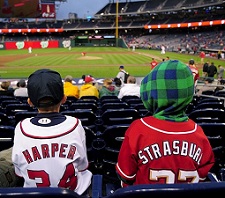 Routinely featured in the early highlights on ESPN and on Sports Illustrated covers, the Nationals have captured the public’s attention and currently rank sixth in road attendance, indicating that fans in other cities come in droves to the ballpark to see the youngsters play.
Baltimore, however, sits at 25th in road attendance, and its stars, Adam Jones and Matt Wieters, are not afforded the same level of exposure to the average fan. Jones has played his way into a lengthy contract extension, but between Harper’s home runs and stolen bases and Strasburg’s strikeouts – he was the first pitcher this year to reach 100 – there is little room for Jones’s .310 batting average and 18 homers to stand out.
Around the Orioles, there also remains a heavy pallor of doubt that the team’s early success will simply give way to the usual losing streaks and suffering at the hands of its powerful division-mates in New York, Tampa and Boston. Much like the Pirates last year, these Orioles, the prevailing thinking goes, do not have the talent to sustain a winning record and will not be able to break the lengthy streak, currently sitting at 14 years.
Over the past few years, the Orioles have teased their fans with the taste of victory in April and May before fading in the summer months. The team’s six-game losing streak at the end of May gave credence to these doubts, yet the team rebounded nicely and has won two of three series since, including a sweep over the similarly surprising Pirates.
Now that the season is nearly half over, it seems that the Orioles are at least superior to their predecessors in terms of sustainability.
Washington, meanwhile, has been gripped by Nationals fever, with home attendance continuing its upward climb, having increased every year since 2008.
The sports section of the Washington Post has also fallen prey to the tantalizing excitement that a winning record and young stars provide, allocating front-page treatment to the team previously relegated merely to the baseball pages.
In this regard, the greater preseason expectations for the Nationals, expected at least to initiate their move out of the National League East cellar and show flashes of potential for future seasons, have contributed to the continued excitement surrounding them.
The presence of Strasburg and Harper, and their new dominance of the Washington D.C. jersey market, certainly help as well.