The question was perfect. It was about the difficulty the Tampa Bay Rays have had attracting fans to their park in St. Petersburg and what their future might be. The question was asked at a panel discussion on the business of baseball held last week by New York University.
It was perfect because it enabled me to raise once again a proposal I have made in print twice in the past 10 years. Major League Baseball would do well, certainly wouldn’t suffer, if it lopped the state of Florida off its map.
That’s right, just slice it off and let it slip into the Atlantic Ocean, the Rays and the Florida Marlins washed away with the rest of the detritus.
I first proposed this geographic act in May 2001. At the time the owners were discussing eliminating two teams – contraction, they called it – and Montreal and Minnesota were the most likely candidates to be contracted.
However, I thought the Marlins and the Devil Rays, as they called themselves before they exorcised the Devil, would be a more worthy pair.
As it turned out, no teams were contracted. Commissioner Bud Selig’s threat to eliminate two teams was a negotiating ploy for the talks with the union for a new labor agreement.
But less than five years later, in November 2005, Florida and Tampa Bay were still miserable franchises, and I reprised my proposal. As in the first instance, the idea went nowhere, and the two-time World Series champion Marlins and the newly anointed Rays survived.
Since then, the Rays, under a new owner, Stuart Sternberg, have developed into a legitimate major league team, reaching the playoffs twice in the last three years. But Tampa Bay residents have little interest in the Rays and show no intention of supporting them.
It was the small crowds at Tropicana Field on the team’s last homestand of the season that prompted Evan Longoria, the Rays’ third baseman and eloquent player spokesman, to speak out about the missing fans, and his comments prompted me to think that it was time to renew my call for a drastic geographical adjustment.
“We’ve been playing great baseball all year,” Longoria told reporters on a night when 12,446 showed up for a game in which the Rays could have clinched a playoff spot. “Since I’ve been here, the fans have wanted a good baseball team. They’ve wanted to watch a contender. And for us to play good baseball for three years now, and for us to be in a spot to clinch again and go to the playoffs, we’re all confused as to why it’s only 15,000 to 20,000 in the building.”
Attendance was so poor that last homestand that for the final home game the Rays gave out 20,000 free tickets and finally filled the 36,973 seats.
The team’s consistently low attendance, Longoria said, was disheartening.
 “In 2008, when we clinched, this place was packed,” he added. “It’s kind of like what else do you have to do to draw fans in this place. It’s actually embarrassing for us.”
Columnists criticized Longoria for criticizing the fans. One said it was like the owner of a bagel shop criticizing his customers for not buying more bagels. I would suggest there’s a difference between bagels and baseball players.
As well as players are paid today, they still want other rewards, and one of those rewards is the appreciation of the fans. If they are winning and playing hard to win a playoff spot, they want the vocal and emotional support of their home fans.
If the owner of a bagel shop criticizes his customers and they don’t like it, they can find another bagel shop. What are the Rays’ fans going to do if they don’t like what Longoria said, stay away in greater numbers?
In 2008, when the Rays won their first division title, their attendance increased from 1.39 million to 1.81 million. This year, however, attendance slipped by 10,000, from 1.875 million to 1.865 million’ The half a percent decline was similar to the major league decline of 0.4 percent, but the Rays had one of the best and most exciting teams in the majors.
Sternberg, the Rays’ owner, declined a request for an interview, but he is feeling the economic hardship created by a team playing in a bad park and not generating enough revenue through attendance. He announced last month that he would cut the $72 million payroll next season’ meaning it will be difficult for the Rays to retain Carl Crawford, Carlos Pena and Rafael Soriano as free agents.
Commissioner Bud Selig did not express concern about the Rays. “Stu Steinberg and I have had a lot of discussions and we’ll continue to have them” Selig said. “Operating in the facility they play in has never worked and never will work. But Stu Sternberg is a bright young man and will be all right.”
Sternberg, who made his millions working in the financial securities industry in New York, has done a good job overcoming the mess that Vince Naimoli, the founding owner, made of the Tampa Bay franchise. The Marlins have also had to overcome a disastrous act of an original owner.
After the 5-year-old Marlins won the 1997 World Series as a wild-card entry, their owner, H. Wayne Huizenga, demolished the team rather than pay the players.
Remarkably the Marlins won the World Series again in 2003, and this time a different owner, Jeffrey Loria, waited two years before he dismantled the team.
From two-time World Series champions, the Marlins became welfare cheats. They were caught earlier this year using their revenue-sharing proceeds on expenses it wasn’t intended for, and to avoid a union grievance that even the commissioner’s office wasn’t going to fight, they agreed to start spending the money on players.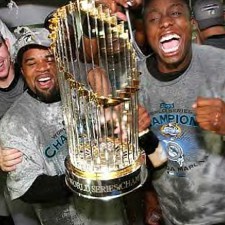
Compounding their problems and their public persona, they were found to have made a profit in recent seasons while taking in huge amounts of revenue-sharing money and banking it.
With 1.5 million in attendance, the Marlins had the smallest crowd total in the National League for the fifth consecutive year.
Jeffrey Loria, the Marlins’ owner, didn’t return a call seeking a discussion on the Marlins’ circumstances. Loria used to return calls and was willing to talk to reporters. But welfare cheats find it better to remain in hiding.
Selig, meanwhile, said all will be right with the Marlins when their new park is completed. “The Marlins are building a new park,” the commissioner said. “It’s half up and I feel good about it. The Marlins will enter a new era in 2012.”
I have some doubts about that happening. Certainly a new park attracts fans, but the Marlins have soured baseball fans in south Florida to the extent that they may not go to the new park any more than they have gone to the old one.
Furthermore, if the new park produces large amounts of revenue, the Marlins, unlike the Minnesota Twins with the increased revenue from their new park, may not spend it on players. With Loria, old habits may die hard.
Three theories are often offered for the problems of Florida teams: 1. Most baseball fans in Florida remain fans of the teams in the cities from which they migrated; 2. The state has too many elderly people whom they can’t lure to games at night or in the summer heat; and 3. Fans are accustomed to paying far less for tickets to exhibition games and don’t want to buy the more expensive tickets for regular-season games.
None of that is going to change. Let the final verdict, then, be rendered. The Rays’ future in Florida is highly questionable, and the Marlins have lost the right to continue their shoddy, shady operation. It’s time to say goodbye to Florida. It will not be missed, and Major League Baseball will be better for its absence.
SMITH CONNECTS AGAIN
After missing each other in the days leading up to the Pittsburgh Pirates’ celebration of the 50th anniversary of their 1960 World Series triumph over the New York Yankees, Hal Smith and I finally connected after he returned home to Columbus, Tex.
“It was great,” Smith said of the Oct. 13 festivities. “There were nine of us there. Three couldn’t make it.”
 Another of the nine players who was there was Bill Mazeroski, whose home run leading off the ninth inning of Game 7 won the Series, 10-9. Smith clubbed a three-run homer in the eighth inning that put the Pirates ahead, 9-7.
“Everyone I met told me they never forgot my home run because it was the most important,” the 79-year-old former catcher said.
Indeed, without Smith’s home run, Mazeroski’s would not have become one of baseball’s most memorable. Smith’s home run is most memorable to me because I wrote about it after that game, my second World Series game as a reporter for the Associated Press.
Many years later I discovered a painting by Andy Jurinko, a New York artist, of Smith hitting the home run. A lithograph of the Forbes Field scene hangs on a wall in my office.
Last week Yogi Berra, who was the Yankees’ left fielder that day, recalled that had Jim Coates, the Yankees’ pitcher, covered first base on Roberto Clemente’s two-out grounder to Bill Skowron wide of first, Clemente would have been out and Smith would not have batted that inning with two on.
“Sure he would have been out, but he didn’t go to first,” Smith said. “Yogi tells me that all the time when I see him.”
But Clemente was safe, and Smith got to hit his home run.
”I was trying to hit the ball hard to get at least one run in,” Smith recalled. “I was trying to hit a line drive except I hit it higher over the left-center field wall.”
After the game, Smith said, “a young boy brought the ball to the locker room. I gave him a ball autographed by all the Pirates, and he gave me the ball I hit.”
Those were simpler times. The ball didn’t have to be authenticated, and it didn’t have to be auctioned. It rests in Smith’s home 75 miles west of Houston. Written on it is “1960 World Series 3-run homer.”
Smith retired after the 1964 season, but he is linked in two ways to this year’s playoffs. He was in the gargantuan 17-player trade between the Yankees and the Baltimore Orioles in November 1954, and one of the seven players going in the opposite direction was Don Larsen.
Two years later Larsen pitched a perfect game in the World Series, which was the only post-season no-hitter until Roy Halladay pitched one this year in the division series.
Then there is Smith’s rooting interest in the National League Championship Series. It’s the San Francisco Giants, whose third base coach, Tim Flannery, is Smith’s nephew.
ALDERSON READY TO RETURN TO PAST
Sandy Alderson, who hasn’t been a general manager since 1997, may become the next general manager of the Mets’ succeeding Omar Minaya, who was fired two weeks ago.
It seems likely that Alderson will get the job if he and Jeff Wilpon, the owner’s son and chief operating officer, can agree on their relationship in the Mets’ front office. Alderson will not agree to take the job unless he is convinced he will have free reign and no interference from Wilpon.
Fred and Jeff Wilpon have said that Jeff did not interfere with Minaya, but executives of other clubs have scoffed and snickered at that claim. Minaya, who has great respect and admiration for Fred Wilpon, has declined to discuss his six-year tenure as the Mets’ general manager.
Why would Alderson return to the general manager’s job after having been the president of two teams, Oakland and San Diego, and an executive vice president of Major League Baseball?
For one thing, he may want to get back to working for a team instead of working for the commissioner’s office, where he is revamping baseball’s operations in the Dominican Republic. He could always move up to a club’s presidency if somebody wanted him for that role.
For another, the Mets’ job would give him great visibility for possible future jobs, commissioner, for example, if the incumbent decides to retire before Alderson grows too old for the job.
The fact that Alderson interviewed for the Mets’ job last week indicates that he is interested in it. He wasn’t just going through the motions.
“Clearly he’s very serious,” a baseball executive said, adding, “He’s a great executive, a very talented guy.”
In addition, said another baseball man who sees the Mets as a better team than maybe even the Mets do, “It’s not like he’d be coming in and trying to turn around a team that lost 100 games. He could look smart fast.”
Meanwhile, to avoid violating the commissioner’s guidelines for hiring general managers and managers and consider members of minorities, the Mets plan to interview Al Avila, assistant general manager of the Detroit Tigers.
According to a baseball person who knows him, Avila was concerned that he would be the token minority interview and that he wouldn’t be a serious candidate for the job. But the friend said he told him “You gotta go.”