Negotiators for baseball’s players and club owners have details to work out on several issues before they have a new labor agreement, but Jim Crane, a Houston businessman, has a deal of his own because he accepted an offer he couldn’t refuse.
Crane was expected to be approved as the Astros’ new owner at the owners’ meeting in Milwaukee Thursday.
Crane’s purchase of the Astros’ will trigger realignment of the National and American Leagues, most likely for 2013 because the 2012 schedule has already been completed, although Major League Baseball officials may have a revised 2012 schedule in their pocket ready to pull out at a moment’s notice.
The Astros will move to the American League, giving each league 15 teams instead of having 16 teams in the National and 14 in the American. The Astros will join what has been a four-team A.L. West since 1994.
The new alignment will require interleague play for all 162 games of the season.
Crane, who is buying the Astros from Drayton McLane Jr., agreed to the switch because Commissioner Bud Selig made him a two-tier offer he couldn’t refuse: You don’t get approval to buy the team if you don’t agree to move, and the other 29 clubs will contribute about $1 million each of their central fund money to defray part of the estimated $680 million purchase price of the Astros.
It remains to be seen how Astros’ fans will greet the switch, but followers of ESPN.com must have been captivated, not to say fascinated, the past couple of weeks by its coverage of baseball’s labor talks. I know I have been, and I have written probably more baseball labor stories than anyone living or dead.
In the space of less than two weeks, ESPN.com raised the possibility of a serious problem in the talks and practically had a new labor contract signed, sealed and delivered
According to the Web site, in articles loaded with anonymous sources, a new labor deal has gone from being “still stuck in negotiating limbo” to having the “stalled” talks taking “a step forward” to the owners and players being “on the verge of a new labor deal” that could be concluded by the end of this week.
Now it’s always possible that labor negotiations can proceed the way ESPN.com reports described the baseball talks, but the outcome of these talks has never been in doubt. The ESPN.com version of the talks demonstrates a naiveté about labor negotiations.
“I think you have a valid point,” one labor negotiator said.
There was no “negotiating limbo,” and the talks were not stalled. There was the usual ebb and flow of talks. Sometimes the negotiators have to pause or take a step backward to try to take two steps forward.
Here’s one way negotiations work: One side makes a proposal; the other side rejects it. The second side makes a proposal; the first side rejects it. This is how the two sides can get to a compromise that produces a deal. It doesn’t happen overnight, and the time it takes to get from Point A to Point B does not constitute limbo.
Of course, there are breakdowns in communications between management and labor, and they create limbo. The National Football League experienced that earlier this year. The National Basketball Association has that problem now.
Baseball, however, has escaped that syndrome. Although no negotiations run 100 percent smoothly, these were primed to get as close to that ideal as any ever have in professional sports.
The sport is flourishing, awash in money. There’s enough for everybody with no need to fight over it. Over the past 15 years of labor peace, players and owners forged a new relationship in which they can meet amicably without threat of a strike or a lockout.
Some of the owners still greedily thirst for control over players’ salaries, but the owners as a body gave up their quest for a payroll cap after the disastrous 1994-95 strike and sought salary control along other avenues. In these negotiations, for example, the owners, at Commissioner Bud Selig’s direction, sought a system that would place a lid on signing bonuses paid to amateur draft choices.
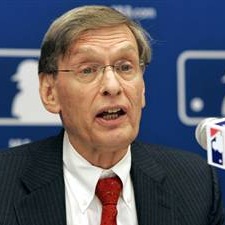 The union, however, opposed the hard slotting system, and Selig was smart enough not to take a hard-line stance that could provoke a strike. I would repeat something I wrote earlier this month about a management person saying that Jerry Reinsdorf, the Chicago White Sox chairman, told Selig the players wouldn’t strike over slotting, but Selig was incensed that I had invoked Reinsdorf’s name in connection with his decisions, and I don’t want to incite him again so soon.
The reality is, however, that Selig doesn’t want a work stoppage. He has lived through eight stoppages (five strikes, three lockouts), and he doesn’t want a ninth that would wreck his legacy on his way out of the door next year – if he follows through on his threat to retire.
Seeing that the union wouldn’t agree to his idea of a hard slotting system, Selig apparently has accepted an alternative in which teams would pay a luxury tax if they exceeded the negotiated total of bonuses clubs could pay draft choices.
The tax threshold and rate are to be determined. If a club exceeds the draft threshold a second time, the tax rate is expected to rise. It hasn’t been decided, but it’s possible that a third time could result in the loss of a draft choice.
Other matters have to be determined too, including the threshold and tax rate of the luxury tax, or competitive balance tax on payrolls, which only the Yankees pay every year.
ESPN.com would have you believe, according to a Nov. 4 post, that the negotiators will come up with a new tax system. In fact, ESPN.com discovered that the expiring labor agreement has a provision that eliminates the luxury tax after the 2011 system.
Known as a sunset provision, paragraph I of Article XXIII says the tax will not survive the expiration of the agreement. ESPN.com seemed to make a big deal of it, but the provision has been in the agreement for six years and comes as no surprise.
Furthermore, the two sides will have a new agreement before long, and it will include a luxury tax for next season.
But ESPN.com, trying hard to create a story where none existed, said, “Nevertheless, the expiration of the tax has created one more hang-up in the labor negotiations, adding at the end of the post, “So with neither side moving and the negotiating clock ticking, a labor deal that once seemed imminent remains in limbo. And the first casualty, at least for now, is the current luxury-tax system, which has been in place since 2003.”
But the luxury tax lives, though details remain to be worked out, as is the case with some other issues as well. Agreement is close.
“The deadline is Dec. 11,” said an official, referring to the expiration date of the current agreement, “and there will be a deal,