Readers may nominate other candidates, but my choice for the most significant baseball question that has no sensible answer is this:
Why do baseball people persistently pursue pitcher-pampering practices when pitchers keep getting hurt in spite of them?
My runner-up question:
Why do players persistently slide head-first when that practice produces unnecessary injuries to hands and heads?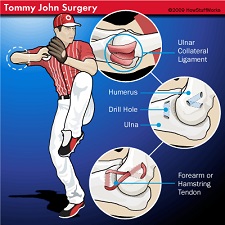
This second question was prompted by Josh Hamilton’s recent head-first slide into first base. In so doing, the Anaheim outfielder struck the base with his left thumb, tearing a ligament and a capsule. The Angels said he will miss six to eight weeks following surgery.
Hamilton, who had a poor first season of his 5-year, $125 million contract with the Angels last year, was hitting .500 entering the game in Seattle in which he was hurt. If that performance was the beginning of a comeback, he’ll get to make Comeback II when he resumes playing in May or June.
A few days before and a few days after Hamilton tried to shake hands with first base, Yasiel Puig, an outfielder with the team that actually plays in Los Angeles, and Mike Napoli, Boston’s first baseman, tried Hamilton’s trick and were fortunate to avoid his serious injury.
Puig hurt his left thumb, and Napoli dislocated the ring finger on his left hand.
As bad as those hand injuries might be, however, they are dwarfed in number and time-to-be-lost by a cascade of pitchers’ elbow injuries. This year alone, since the start of spring training, there has been what seems like a full-blown epidemic of torn elbow ligaments.
Matt Moore of Tampa Bay was the latest addition to the roster of pitchers with torn elbow ligaments. He was scheduled to have surgery Tuesday. Meanwhile, Josh Johnson, San Diego’s ailing starter, had a doctor’s appointment scheduled to find out if he needed his second elbow-ligament operation.
Major League Baseball loses many millions of dollars in contracts of pitchers who spend a year or more recovering and rehabilitating from what is popularly known as Tommy John surgery, the transplant of a tendon to replace the ulnar collateral ligament in the pitching elbow.
Although teams pay pitchers those millions while they recuperate, the person getting rich from the injuries is Dr. James Andrews, who has succeeded the late Dr. Frank Jobe as the orthopedic-surgeon-to-see about the torn elbow ligament.
There’s another doctor, a doctor of exercise physiology, Mike Marshall, who did not join in the praise for Jobe when he died recently.
“I’ve said the worst thing that happened to baseball was Dr. Frank Jobe,” Marshall said in a telephone interview last week. “People thought he was a magic man.”
Jobe created Tommy John surgery when he performed John’s elbow transplant in 1974, salvaging the left-hander’s career. The operation grew and grew, becoming the standard procedure for elbow ligament tears. Why try to rehabilitate the injury when it can be fixed in a 1-2-3 operation?
“The general managers have given wellness of pitchers over to orthopedic surgeons,” said Marshall, a record-setting relief pitcher with six teams from 1967 through 1981. “I look at it and it’s sickening to see what they’re doing. It’s malfeasance. They don’t hold pitching coaches accountable for injuries their pitchers have.”
Why do pitchers keep incurring those injuries without prompting baseball to do anything to try to prevent the resulting flood of injuries?
“I’ve been asking that question for a lot of years,” Marshall said.
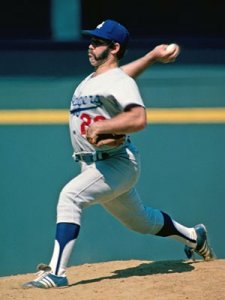 Marshall, who pitching for the Dodgers in 1974 relieved in 106 games, pitched 208 1/3 innings and won the National League Cy Young award, tried for many years following his retirement to change the culture of pitching. He operated a pitching school in Florida and produced videos of his pitching techniques.
Marshall, however, was too radical for the baseball establishment, and no organization was willing to be different enough and bold enough to adopt his methods, even to try his methods with a small group of pitchers who had arm injuries. General managers would apparently rather sit by and watch their pitchers develop elbow injuries than see if the Marshall plan might work.
“When other coaches see what we’re doing they don’t like it,” Marshall said. “I look at it and it’s sickening to see what they’re doing.”
Marshall, 71, said that over the years he spoke with several baseball officials but with no success in advancing his cause.
“Bill Veeck,” Marshall said of the late club owner, “came up to me and said ‘I want to know what you know.’ He said he wanted me to be pitching coach for life.”
Veeck, a maverick owner, and Marshall, an equally maverick player, might have made a great match, but neither Veeck’s second tenure as owner of the Chicago White Sox nor his life lasted long enough for Marshall to connect with the owner, who was as much a pariah in the baseball establishment as the pitcher became.
Among other executives Marshall recalled he talked with were Jim Bowden, who was the Cincinnati general manager, and Stan Kasten, president, and Mike Rizzo, general manager, in Washington.
“Bowden sent me three pitchers to work with, but he got fired in the middle of the season,” Marshall said. “The Reds reneged on our agreement.”
Kasten, who knew Marshall from a previous stop, “asked Rizzo to meet with me,” Marshall said. “We met and he said ‘this is great stuff. I’ll call you.’” That call, the pitcher said, never came.
Rizzo remembered it differently. “I vaguely remember that,” he said. “He lived in Florida. The way I left it was I would encourage him to come to our spring training camp, but we never hooked up.”
Whatever developed and why and how it did or didn’t, Marshall never met with Rizzo or any other baseball executive. Discussing torn elbow ligaments, Rizzo said the Nationals “have a couple theories that we’ll be trying to investigate internally. We don’t want to share it with anyone. We have a way of rehabilitating arms, but we’re trying to do it internally.”
The Nationals have had a few elbow ligament transplants, most famously for Stephen Strasburg in 2010, but Marshall’s efforts have been aimed at prevention, not rehabilitation, and baseball doesn’t appear to be doing anything to try to prevent the injuries.
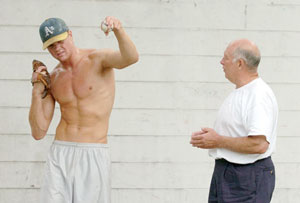 “I was naive enough to think people would want to know what I know,” Marshall said. “Nobody had said ‘what do you say you teach our guys to pitch without hurting themselves?’ They don’t understand what they’re doing isn’t working.”
Marshall was and is not a proponent of restricting a pitcher’s innings or pitches. “You must train to maintain a level of fitness,” he said.
For a pitcher, an integral part of training is throwing, not pampering his arm. Dr. Andrews said in an interview recently that a contributing factor in elbow injuries to high school pitchers is their amount of pitching – for two teams at a time, all-year round, showcases. It’s all too much for a teenager.
That may be so, but minor league pitchers don’t fit in that category. They need to build up their arm strength, and they need to throw to achieve that goal.
General managers and managers now impose pitch and game restrictions on pitchers at all levels. That’s not how Ferguson Jenkins and Jim (Catfish) Hunter and Tom Seaver grew up. Seaver, on the other hand, was in the forefront of the change from four-man to five-man rotations, which was another way of limiting a pitcher’s work.
According to Jim Gates, librarian at the Hall of Fame, he could find no published study that traces the evolution of the four-man rotation into the five-man rotation.
Seeking an answer to my question, Gates said he reviewed American League starting pitching data between 1970 and 1990.
“This quick review,” he wrote in an e-mail, “does indicate that most teams used the four man rotation at the beginning of this period, but had transitioned to the five man rotation by the end of this 20 year period.”
I could be wrong, but I believe one of the first teams to switch to five starters was the New York Mets in the late 1960s. The Mets also were one of the first teams to pamper their pitchers, beginning in the minors, by having them throw less than pitchers did in earlier years.
They also were one of the teams that suffered the most from injuries to young pitchers despite their pampering practices. The names of Paul Wilson, Bill Pulsipher and Jason Isringhausen come immediately to mind.
The Mets drafted Pulsipher and Isringausen in 1991, Wilson No. 1 in the country in 1994. Pulsipher and Isringhausen joined the Mets in 1995, Wilson in ’96. All three had damaged and shorter careers than expected. The Mets’ coddling of them didn’t help them or the Mets.
YANKS HAVE NEW DYNAMIC DUO
During the off-season New York Yankees’ very likely figured that CC Sabathia and Hiroki Kuroda would be the team’s top two starters. Only 18 games into the season that distinction looks like it will go to Masahiro Tanaka and Michael Pineda.
Yes, it’s too early to make such projections, but Tanaka and Pineda have been so impressive in their early starts that it got me wondering. With the assistance of Elias Sports Bureau, I satisfied my curiosity.
Which two pitchers combined for the most victories in a season in Yankees’ history?
The answer is the 1928 pair of George Pipgras (24) and Waite Hoyt (23), total 47.
In 1934, Lefty Gomez (26) and Red Ruffing (19) combined for 45, and their total was matched by Whitey Ford (24) and Jim Bouton (21) in 1963 and Ron Guidry (25) and Ed Figueroa (20) in 1978.
ESPN SPEAKS, NAMES SPEAKER
ESPN operates 24 hours a day, 7 days a week. That is, their various channels follow that schedule. Their executives? They apparently operate on a much more limited schedule.
For a column last week on ESPN.com’s use of anonymous quotes, which the players’ union suggested bordered on collusion, I tried to find out if the web site had a policy on anonymous quotes.
In a response to my e-mail, Kristie Chong Adler wrote:
“While we appreciate you reaching out to allow us to provide comment, I’m sure you can understand that we were pretty disappointed that we weren’t given an earlier heads up than Saturday night for a Sunday morning story. We, of course, have a policy when it comes to unnamed sources, and could have provided you with a quote from Patrick Stiegman (VP and Editorial Director, ESPN Digital & Print Media), had we been given more time. If you are still seeking context on our end, we can provide.”
I replied that the only reason I sent the e-mail Saturday night was that I had received no response to at least two telephone calls Friday.
However, Adler sent a comment from Stiegman on Monday. I wasn’t able to read it until Thursday because I was preparing for and observing our holiday of Passover. When I decided Friday that I would depart from my usual practice and run a belated response to a column that had already been posted, I advised the ESPN publicist that I would like to speak to Stiegman about the policy.
Adler then wrote: “Given the late notice and the holiday weekend, I’m not sure Patrick will be available to discuss. I will check, but just a heads up.”
So I did not get to ask the vice president and editorial director about this policy statement:
“ESPN.com has a defined standard in regards to anonymous sources, which includes a thorough review process to ensure that the information is both substantive and substantiated and that anonymity is warranted.”
I suppose ESPN can justify for its own satisfaction that an anonymous quote is “substantive and substantial,” But all eight people in the article primarily written about were unnamed, and 15 of 16 people in a second article I mentioned were not identified.
In both instances, that’s a lot of substance not identified. I would still like to talk to the ESPN executive to find out how the web site justifies its policy as it pertains to the articles quoted – not anonymously.