Four weeks ago, when the Hall of Fame announced the ballot for its “Modern Baseball Era” election, I speculated that the 10-man ballot had been rigged so that no one could get in the way of Marvin Miller’s long delayed election. Miller had appeared on a Hall’s veterans ballot six times and had been rejected six time.
In Miller’s 10- year period of rejection during his lifetime (he died in 2012), he saw Bowie Kuhn elected to the Hall, one of the most undeserved elections in the Hall’s history. Red Barber, the renowned baseball announcer, once declared that the three men who had made the greatest impact on baseball were Babe Ruth, Jackie Robinson and Marvin Miller. He did not mention Bowie Kuhn, the baseball commissioner from 1969 to 1984.
Another election is upon us, and I have to admit I’m not so sure about my November speculation. If the Hall’s historical overview committee rigged the ballot to ensure Miller’s election, why have Hall officials once again stacked the 16-man electorate with owners and management officials, the types who have always voted against Miller, or have never voted for Miller?
Among the 16 voters are owners Bill DeWitt of St. Louis, Bob Castellini of Cincinnati and David Glass of Kansas City, who I think would rather have the Royals lose Game 7 of the World Series than see Miller get in the Hall of Fame.
Joining DeWitt, Castellini and Glass in Sunday’s meeting and vote in Orlando, Fla., are John Schuerholz, vice chairman of the Atlanta Braves; Paul Beeston, president emeritus of the Toronto Blue Jays, and Sandy Alderson, general manager of the New York Mets.
A seventh Miller rejection would require only five of those six voters to spurn Miller because a candidate needs 75 percent of the electorate, or 12 of the 16 voters. Five no votes would leave only a maximum of 11 votes for Miller.
To be sure, I don’t know how the six management members will vote. I don’t know how owners and club executives have voted in past elections when Miller was on the ballot. But it seemed to be pretty clear from the outcomes of those elections that Miller did not get the votes of owners and club executives.
In fairness, I should recall that in his first two times on the ballot, in 2003 and 2007, Miller failed to get 75 percent of the vote from the players he represented as executive director of the Major League Baseball Players Association. In those elections, the electorate consisted of players in the Hall of Fame.
In the first election, Miller received 35 of 81 votes, or 43.2 percent. In the second, the Hall of Famers gave Miller 51 of 84 votes, or 60.7 percent.
Why didn’t the players vote for Miller? Can anyone understand why players do what they do?
More than one person has told me that players who are in the Hall don’t want anyone else joining them. They don’t want to share their prestige. I was once told that Robin Roberts, one of three players who recruited Miller to head the union, was said to be upset with Miller because, the HOF pitcher said, Miller said he wouldn’t take the players out on strike. I would guess that Roberts heard what he wanted to hear, but Miller never made such a promise or commitment.
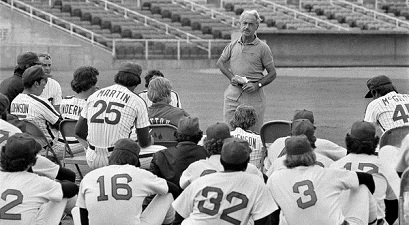 I also have heard this story. After the first election, Reggie Jackson encountered Terry Miller, Marvin’s wife, who berated him for not voting for her husband. Jackson reportedly defended himself by saying he thought the Hall of Fame was only for players. Terry Miller set him straight, and in the 2007 election Jackson voted for Miller.
The Hall’s board of directors changed the voting format after Miller’s second election. They put the ballot before a committee of 12 voters for his next two appearances on the ballot, and then changed the committee to 16 voters. Miller complained that whenever he got close to election, the Hall’s board changed the format.
Whether intended or not, that was true some years, but the 16-man voting format remained in place for the 2013 election after Miller fell one vote short of election in 2010.
Besides the six owners and executives, this year’s voting committee includes six HOF players: George Brett, Rod Carew, Dennis Eckersley, Don Sutton, Dave Winfield and Robin Yount; HOF Manager Bobby Cox and three media members: Bob Elliott, Jayson Stark and Steve Hirdt
On the ballot with Miller are Steve Garvey, Tommy John, Don Mattingly, Jack Morris, Dale Murphy, Dave Parker, Ted Simmons, Luis Tiant and Alan Trammell.
If any of these players is elected, it most likely will be Morris. He came close near the end of his 15-year run on the writers’ ballot. In his last four years he received 311, 382, 385 and 351 votes. In his next-to-last year on the ballot he received 67.7 percent.
The new metrics that younger writers have jumped on work against Morris, but the older members of the voting committee aren’t very likely to be influenced by them. Brett, Carew, Winfield and Yount played against Morris in the American League and know how good he was.
As for Miller, if any of the voters, particularly the management voters, want to leave him off their ballots because of what he did in creating free agency and causing salaries to soar, they have a ready-made excuse. In 2008, after three embarrassing rejections, Miller asked the Baseball Writers Association to leave him off the ballot.
HOF officials, however, put him on the 2009 ballot and subsequent ballots despite the strong objection of Peter Miller, Marvin’s son. Peter Miller has said clearly that if his father is elected, no family will appear in Cooperstown in July to represent Miller.
I may turn out to be wrong about the rigged ballot, but if Hall officials were serious about electing Miller despite his wishes, they had a way of doing it without rigging the ballot. They could have replaced some of those six owners and executives with former executives of the Players Association: Richard Moss, Don Fehr, Gene Orza.
They also could have chosen a neutral observer, Fay Vincent, the former commissioner, who has a high regard for Miller and his place in baseball history.
But if any of those former baseball participants had been given one or more spots on the voting committee, Miller might have actually been elected, and Jane Forbes Clark, the narrow-minded HOF board chairman, might have suffered a stomach ache.