Imagine that on the eve of Game 7 of the World Series the manager of one of the teams, let’s say Ozzie Guillen of the Chicago White Sox, announces that his designated hitter, Adam Dunn, will hit three home runs, including a grand slam, to win the Series. Think that might put some pressure on Dunn?
But that’s exactly what Commissioner Bud Selig has done to Rob Manfred with his comments last week that offered an optimistic outlook to upcoming negotiations between the owners and the players for a new collective bargaining agreement.
Manfred is Major League Baseball’s chief labor executive, and he will be responsible for delivering a new agreement without the work stoppage Selig said he doesn’t expect to occur.
The owners and the players have enjoyed an unlikely and uncharacteristic streak of labor peace that will reach 16 years when the current agreement expires 12/11/11. Manfred will try to extend the streak in his negotiations with Michael Weiner, executive director of the Players Association.
We’re on a constructive path,” Selig told reporters at the owners’ quarterly meetings in Paradise Valley, Ariz., last week. In its report on the meetings, the Associated Press said:
“Selig offered a rosy picture of the economics of the coming seasons on Thursday and praised the solid relationship that his staff has formed with the union.”
According to MLB.com, at another point Selig said, “Look, the thing that I’ve said all along is that there’s a constructive relationship now.”
Manfred declined to comment on his boss’ outlook. Weiner, who became head of the union a year ago, said he was aware of Selig’s remarks, but he didn’t say much more.
“Predictions about the path of collective bargaining are difficult to make,” Weiner said, “but the union and the players look forward to discussing the issues with the owners and we, too, are hopeful the process will proceed smoothly.”
For a man seeking a positive outcome, though, Selig has made a curious appointment to a committee that will be critical to the development of the talks. It makes one wonder what he might really have in mind and if his view of the labor landscape is really what he says it is.
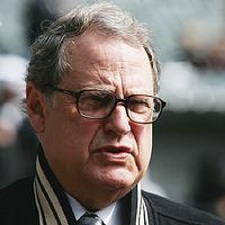
Selig has appointed his good friend and long-time ally, Jerry Reinsdorf of the White Sox, as a co-chairman, with the Angels’ Arte Moreno, of the owners’ labor policy committee.
Based on Reinsdorf’s history, placing him in such a position would seem to guarantee a war
Reinsdorf was initially opposed to the agreement that settled the 1994-95 strike, and he was one of the leaders – Selig was another – of the Great Lakes Gang that led the move in 1992 to force Fay Vincent to resign as commissioner because they felt he would get in the way of their plan to go to war with the union.
Other qualifications for Reinsdorf’s anti-union stance include his intense dislike for Donald Fehr, the former union leader, whom Reinsdorf has always blamed for the 1994 strike, ignoring the owners’ efforts to induce it, and his failure, as a member of the veterans committee, to vote for Marvin Miller for the Hall of Fame.
 Selig did not return telephone calls seeking comment on the Reinsdorf matter, but others on the management side said that the White Sox owner has mellowed and is not the fiery militant he used to be.
One person went so far as to say Reinsdorf had become more a senior statesman than a fighter. “Jerry is always prepared and he’s very smart,” he added. “I think he will be less antagonistic.”
As for Selig’s selection of Reinsdorf to chair the labor committee, a labor lawyer said, “Start with the premise that Bud doesn’t want to fight, yet he appoints Jerry. That must mean Bud doesn’t think that would provoke a fight but means we’ll have productive talks.”
That’s one way to look at it, but my skepticism makes it difficult to believe that Reinsdorf could contribute to a peaceful deal. I’ll believe it when it happens.
The lengthy period of peace has followed a 24-year stretch (1972-96) during which the players struck five times and the owners locked out the players three times.
The peaceful period dates from November 1996 but should be counted only from September 2002, when a new agreement began without aid of a work stoppage. Nevertheless even nine years of peace would be impressive. Will the peace last beyond this year?
I would say yes, it will. Of course, I could wind up being wrong, but my many decades of covering baseball labor tell me there are telltale signs that point to an agreement in the next 11 months:
- Selig has said he plans to retire when his contract expires at the end of 2012. Few believe he will leave then, but in case he does, as long as he says he plans to, it is unthinkable that he would allow a work stoppage to mar his exit and his legacy.
- Major League Baseball is flourishing financially, reaping $7 billion in revenue last year. The players’ average salary has reached $3 million. Neither side has a reason to wreck the riches that flow.
- Despite industry wealth, there are clubs that would have severe financial problems in a work stoppage.
- Only six players who played last season played in 1994, according to Elias Sports Bureau. The rest have no strike experience. The union would have to undertake a massive educational effort in a brief time to get the players thinking strike.
On the other hand, one thing the owners have learned – or should have learned – over the years is not to underestimate the players and their resolve. On yet another hand, only a handful of current owners were in baseball in 1994 and haven’t experienced the players’ determination in labor negotiations.
Another new element is the union leader. Weiner has been around for work stoppages, but he hasn’t led the players through one. His newness, said one management person, has prompted some owners to suggest that they test him. The idea has made other management people cringe.
Management people think Weiner adds a different factor. He is not, they say, Marvin Miller, Don Fehr or Gene Orza, the principals in negotiations that led to work stoppages.
”They’re counting on Michael not being Marvin or Don, but Michael was brought up by them,” a labor observer said.
But again, if the owners go into the talks thinking Weiner will be a pushover, they will be making a serious mistake. Weiner will be as formidable as his predecessors.
Weiner will be the new No. 1 man at the table for the players, but the commissioner’s office will be missing an integral member of its negotiating team from the successful, no-stoppage bargaining in 2002 and 2006.
Bob DuPuy, who recently left his position as baseball’s president and chief executive officer, was an important person to have at the bargaining table as far as a the union was concerned.
DuPuy gave union negotiators confidence that if he said something at the table, they could take it as something that Selig would accept. They didn’t feel that way about negotiators in previous talks.
For example, on the field before the final game of the 1996 World Series at Yankee Stadium, Fehr told reporters that he and Randy Levine, the clubs’ chief negotiator, had reached agreement on the dispute that prompted the players to strike in August 1994.
During the game, however, Selig appeared at the back of the press box and denied, when asked about Fehr’s announcement, that there was a deal.
During the game, two officials from Selig’s office came to me in the press box and asked if I could avoid writing what Selig said. They were afraid that if Fehr read what he said, the deal would blow up.
I told them I had to write it because I wasn’t the only reporter present when Selig denied the existence of a deal.
I wrote it even though I was incredulous. Selig thought from the look on my face that I was angry. When he later asked me why I was angry, I told him I wasn’t; I was incredulous that he denied there was a deal.
Selig initially refused to take a stance on the agreement, and it took two owners’ votes, but the deal was finally approved. Apparently times have changed.
CATCHING A TRAVEL FEVER
 Too bad airlines don’t award frequent flyer miles to baseball players for off-season travel. If they did, Max Ramirez would have himself a bundle of miles just from his travels this month.
Ramirez, a Venezuelan catcher, didn’t actually board a plane and fly anywhere, but on paper, in the space of five days, he and his catcher’s glove went from the southwest to the northeast to the midwest.
Primarily a minor leaguer for 10 years in the Rangers’ system Ramirez was claimed on waivers by the Red Sox Jan. 5, immediately put back on waivers and then claimed by the Cubs Jan. 10. He has not traveled anywhere since, on planes or on paper.
The 26-year-old Ramirez spent part of one season, 2008, in the majors, playing 17 games for the Rangers and hitting .217.
INSULT PROMPTS LATEST MOVE
Edgar Renteria hasn’t changed teams every year; it just seems as though he has.
A 35-year-old shortstop, Renteria will be with a new team this coming season. The Cincinnati Reds will be his sixth team in eight seasons.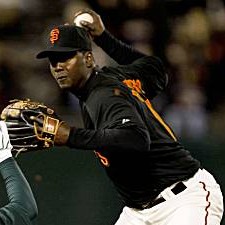
It would be easy to surmise that the man can’t hold a job, but he was named the World Series most valuable player last season, and he won the 1997 World Series with a run-scoring single in the 11th innings of Game 7.
In between those achievements, Renteria played another season for Florida, six seasons for St. Louis, then one season for Boston, two for Atlanta, one for Detroit and two for San Francisco.
A free agent this winter, he could have stayed with the Giants for a third season, but he didn’t like their offer of $1 million. In fact, Renteria said the offer insulted him.
That’s unfortunate, not that he felt insulted by the offer but that he said so publicly. Renteria isn’t the first player to say a team insulted him by offering him $1 million, but it is hoped that he will be the last. With so many people unemployed, the public doesn’t have to hear that a baseball player finds a $1 million salary insulting.
The Giants paid Renteria $16.6 million the past two years but weren’t prepared to pay him millions again. He rejected their offer and signed with Cincinnati for $2.1 million.