Omar Minaya and I were both wrong. Except the Mets pay Minaya a lot of money to be right. When I’m wrong, I don’t even hear about it from my wife because she doesn’t pay attention to what I write. Never has. Oliver Perez? She has no clue.
But I know, and Minaya knows. The Mets’ general manager opted to retain Perez as a free agent last winter, and I endorsed his decision. Bad decision. Minaya’s alternate choice for that spot in the Mets’ rotation was Derek Lowe. Based on the pitchers’ first-month performances, Minaya opted for the wrong choice.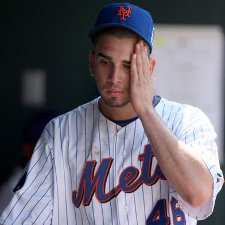
Perez could still turn his season around and prove Minaya right, but the erratic left-hander would have to force his way back into the rotation, and how is he going to do that? Hypnotize Jerry Manuel and say, “You will put me back in the rotation?” Give all of the other starters swine flu?
Ollie, boobie, it just ain’t happening. Manuel would have to suffer a sudden case of dementia to put you back in the rotation. The Mets want to win a playoff spot, and they won’t do that starting Oliver Perez every fifth game. Not the Oliver Perez we have seen this season.
When Minaya acquired Perez from Pittsburgh in July 2006, it appeared to be a good gamble. Perez was a throw-in with Roberto Hernandez in an emergency trade the Mets were forced to make for Xavier Nady because they needed a relief pitcher (Hernandez). Duaner Sanchez had suffered a season-ending shoulder injury in the back seat of a taxi when the cab collided with another vehicle.
Facing the same frustration that would immerse the Mets, the Pirates had sent Perez to the minors. He had a 2-10 record and a 6.63 earned run average when he was demoted. Sound familiar?
But Perez was left-handed (left-handers develop later), he wasn’t even 25 and two years earlier he had led the National League with 10.97 strikeouts per nine innings and had a 2.98 e.r.a. His potential seemed limitless.
At different times after Perez joined the Mets, Rick Peterson, the pitching coach, thought he had him figured out. Last season, Peterson’s successor, Dan Warthen, thought he had Perez figured out. It seemed to be a matter of helping Perez develop consistency, both with his pitching delivery and from start to start.
A 15-win season in 2007 and a 3.56 e.r.a. that was the league’s ninth lowest signaled that Perez was ready to establish himself as a big winner, but he regressed last season, finishing with a 10-7 record and 4.22 e.r.a. Now this season’s five-start disaster.
Actually, Perez has had one decent start this season, but that’s not good enough for a month’s worth of work. He has a 1-2 record and a 9.97 earned run average. He has allowed 28 hits and walked 21 in 21 2/3 innings. His strikeout to walk ratio is not what pitchers strive for: 20 strikeouts, 21 walks. He has allowed a ratio of 20.4 baserunners per nine innings.
Lowe, meanwhile, has a 3-1 record and a 3.03 e.r.a. for the Atlanta Braves. His strikeout to walk ratio is 28 strikeouts and 14 walks. He has permitted 11.6 baserunners per nine innings.
Lowe, however, cost the Braves a lot more than Perez cost the Mets, $60 million for four years. The Braves willingly paid the price because they had had a bad winter, missing out on A.J. Burnett and Rafael Furcal, and they weren’t about to let Lowe get away.
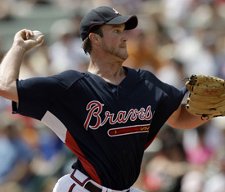 Minaya looked into the possibility of signing Lowe, but Lowe would be 36 years old two months into this season and he wanted a four-year contract for $15 million a year.
“I couldn’t give him $15 million a year for four years at 36 years old,” Minaya said the other day.
Minaya signed Perez to a three-year deal for $36 million. At $12 million a year, Perez earns $2 million a month based on the six-month season, which means that he has squandered $2 million of the Mets’ money and promises to waste a lot more before this season is over.
“It’s disappointing to all of us,” Minaya said but added, “I do believe he’ going to be fine. I think right now he’s feeling the pressure of his contract. I think we will get him back.”
Players, even the best, often feel pressure from a new, big contract. The history of free agency is filled with examples. Instead of pitching and hitting the way they did to earn the big contract, players feel they have to do even more to justify the big contract.
But has that been Perez’s problem? Has the pressure of the big contract caused him to lose sight of the strike zone? In his last start, last Saturday in Philadelphia, Perez walked 6 of the 18 batters he faced and gave up 5 hits in 2 1/3 innings. He threw 36 strikes and 41 balls. Many of his pitchers weren’t close to the strike zone.
“He has to build his confidence up,” Minaya said. “He’s in good shape physically. He just has to get his confidence back. We know he’s one of those guys who’s going to be up and down.”
Right now Perez is down, way down. He’s also down in the bullpen. That is the Mets’ way of trying to fix him. For him to relieve in a game, the Mets will have to be way behind. You won’t see Perez coming into a one-run game.
Despite their struggling start, the Mets aren’t far off the division lead, but they would be in better position if Lowe were pitching for them and pitching as effectively as he has for the Braves.
When the Mets signed Pedro Martinez in December 2004, he was 33 and they gave him a four-year contract for $53 million. They were the only team willing to give him a fourth year, and critics predicted that he would not be able to complete the contract. He did complete it, but he missed starts in the final three years because of injuries and totaled 79 starts in four years instead of a normal complement of about 124.
In that instance, though, the Mets were willing to gamble on a fourth year because Minaya wanted to change the environment in which the Mets had wallowed. If Martinez joined the Mets, Minaya felt, other top players would follow. He was right, and the fourth year for Martinez paid off.
The reluctance to add a fourth year for Lowe could turn out to be the difference between a division title and no division title. Would a chance to win the World Series be worth $24 million? The Mets may have to ask themselves that question and answer it in the next few months.
