On a shelf somewhere in my house is a can of pine tar. What on earth am I doing with a can of pine tar?
I can explain that more easily than I can explain why, 35 years later, I still have the pine tar. I guess I have kept the can all these years because I tend to keep things. My wife calls it hoarding, but I just don’t like throwing things away. I mean, in this instance, for example, how do I know I won’t wake up tomorrow and discover I need a glob of pine tar?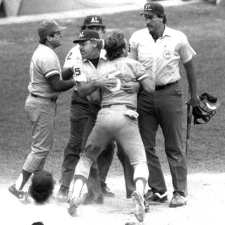
I have the pine tar because Ken Nigro gave it to me and other baseball reporters who covered the Pine Tar game between the Yankees and the Royals 35 years ago July 24.
The month of July is filled with anniversaries of momentous events in recent Yankees history. For example, take that same date – July 24. It was on that same date five years earlier, 1978, that Billy Martin tearfully resigned as the Yankees’ manager after having declared a day earlier, “The two of them deserve each other. One’s a born liar; the other’s convicted.”
Martin was referring to the Yankees’ slugger, Reggie Jackson (“born”), and the team’s owner, George Steinbrenner (“convicted”).
Martin was proud of his remark, as he should have been, because it was a clever and a memorable comment (40 years later it remains one of the best observations of the era), but it also got him fired. Well, technically, he resigned before he could be fired, but he would have been fired if he hadn’t resigned.
When Steinbrenner heard what Martin had said (from me, when I called him for comment), he immediately called Al Rosen, the club president, and ordered him to get to Kansas City, the Yankees’ next stop, and find out what was going on. However, by the time Rosen arrived at the Crown Center Hotel, Martin had resigned in a brief lobby news conference and was gone, led away by a Kansas City friend.
While we’re on the subject of arrivals and departures, I should note that Martin’s last day as manager was the day Jackson returned from a five-day suspension Martin had imposed for insubordination.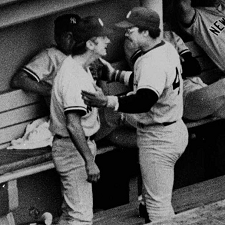
Martin had given Jackson a sign to sacrifice, Jackson was offended and didn’t bunt, Martin removed the sign, Jackson bunted anyway and fouled out. Martin was enraged and threw a clock radio and a beer bottle against the wall in his office. Then, amid the broken glass, Martin announced the Jackson suspension.
No other Yankees’ July event – no other event of any team – topped that one for melodrama. However, that event had a corollary event that has lived on. At the same time Martin and Jackson were feuding the Yankees fell a season-high 14 games behind Boston in the American League East.
Some publications might say the Yankees were 14½ games behind the Red Sox, but that never happened. When 14½ became a prominently used figure, I decided to put it to rest. With my son’s assistance I checked the day-by-day results of the two teams’ games, even the hour-by-hour results in case one team’s game ended before the other’s and created a temporary half-game difference. But that never happened either. Fourteen games it was and 14 games it will forevermore be.
The Yankees, of course, overcame that deficit, stumbled at the end but won a one-game playoff behind an unlikely Bucky Dent home run that earned the shortstop a new middle name in Boston.
The Yankees lost the Pine Tar game when the American League president, Lee MacPhail, overruled the umpires and credited George Brett with a home run. The game was completed Aug. 18 with a brief finish for which Ron Guidry, the Yankees’ athletically gifted pitcher, convinced Martin to let him play center field for the inning that remained.
Brett’s image remains from the game. His demonic dugout dash, triggered by umpire Tim McClelland’s out call for having pine tar too far up his bat, is mandatory viewing. Brett, an otherwise stable fellow, charged out of the dugout looking as if he were going to strangle McClellan.
It’s too bad the Brett image doesn’t appear on the T-shirts Ken Nigro gave to reporters with the pine tar.
“I covered the Pine Tar game,” the shirt says.
Nigro was the Yankees’ public relations director that season, and he was not a typical p.r. man. He had been a long-time baseball writer for the Baltimore Sun and a darn good one until the Sun hired a sports editor whose knowledge of sports coverage rivaled that of the editor who currently determines sports coverage in The New York Times.
Anyway, Nigro decided to have some fun with the Pine Tar game, and of course Yankees’ officials didn’t find it humorous. Nigro didn’t find them humorous and left after a year.
Incidentally, Nigro created one of my favorite sayings, the one about “the fallacy of the predestined hit.” Nigro used the phrase to counter the contention that if a player, say, is picked off second and the batter then gets a hit, the player who was picked off has cost his team a run.
That, however, is the fallacy of the predestined hit. The run, Nigro noted, could not be assumed because the pitcher might have pitched the batter differently had the runner still been at second.
HOW MANY HOMERS IS ONE HOMER WORTH?
“Four-hundred-forty-seven!!!” Michael Kay gushed once, twice, three times. Then a minute later he added, “Four-hundred-forty-seven put the Yankees right back in it.”
The over-the-top Yankees announcer was referring to the distance of the home run Giancarlo Stanton had just hit for the Yankees, cutting the Kansas City lead last Saturday afternoon to 6-2.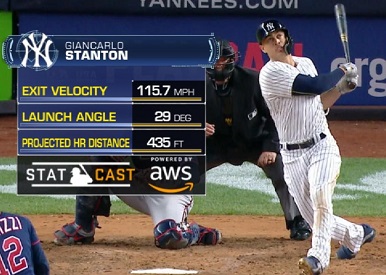
No matter how many times Kay repeated the distance of the home run, though, it still counted as one run. If the ball goes over the fence, it’s a home run, no matter how far it travels. The batter doesn’t get extra credit for excessive distance.
But someone sold Major League Baseball on this Statcast gizmo, and some announcers run with it – right into the ground.
Teams have long estimated distances of home runs, but Statcast supposedly makes it official. But a home run is a home run is a home run. From the time you watch your first game you know that if the ball clears the fence, it’s a home run. You don’t need a gimmick like Statscast telling you it’s a home run. The distance might add to your appreciation of the hit, but it doesn’t add runs.
Nor do the other new-fangled figures – exit velocity and launch angle. No matter the angle of the hit or the speed, it is what it is. The batter doesn’t get extra credit for a steeper launch angle or how fast the ball leaves the park. If you’re a Giancarlo Stanton fan, the sight of the ball clearing the wall is a welcome vision.
Is this M.L.B.’s idea of enhancing fans’ enjoyment of the game? If it is, Commissioner Rob Manfred needs to find a better way of attracting fans.
JUDGE OUT OF STRIKEOUT RACE
 When a pitch fractured Aaron Judge’s wrist last week, it interrupted what could have been the most intriguing race of the season. At the time of the mishap, Judge had struck out 137 times this season, putting him two strikeouts behind Yoan Moncada, one behind Joey Gallo and two ahead of teammate Giancarlo Stanton. The race will go on without Judge, but having two players from the same team made it especially interesting.
As this week began, Moncada was leading with 141 while Gallo had 139 and Stanton 138.
By the time Judge returns to the lineup in a few weeks, he’ll have a lot of catching up to do.
PONCEDELEON WINS FIRST AWARD
 While official awards like most valuable player and Cy Young remain wide open, one award has already been wrapped up. No one else needs to apply for comeback player of the year. Daniel Poncedeleon of the St. Louis Cardinals won it with his major league debut last week.
It’s not simply that Poncedeleon pitched seven hitless innings. It’s that he pitched at all.
The 26-year-old right-hander was pitching for AAA Memphis a year ago May 9 when a line drive struck him in the head. Emergency surgery was performed to stop the bleeding and reduce pressure on his brain. Fourteen months later he was not just back on the mound but he was making his initial major league appearance against Cincinnati.
The 6-foot-3 Californian threw 116 pitches before being removed from the game. The Reds got a hit against a reliever in the eighth.
Waiting for his chance to pitch was not unusual for Poncedeleon. Before he was drafted and signed by the Cardinals in 2014, he was drafted three times but did not sign – by Tampa Bay in 2010, Cincinnati in 2012 and the Chicago Cubs in 2013.