Let the word go forth across the baseball land. The Texas Rangers, long a fumbling, bumbling team and incompetent organization, are a legitimate champion and a team to be reckoned with for years to come.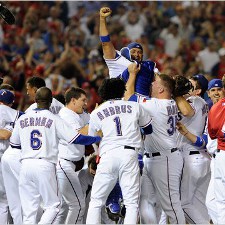
They have demonstrated their emergence into legitimacy this post-season, knocking off the teams (Rays and Yankees) with the two best won-lost records in the American League. They can further enhance their status in the World Series by beating the Giants, who toppled the two-time National League champion Phillies, who had the best record in the majors this year.
“The old Rangers are gone; they’re a thing of the past,” Chuck Greenberg, the Rangers’ new managing partner, said. “We’re very well capitalized. We’ve got an ownership group with tremendous resources.”
Greenberg, whose ownership group assumed control of the team two months ago, was speaking last week of the team’s financial capabilities, specifically with reference to its ability to retain Cliff Lee, the supernatural post-season pitcher. But his declaration applied to the entire Rangers’ operation, off field and on.
The franchise is in the World Series for the first time, ending a shutout that began in Washington, D.C., in 1961, moved to Texas in 1972 and lasted just a year less than half a century.
The Rangers won three division titles in a four-year span in the late ‘90s, but Tom Hicks, who bought the team in June 1998, set the team on a downward spiral when he signed Alex Rodriguez to an unheard of $252 million contract after the 2000 season and fired general manager Doug Melvin after a second straight last-place finish in 2002.
Hicks, however, was the owner under whose regime the Rangers began their ascent. His hiring of Nolan Ryan as the club’s president in February 2008 triggered the ascent. During Ryan’s reign the Rangers have increased their annual victory total from 75 to 79 to 87 to 90.
“I have enormous respect and appreciation for the fact that the cornerstones for our success were put in place before I showed up,” said Greenberg, a Pittsburgh sports lawyer. “At the same time we’re proud that we were in this in 2009 when it wasn’t obvious. The team was under .500 and not drawing well.”
Seven weeks before Ryan rejoined the Rangers – he played his last five years and pitched the last two of his seven no-hitters for them – they acquired a player who would join Ryan as a cornerstone of the pennant-winning team. He was Josh Hamilton, whom general manager Jon Daniels obtained from Cincinnati, where he played in 2007 after basically missing four seasons with drug and alcohol problems.
“You have to commend Jon Daniels and his staff for making that deal,” Ryan said. “We had a real need for a center fielder.”
Hamilton’s is one of the great baseball stories of recent times. Selected by Tampa Bay as the No. 1 player in the 1999 draft, Hamilton was sidetracked by drugs and alcohol and didn’t play in the majors until 2007. Next month he will most likely be named the A.L. most valuable player.
 “His story is a phenomenal story,” Ryan said. “It’s so rare to see someone experience what he’s experienced in his life and come back and accomplish what he’s accomplished.”
Hamilton’s .359 batting average this season was 31 points better than the A.L.’s next highest average. He also led the league in slugging (.633) and average with runners in scoring position (.369). He was among the league leaders in a host of other categories, some of which were affected by his absence for all but two games in September with a ribcage injury.
“If he had been healthy the whole time and had the approach that he had once he hit bottom earlier in the year (he was hitting .268 mid-May) there’s no telling what kind of numbers he might have put up,” Ryan said.
“There’s a lot of organizations now that aren’t going to let Josh Hamilton beat you. They know of his ability and are going to pitch around him.”
The Yankees walked Hamilton eight times in their six-game playoff series, including five times intentionally.
“He sees so many more breaking balls and changeups,” Ryan said. “In Tampa Bay Joaquin Benoit threw him five straight changeups. I was sitting here thinking have I ever seen another hitter in the game get five straight changeups? Not that I could recall. That shows the respect and attitude of opposing teams toward him. I didn’t see Mickey Mantle in his prime when they were facing him, but they always had someone hitting around him.”
The need to protect Hamilton in the lineup prompted the Rangers to sign Vladimir Guerrero last winter, and the 35-year-old designated hitter produced his 13th .300 season.
The Rangers’ story, however, goes well beyond hitting. Its telling would not be complete without relating the change in baseball’s pitching culture that Ryan has initiated. Before changing the entire culture, though, Ryan has worked on his local problems.
His first priority was changing his pitchers’ mindset.
“We had to get our pitchers knowing they could pitch in our ball park and you could be successful,” said Ryan, who is not your average everyday club president.
“We’ve proven that you can do that. We had been an organization that tried to outslug everybody. We were getting beat, 12 to 13, and our pitchers didn’t feel they could be successful there. We’ve proven that wrong. Our guys are very much at home, very much at home pitching in the heat.”
The summer Texas heat has long been considered a problem for Rangers pitchers and for at least some would become a mental as well as a physical problem. Ryan recalled that when he signed with the Rangers as a free agent, he called Charlie Hough, a pitcher, who had played for the Rangers for eight years.
“I asked him what about the heat,” Ryan related. “He said what you have to do is last longer than the opposing pitcher. That’s what I tell our guys because if you can do that you’re going to win a lot of ball games.”
Then there is Ryan’s broader initiative. Earlier this year I referred to it as a Ryan renaissance.
Though I have known, respected and liked Ryan for decades, he has gained my admiration anew for instituting a change in the way the Rangers will work with their pitchers. Pitcher pampering is out. Work is in.
The New York Mets, the team Ryan played for early in his Hall of Fame career, began what I call the pampering phase of Major League Baseball. In the 1960s, they changed from a four-man pitching rotation, and other teams followed or initiated the practice concurrently. Pitch counts, limits on number of innings pitchers could pitch and other bad things followed.
“It has to be changed,” Ryan said of the prevailing pitching philosophy. “We’re underutilizing our pitchers and we can’t take the mindset that you’re going to go the other way and try to defend against injuries because they’re going to happen. I don’t care who they are.”
Ryan cited a non-pitching injury in Game 5 of the A.L. playoff series between the Rangers and the Yankees. “Mark Teixeira pulled his hamstring,” Ryan said. “You can’t defend against that.”
“I told them the first year we started this,” the 63-year-old Ryan added, “we’re going to have pitchers with the usual problems and that’s going to be the first question they ask us. We’re going to have those whether we have them throw 60 pitches or 120 pitches.”
Ryan has told Texas pitchers he wants them to work deeper into games, which means either getting through innings with fewer pitches or working more effectively.
“The pitchers are a product of the system,” Ryan said, “and that’s exactly where it lies. And until that changes we’re going to see what we’re seeing. But I believe we saw pitching come back into play this year for the first time and I think we’ll see more emphasis put on it and I’d like to think they’re going to stretch some of these starters out and take the pressure off the bullpens.
“The way the game has changed teams carry 12-13 pitchers and what it does it ties a manager’s hands because he has no bench strength at all so he has no one to go to so he can’t manage the game. All he can do is manage his bullpen. It’s really changed the game.
“I want to see it go back to smaller staffs. I can remember one time with the Angels we had nine pitchers. That’s unheard of now. I’d like to see it go back to 10 or 11. Will we ever get to 10? Probably not. You’d have an innings pitching staff if you did, not because of the way they use bullpens now. I’m really pushing for us to see some adjustments in that.”
The more successful the Rangers are, the farther they go, the greater attention Ryan and his efforts will attract.
“With the success of our organization,” he said, “I think people will view us differently than they have in the past. I think pitchers used to think like they did with the Rockies. If you go there you can figure on tacking another run, run and a half on your earned run average. That’s not the case with us. We didn’t have to do anything to make any changes to make it friendlier for pitchers. What we had to do is have pitchers that pitch better.”
METS EXCHANGED TOKENS
As it turned out, Al Avila was not the token minority interviewed for the Mets’ general manager vacancy. Dana Brown of Toronto was.
 Avila, assistant general manager of the Detroit Tigers for nine years, was on the Mets’ original list of candidates and could have received permission from the Tigers to talk to the Mets, but he chose not to.
“In my contract extension I signed a couple years ago,” Avila said by telephone from Detroit, “it says the Tigers have the right to not give permission to any team that would want to interview Jack Zduriencik.”
In this instance, however, president and general manager Dave Dombrowski was prepared to give Avila permission to talk to the Mets because he is going into the last year of his contract.
“He said I could do it,” Avila related, “but I said no. I’m happy where I am. I’ve been with Dave for almost 20 years, and we have a very good relationship. I’ve been here since 2002, I make enough money and Mr. and Mrs. Ilitch are like family.
“I have as much to do as anybody as far as responsibilities in all aspects of the organization. I just didn’t think it was the right fit for me at this time. I don’t think I have to go anywhere. I think it’s a better fit for me.”
Under the commissioner’s hiring rules for decision-making positions, the Mets had to interview a member of a minority so they selected Brown, an African-American, who is a special assistant to the Toronto general manager.
He was never a serious candidate and didn’t make the cut. The Mets announced Friday that the finalists are Sandy Alderson and Josh Byrnes. Even that aspect of their search is a charade.
Unless they want to go cheap, they are not about to reject Alderson and hire Byrnes, whom the Arizona Diamondbacks fired last season halfway through the third year of an eight-year contract. The Diamondbacks obviously did not think much of the job Byrnes did if they were willing to pay off the 5 ½ years remaining on his contract.
If, on the other hand, the Mets were to hire Byrnes, they could pay him less than the going rate for general managers with his salary being deducted from what Arizona owes him.
Alderson would cost more, but the Mets would do far better from a public relations standpoint hiring Alderson. He also would be a better general manager as long as he remembers how to do the job. He hasn’t been a general manager since 1997.
GIRARDI’S GYRATIONS
If Joe Girardi were seeking a job managing somewhere, he wouldn’t want to use Game 4 of the American League Championship Series as his resume. Just about every decision the Yankees’ manager made turned out to be disastrous and led to nearly all of the runs the Rangers scored in their 10-3 victory: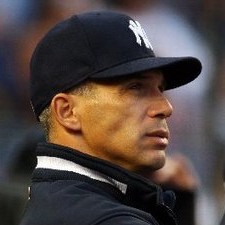
With a runner at second and two out in the sixth and the Yankees ahead, 3-2, Girardi left A.J. Burnett in the game and ordered an intentional walk for David Murphy.
Bengie Molina hit a 3-run home run.
After David Robertson retired the first two batters in the seventh, Girardi replaced him with Boone Logan.
Josh Hamilton hit a home run.
Girardi brought in Joba Chamberlain for Logan,
Vladimir Guerrero doubled, Nelson Cruz walked and Ian Kinsler singled home Guerrero.
In the ninth, Girardi replaced Chamberlain with Sergio Mitre.
Hamilton hit a home run, Guerrero got an infield single and Cruz hit a home run.
If that series of strategic backfires weren’t sickening enough for the manager, the Yankees did it again in Game 6. With the Yankees just having tied the game, 1-1, the Rangers had a runner at third with two out in the fifth and Hamilton coming to bat.
Girardi held up four fingers, signifying an intentional walk, Hamilton’s second in three innings. In the third inning, Guerrero popped to second for the third out, but this time he laced a tie-breaking, two-run double to center.
Girardi had one backfiring move left. He brought in Robertson, and immediately Cruz crashed a crushing two-run homer.