The National Football League has had its lockout. The National Basketball Association is having its lockout now. Then there’s Major League Baseball, the granddaddy of all lockout and strike-affected sports leagues.
Far from a lockout or a strike, Major League Baseball is so awash in peace and tranquility that negotiators for the players and the owners are said by a baseball official familiar with the labor scene to be 90 percent, maybe 95 percent, finished with their talks for a new collective bargaining agreement to replace the one that expires Dec. 11.
Six weeks prior to the expiration of existing agreements in many labor negotiations of years past, the two sides hadn’t even agreed that the ball was white with red stitching.
Peace, however, has reigned in baseball since the November 1996 agreement that belatedly resolved the differences that caused the players’ 234-day strike in 1994 and ’95, forcing the cancellation of the World Series for the first time.
Baseball, which has endured five strikeouts and three lockouts, has enjoyed 15 years of labor peace, an unprecedented period in the sport, while the other major professional sports continue to engage in their labor wars and be wracked by them.
Once again Major League Baseball is within sight of yet another peaceful resolution to labor negotiations. Being that close to the finish line, though, offers no guarantee that the players and the owners will cross it arm in arm. One word, one issue, may get in their way and block the path to a third consecutive labor agreement without a work stoppage.
The word is slotting. Management wants it; the union opposes it.
Having abandoned years of futile efforts to get what the other sports have – a payroll cap – Commissioner Bud Selig has set his sights on slotting. If he can’t restrict the salaries of major league players with a payroll cap, Selig is intent on restricting the size of signing bonuses for drafted players.
He can achieve that by setting maximum payments for them based on the round in which they are drafted and the place in each round through the first five rounds of the annual June draft.
This is called slotting, and it’s designed to help teams save money and create cost certainty. It would also prevent agents from holding teams hostage to force them to give their clients what they want. If the league can establish a maximum bonus for a draft pick, the team that drafts him simply says to the youngster, no matter how good he is, sorry, fella, this is all the rules allow.
A couple of people involved in the labor talks cautioned that slotting isn’t the only issue to be resolved; some work needs to be done on revenue sharing and the luxury tax, they said, though most likely nothing major, and other matters relating to the draft (trading draft choices, for example) need to be discussed.
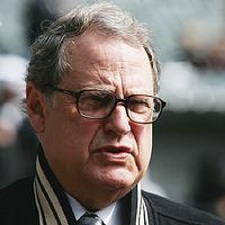 But slotting is the single major outstanding issue. Selig didn’t return a call seeking comment on why he is so eager to get such a rule included in the next labor contract, but two people, one on each side of the labor fence, said the moving force behind the idea, is Jerry Reinsdorf, the Chicago White Sox chairman.
Reinsdorf has long been viewed as Selig’s Svengali, if not his outright puppeteer, though Selig vehemently denies that Reinsdorf tells him what to do or that he does what Reinsdorf wants. But one of the people who mentioned the White Sox owner said, “Reinsdorf tells Bud players will never strike over slotting.”
Technically, under labor law, players could not strike over slotting because the union doesn’t represent drafted players, but the union has other methods of dealing with an issue that it finds objectionable but can’t strike over. It can simply, for one example, let management know it would not agree to any contract that includes the matter it objects to. That’s an old union strategy that has been employed successfully.
Michael Weiner, who is in his first contract negotiation as head of the baseball union, declined to discuss slotting or any other aspect of negotiations. Both sides have agreed to keep their talks confidential, and they have done so to an unprecedented degree.
Their agreement, however, doesn’t preclude former union executive directors from talking.
Asked why the union would oppose slotting, Donald Fehr said, “The view always was it’s philosophically inconsistent with free agency, and drafting is bad enough.” In addition, he said, “If it’s tied into an international draft, that makes it worse.”
“A salary cap by any other name is still a salary cap,” Marvin Miller said. “It’s not the union’s business to have an artificial limit. That’s not why a union exists for. It’s outrageous that anything that resembles a salary cap would be acceptable.”
As far as drafted players not being union members, the union leaders pointed out that the union looks out not only for active major leaguers but also past union members and prospective members.
The publication Baseball America and its executive editor, Jim Callis, provide the leading and most comprehensive information on the draft and payments arising therefrom. All of the data I use here is courtesy of Callis and Baseball America.
Of the 33 players chosen in the first round of the 2011 draft, 27 signed for bonuses above the M.L.B. recommended figures, 5 signed for the slot recommendation and 1 did not sign. Without agreement with the union, the slot figures are only recommendations, and most teams go above slot to be able to sign their picks.
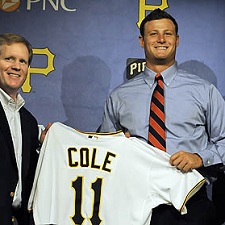 This year the Pittsburgh Pirates signed the No. 1 pick, pitcher Gerrit Cole, for an $8 million bonus, twice the suggested figure. Seattle did basically the same with the No. 2 pick, pitcher Danny Hultzen, giving him a $6.35 million bonus, just about double the slot figure of $3.25 million.
Some other slot-exceeding bonuses for high draft picks:
- No. 5, by Kansas City, outfielder Bubba Starling, $7.5 million (slot $2.52 million)
- No. 6, by Washington, third baseman Anthony Rendon, $6 million (slot $2.34 million)
- No. 7, by Arizona, pitcher Archie Bradley, $5 million (slot $2,178,000).
The clubs did not make a strong case for a slotting system leading up to its bargaining proposal. Baseball America said the estimated slot figures for 2011 were the same as they were in the previous two drafts.
The signing bonuses, however, were not the same. Baseball America reported that on the signing deadline day, Aug. 15, teams spent a record $132 million in signing bonuses, up from the previous high of $91 million a year earlier.
Given those figures, it’s no surprise that Selig wants a slotting system. “Bud has said under no circumstances will he take a deal without slotting,” an official said.
But will Selig take a strike or join the lockout parade next spring if the two sides haven’t agreed on a new contract? The answer here is no.
Selig has boasted of labor peace too much to undermine it, and with his retirement scheduled for the end of next season, there’s no way Selig would want to mar his legacy. On the other hand, he could use the excuse of an unsettled landscape to stay in office another year and earn an additional $22 million, or whatever his salary would be then.