What did Bud Selig know about steroids and when did he know it? What did the former commissioner know about Bob Bowman’s bad behavior and when did he know about it?
By no means am I equating Bowman’s behavior with steroids, but Selig’s reaction to both provides grounds for solid speculation. See if you agree that there might be a link in Selig’s reaction to both.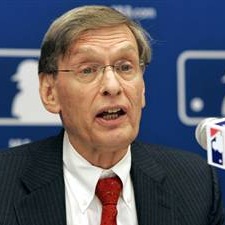
First, I have to explain my reference to Bowman’s behavior. As Major League Baseball’s president of media and business, Bowman was a digital genius and made billions of dollars for M.L.B. and its 30 club owners.
Bowman, for example, developed a spinoff company of M.L.B. Advanced Media, BAMTech, and sold a majority share to Walt Disney Company for $2.58 billion.
But not all was blissful in Bowman’s 17 years with M.L.B., and his contract was not renewed. Last month M.L.B. announced that Bowman, who is about 61 years old, was leaving baseball. No reason was given, and Bowman offered no explanation.
“I had no idea; I thought he was leaving to make more money,” said a high-ranking executive of a major league club who usually knows everything that is happening. He and I and many others learned otherwise in a remarkably reported article in the Wall Street Journal last week. Written by Rachel Bachman and Brian Costa, the article said Bowman was pushed out by M.L.B.
The reason, the Journal said, was Bowman’s treatment of employees, subordinates, colleagues and others outside M.L.B. Advanced Media, or BAM, as it is commonly called.
And there was this:
“People familiar with Bowman say he engaged in a pattern of behavior that included propositioning female colleagues, allegedly conducting consensual relationships with subordinate coworkers and cultivating a culture of partying and heavy drinking with employees outside the office.”
And this:
“During the week of the All-Star Game in July 2016 in San Diego, MLB Advanced Media hosted a party at which women were allegedly hired to entertain attendees, according to two people who attended. These people said the women, who arrived at the party by bus, were widely believed by attendees to be escorts. Some of them were heard encouraging attendees to leave to have sex quickly so that they could return to solicit another attendee before the party was over, according to one person who was there.”
Based on the unparalleled results M.L.B. gained from Bowman’s efforts, it was obvious that Bowman also did his job and did it extremely well. However, he did not challenge Rob Manfred’s decision not to renew his contract, and his statement to the Journal for its article acknowledged his questionable behavior.
That acknowledgement only heightens the question: Why didn’t Selig take any action, severe or mild, when he learned of problems with Bowman?
Disclosing the problems, the Journal wrote, “At least 10 years ago former M.L.B. president and chief operating officer Bob DuPuy was told of concerns about Bowman’s behavior by BAM employees and raised them with former M.L.B. commissioner Bud Selig, according to people familiar with the situation.”
Despite DuPuy’s warning, the article noted, Selig did nothing. “Bowman remained with the company as it grew increasingly lucrative for team owners.”
Selig didn’t fire Bowman. He didn’t take him to baseball’s woodshed. He took no disciplinary action. He leveled no harsh reprimand. He didn’t even say don’t do it again. Why not?
Selig didn’t say anything. Instead, his spokesman from his days as commissioner, Rich Levin, issued a statement, saying, “It is highly inappropriate for the Commissioner Emeritus to publicly discuss any private conversations he has had with former employees.”
OK, if Selig won’t say why he ignored Bowman’s bad behavior, I will speculate on the reason.
 As I have said, Bowman was generating hundreds of millions, maybe billions, of dollars for M.L.B. and its club owners. Why would Selig want to dismiss Bowman and kill that golden goose?
In his more than two decades as commissioner, Selig was never one to disturb the status quo. For example, he would do nothing about a club’s tampering with another club’s player, even when it was obvious, unless the player’s club lodged a complaint.
Now what about Selig and steroids? The pattern is not dissimilar. When the money is rolling in, stuff it in your pocket and put your head in the sand.
Selig has always claimed he didn’t know about steroids, when players were found to have been knee deep in them, and when he discovered their presence in baseball the union blocked his effort to initiate testing.
Selig, however, has never explained how he didn’t know about steroids when, as owner of the Milwaukee Brewers, he received a memo from the commissioner, Fay Vincent, on June 7, 1991, reminding the owners that the previous November Congress had passed a law making unauthorized use of steroids a federal crime.
Selig ignored Vincent’s memo and continued to ignore it when he became commissioner in September 1992. He ignored it in 1998 when Mark McGwire and Sammy Sosa competed in their personal home run derby.
He ignored McGwire’s use of androstenedione, a steroids precursor, saying in reply to my question, “I like Mark. I’m not going to do anything to hurt him.”
If Selig could ignore steroids because they made baseball more exciting and compelling for the fans, he could easily ignore Bowman’s bad behavior and whistle ignorantly on his way to the bank.
Manfred, who succeeded Selig as commissioner in January 2015, didn’t do anything either initially even though, according to the Journal, he was well aware of the Bowman stories before he became commissioner.
Pat Courtney, M.L.B.’s chief communications officer, did not respond to an e-mail seeking comment on Manfred’s position.
According to the Journal, two incidents earlier this year prompted Manfred finally to act. In October Bowman allegedly verbally abused a co-worker, and in July Bowman allegedly shoved an executive from the Red Sox ownership group.
From the Journal’s description of Bowman’s verbal and physical outbursts, Bowman seemed like a good candidate for anger management rehab. As chief of human resources before he became commissioner, Manfred could have ordered Bowman to submit to such a course. But both Manfred and Selig ignored the potentially combustible problem.
Interestingly, when Manfred was a candidate to succeed Selig, Bowman was considered a candidate, possibly an even stronger candidate than Manfred. But Bowman declined to run for the office.
“I support the better candidate,” Bowman said at the time. In retrospect, perhaps Bowman either knew he had offended too many people or didn’t want his skeletons coming out of the closet.
I didn’t really know Bowman, having had only a few telephone conversations with him. But my experience was very different from that of Craig Calcaterra of NBC Sports, who wrote:
“Bob Bowman called me at home on a couple of occasions because he didn’t like things I wrote. He was a yeller. Tried to be a bully. Definitely a guy who thought his power entitled him to the sort of deference most people don’t get.”
I, on the other hand, appreciated Bowman for his honesty and his candor. In one phone interview I recall, I made it obvious that I didn’t agree with his position, but he nevertheless answered my questions forthrightly and carefully explained his position. I have found very few members of M.L.B. management as honest and as candid as Bowman.
MANFRED: OUT OF TOUCH OR LYING?
Seldom, if ever, does a commissioner admit to being out of touch with events in his sport, but that, in effect, was what Rob Manfred did last week in regard to the Miami Marlins’ payroll-slashed strategy this off-season.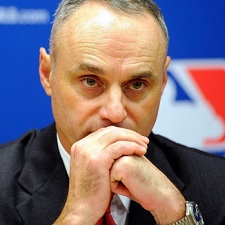
Manfred was promptly accused of lying, but it’s not known for sure if he was lying, out of touch or suffering from a sudden attack of transient global amnesia.
Manfred dug his hole on the Dan Le Batard radio show in Florida when he said he didn’t know during the approval process of the team’s new owner that he planned to slash the team’s payroll from $115 million to the $85 million-$90 million range.
Owner Bruce Sherman and C.E.O. Derek Jeter initiated that plan by trading outfielders Giancarlo Stanton and Marcell Ozuna and second baseman Dee Gordon.
Le Batard said on ESPN radio that Manfred’s claim was “a lie.” Then the Miami Herald reported that Manfred’s contention was “disputed by two people directly involved in the negotiating process.”
Consider this, however. Even if Manfred was correct in his assertion that the commissioner’s office knew nothing of the plans of Sherman and Jeter, why wouldn’t the commissioner figure that salary slashing would be the plan?
The Marlins, no matter who the owner has been, have been notorious payroll slashers. Worse, they have been demolition practitioners, H. Wayne Huizenga immediately after the Marlins won the 1997 World Series; Jeffrey Loria a year after the Marlins won the 2003 World Series.
Did Manfred think the new owners would keep the payroll intact after paying an astonishing $1.2 billion for the team that cost Loria $158 million?
While the Marlins’ sale price may be astonishing, it might be a sign of what is to come. Sale prices of all teams are expected to rise dramatically because owners believe legalized sports gambling is on the horizon.
The United States Supreme Court has heard a New Jersey case that could lead to legalized sports gambling in all states that want it, and all states are expected to want it because an estimated $150 billion, maybe more, is bet on sports every year in this country.
A lawyer confirmed that Loria figured legalized sports gambling into his asking price, figuring that the new owner would profit from the team’s share of future gambling proceeds. This is a topic for another time, but people I talk to say it’s on its way.