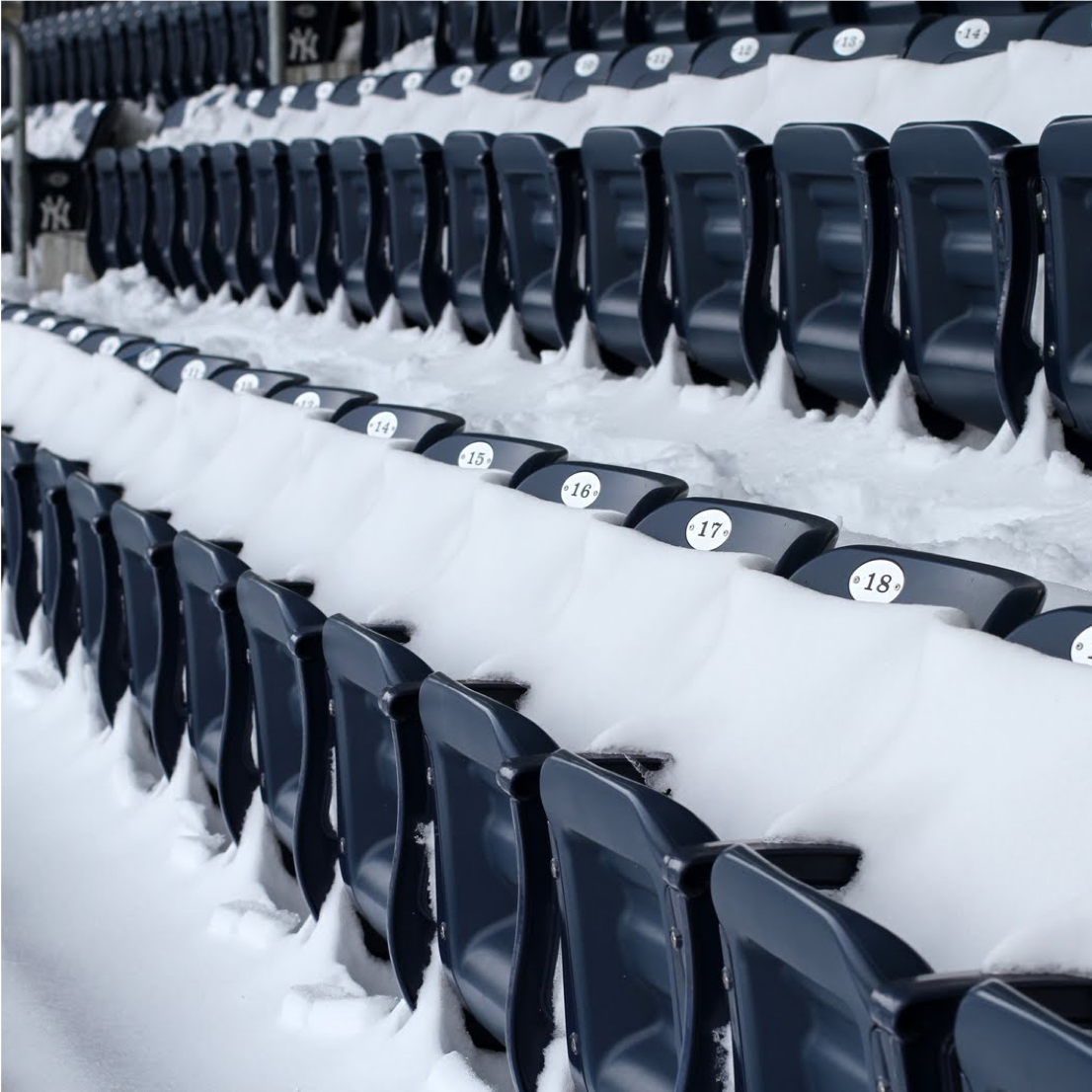
When I woke up the morning of April 2, looked outside and saw snow falling, I instantly thought of April 1982. We don’t normally think of snow falling in April or during the baseball season, but snow fell in April 1982 and deposited its pretty white flakes in the same month 36 years later. In both instances the snow that fell was enough to force postponement of the Yankees’ home opener. The Yankees have to hope that snow was the only similarity between that season and this one. That season was a disaster for the Yankees.
The previous season, 1981, the Yankees won the American League pennant and played the Dodgers in the World Series, losing in six games.
There were no post-season games in snow-disrupted 1982. The Yankees spent most of the season below or around .500 and finished in fifth place with a 79-83 record. But there was more than the won-lost record.
The Yankees didn’t recognize it, but they had a sign early that season that it wasn’t going to be a good one. Late in spring training the Yankees announced the Dave Revering, who was hitting .465 in exhibition games, would be their everyday first baseman.
However, Revering’s strong spring melted in the five-day snow delay. He started both games of the opening-day doubleheader against the White Sox and went hitless in six times at bat. Bob Watson was the first baseman in the next game.
That season the Yankees had three managers, four hitting coaches and five pitching coaches. That season, on the fifth day of a five-day snow delay, the Yankees made a trade, acquiring shortstop Roy Smalley from the Minnesota Twins and prompted Manager Bob Lemon to remark, “I already have a shortstop. What am I supposed to do with Dent?”
Bucky Dent had been the Yankees’ shortstop for the previous seven-plus seasons, and there was no indication a change was forthcoming. Smalley might have been a more productive hitter than Dent, but he had limited range at short and was not an over-all improvement. The Yankees traded Dent to Texas for Lee Mazzilli four months later.
In the Smalley trade meanwhile the Yankees gave up Ron Davis, their No. 2 relief pitcher, and Greg Gagne, who two years later began an eight-year run as the Twins’ shortstop and was a major league shortstop for five more years with the Royals and the Dodgers.
Owner George Steinbrenner was especially active that year, a circumstance that might have contributed to the team’s poor season. Steinbrenner also made a negative contribution before the season.
Reggie Jackson completed his five-year free-agent contract at the end of the 1981 season and wanted to sign a new contract with the Yankees. Steinbrenner, however, thought Jackson, at 35 years of age, was on his way down and refused to offer him a new contract. The owner subsequently acknowledged it was the biggest mistake he had as owner.
Jackson signed with the Angels and in his first game back at Yankee Stadium, he slugged a mammoth home run, igniting raucous chants of “Steinbrenner sucks.”
Jackson hit the home run (personal note: on my father’s 80th birthday) against Ron Guidry, the Yankees’ best pitcher, and after the game Guidry told a couple of writers, speaking of the fans’ chant, “I had to sort of try and keep from smiling. I was keeping my glove over my face.”
Confronted the next day by a furious Steinbrenner’ Guidry denied having said that, but that night, class guy that he was, he sheepishly apologized to us.
The night of the Jackson home run was also Gene Michael’s first as Yankees’ manager. Lemon lasted only 14 games into the season, being relieved of his duties with a 6-8 record. Michael survived in the job for 86 games (44-42) and was replaced by Clyde King, who had been one of the five pitching coaches, for the final 62 games (29-33).
One coach who was not replaced was Harrison Dillard, whom Steinbrenner brought in to be the running coach. A former Olympics hurdles champion, Dillard was a Steinbrenner friend from Cleveland.
Dillard was given the pivotal role of teaching the Yankees how to run because after the Yankees lost the ’81 World Series to the faster Dodgers, the owner decided speed was the new way to go as opposed to power, which had been the way the Yankees had always been built.
It turned out that speed over power wasn’t the way go because the Yankees didn’t go to the World Series again until 1996.
As part of Steinbrenner’s speed project, the Yankees signed Davey Collins, a fleet-footed outfielder, to a lucrative free-agent contract. Collins wasn’t one of the players the Yankees’ constantly shuffled between the majors and the minors, but that didn’t help him get acclimated.
One comment epitomized his season – “Which one’s Espino? I haven’t met him yet.”
Told that catcher Juan Espino had been sent back to the minors because the Yankees had acquired Butch Wynegar in a trade. Told that Espino was already gone, Collins shook his head and walked away.
Reliever Rich (Goose) Gossage was not so calm one night after a bad game. I asked him an innocuous question, and he turned it into a tirade against Steinbrenner, telling radio reporters to turn on their tape recorders and repeatedly shouted “take it upstairs to the fat man.”
Doyle Alexander, a starting pitcher, was no more fond of Steinbrenner than Gossage was, but in his one outburst that season, he targeted himself after a bad performance. He punched a dugout wall in Seattle, breaking a finger on his pitching hand and missing two months.
When Alexander pitched just as poorly upon his return, Steinbrenner ordered him to get a physical. Hearing that, Gossage said, “I don’t know if Doyle needs a physical but George needs a mental.”