In the three-season span 2006-2008, Joe Mauer, the Minnesota Twins’ talented catcher, won two batting championships. With six weeks left in this season, Mauer is the American League’s hitter leading in his bid for a third title in four years.
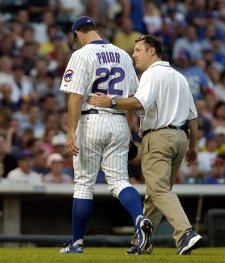
Mark Prior pitched in nine games in the first of those seasons and hasn’t pitched since, not in 2007, not in 2008 and not this year before the San Diego Padres released him at the start of this month. He has spent half of his career on the disabled list, residing there 11 different times for the equivalent of more than four whole seasons and having two major shoulder operations less than 14 months apart.
What do Mauer and Prior have to do with each other? When the Twins had the first choice in the June 2001 draft, they could have taken Mauer and they could have taken Prior. They selected Mauer, and the Chicago Cubs, drafting second, took Prior. Sometimes you get lucky, though as Branch Rickey said, luck is the residue of design.
“It was real close,” recalled Mark Wilson, the area scout who first identified Mauer as a prospect and subsequently signed him. Wilson said Mike Radcliffe, the Twins’ scouting director, made the call on Mauer. “There was a lot of discussion back and forth about which one. You do it as a group decision. It’s not just one person saying this should be the guy.”
Radcliffe recalled that Mark Teixeira was also in the upper echelon of potential picks.
“On draft day we chose Joe over those other guys,” he said. “At the time it was a controversial decision for some people. Teixeira and Prior were college players and better known. So I guess we made a controversial decision. We felt comfortable with it. We probably had a built-in advantage being where Joe lived. We had been watching him for a while. I’m sure that helped make our decision.”
Mauer went to a St. Paul high school, the same one Paul Molitor attended, and it’s highly unlikely that the Twins would have passed up the opportunity to take such a talented local kid.
“We probably had 10 different scouts see him that year,” Wilson said.
Terry Ryan, who was the Twins’ general manager at the time, said the organization felt it couldn’t go wrong with Mauer or Prior. “Prior was a very good looking pitcher when he came out of Southern California, and Mauer was a good receiver,” Ryan said. “But it’s obvious that Mauer is a huge player for the Minnesota Twins and has made a huge impact on the organization. He’s as good off the field as on.”
 As lucky as the Twins were in their draft decision, they were lucky getting to the position where they would have the No. 1 pick. Sometimes baseball people say how they would rather be lucky than good, but in 2000 the Twins were better off being bad than lucky.
The Twins finished the 2000 season with a 69-93 record, worst in the A.L., whose worst team had first pick in the 2001 draft. Tampa Bay finished with a 69-92 record. The Rays could have finished with the same record as the Twins, but they lost a Sept. 17 game with Oakland to Hurricane Gordon that was not made up.
But the Twins also needed a losing streak to end up worse than the Rays, who around the hurricane postponement lost 10 straight games. At the end of that streak the Rays had a 61-90 record, the Twins 66-85. But the Twins “squandered” their 5-game lead by losing 8 of their last 11 games while the Rays won 8 of 10.
That’s how the Twins got the No. 1 pick.
Meanwhile, Wilson, the Twins’ area scout in Minneapolis, became more certain that Mauer was the man.
“As a sophomore, he really started to stand out,” Wilson said. “When you’re watching him as a high school kid and he’s throwing the ball so much better and with so much less effort than other kids, he stood out in every way. When he threw down to second base, most kids were doing it with effort. Their mask would slide over to the other side of their face. With Joe, the mask didn’t move. He would do it so smooth and easy it looked like not a lot of effort was involved.”
Ryan said the Twins became aware of Mauer when he was 14 or 15 years old. “It was always apparent that not only was he a good receiver with soft hands, but he could also handle the bat,” the former general manager said.
Jake Mauer needed to watch his younger brother a little longer before he realized how special he was. The Twins selected Joe, who was 18, and Jake, 22, in the same draft, picking Jake, an infielder, in the fifth round.
“We knew when he was younger he was pretty good,” said Jake, a Twins’ minor league manager, “but probably not until we both went to the Appalachian League did I see how good. That was the first time I saw him play. He was dominating guys from all the big schools, all the schools you see in Omaha every year. He was the best hitter in that league.”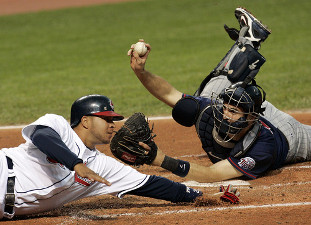
The younger Mauer hit .400 in his first professional season, then better than .300 in each of his two succeeding minor league seasons and his rookie major league season. He slipped to .294 in 2005 and .293 in 2007, but in the alternating seasons of ‘06 and ‘08 he hit better than .300 and won batting titles.
But in neither of those seasons did he hit the way he has this year. He missed the first 22 games because of a sciatic nerve problem in his back, but he hit .414 his first month back and was still hitting .400 three weeks into June.
He cooled off and dropped to .354 with one game left in July, but in the next 18 games (through last Wednesday) he batted .480 (36 for 75) with a .536 on-base percentage and an .880 slugging percentage.
“He was very good early when he came off the disabled list,” Ryan said, “and the last two or three weeks has gone right back to where he was.”
Mauer entered the weekend with a league-leading .378 batting average, and the closest catcher to him was A. J. Pierzynski at .311. Even more significant, the other 17 catchers who had started at least 45 games were hitting a composite .251.
Mauer does not have an insurmountable lead for his third league title. That’s because of the presence of two-time champion Ichiro Suzuki, who was hitting .363.
WATCH THE PIRATES’ MAGIC
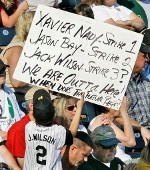 With 42 games left on their schedule before Saturday, the Pittsburgh Pirates’ magic number was 12. What’s that? The Pirates mentioned in the same sentence as magic number?
Well, yes, except this magic number is unique to the Pirates and has nothing to do with clinching a division championship.
The Pirates had to lose only 12 of their remaining 42 games to clinch their 17th successive losing season, an achievement that would leave them alone in the record book for having the most consecutive losing seasons.
When the Pirates lose No. 82, Jack Wilson, Freddy Sanchez, Adam LaRoche, Nate McLouth, Nyjer Morgan, Ian Snell, John Grabow, Tom Gorzelanny, Jason Bay and Xavier Nady will not be there to celebrate the grand event. The Pirates have traded all of them away in the past year or so.
IN DETROIT, EVERY DAY IS FATHER’S DAY
Any father is proud of a son who earns a job in the majors. A father who is a baseball club official is especially proud. But how about a father who is a baseball club official and his son not only earns a job in the majors but he also begins his major league career the way Alex Avila has?
Al Avila is vice president and assistant general manager of the Detroit Tigers. Through no influence of his, the Tigers drafted Alex Avila in the fifth round of the 2008 draft.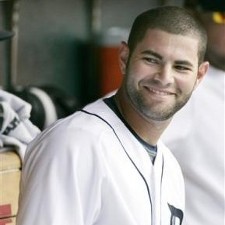
“Our scouting director, David Chadd, who is one of my best friends, approached me and said ‘I’m going to draft Alex.’ I said no you’re not. I want someone else to draft him. We had several discussions. I was part of the draft meetings, but when they talked about Alex I stepped out.”
On draft day, when the Tigers’ turn came in the fifth round, Avila related, “David said, ‘He’s the best player on the board, the player I feel most comfortable with.’ We’ve always taken the best player on the board.”
So the Tigers, who had also drafted him in the 34th round of the 2005 draft but didn’t sign him, selected Alex Avila, the 21-year-old catcher from the University of Alabama, oldest of Al and Yamile’s three children and grandson of Ralph Avila, retired long-time executive of the Los Angeles Dodgers.
Only 14 months after he was drafted, Avila made his major league debut. “It caught me by surprise when I was told we were bringing up Alex,” the elder Avila said.
One reason for Alex’s rapid advancement has been his conversion to catching in his junior year at Alabama and his rapid improvement at the position.
Asked to assess his son from a professional’s, not a father’s, viewpoint, Avila said, “His improvement behind the plate has been tremendous. All the guys in the organization have said his improvement has been off the charts. If you saw him catching for Alabama and see him now, you’d see the difference. He has soft hands, he blocks balls in the dirt, he has better than average throws to second. He’s very accurate. His defense has been a major improvement in just a year and a half.”
As a hitter, Avila said, Alex has always been good. He hit .305 in his rookie season last year. But his hitting in his initial games with the Tigers has been better than good. In nine games before the weekend, Alex drove in nine runs and hit .435 with 10 hits in 23 at-bats, including 3 home runs and 4 doubles. He had a 1.000 slugging percentage and .500 on-base percentage.
Before he gets carried away with that early performance, though, he can look at Trent Oeltjen, the Arizona rookie outfielder, who recently had 12 hits in his first 24 major league at-bats, then had 2 hits in his next 24 at-bats.
“In baseball it’s the law of averages,” Al Avila said. “If you’re going to play baseball at the major league level you have to understand the highs and lows. This is something we’ve gone over his entire career. When you’re doing great you’re not that great and when you’re doing bad you’re not that bad. You have to keep an even keel. Alex has that temperament.”
What does Avila think now of the decision to draft Alex? “As I see it today he made a tremendous decision and it was the right decision,” he said. “He knew if he didn’t take him then someone would have taken him soon afterward. We got messages saying we were going to take him.”
WHEN A CONTRACT ISN’T A REAL CONTRACT
When free agency in baseball was created in 1976 in a negotiated agreement that followed an arbitrator’s decision, the head of the National Football League Players Association criticized and ridiculed the baseball union for bargaining away the players’ rights to complete free agency.
Although the baseball union could have insisted that the owners follow the arbitrator’s ruling, the union leader, Marvin Miller, was smart enough to know that establishing some limitation made more sense and agreed that players would have to play in the majors for six years before becoming eligible for free agency.
 Ed Garvey, the football union leader, did not understand what Miller understood and berated Miller for the plan he accepted. The ensuing history, of course, demonstrated how brilliant Miller was and what a boob Garvey was. N.F.L. players have never had the type of free agency that has made baseball players wealthy.
The difference can also be seen in the kind of contracts baseball and football players sign. When Mike Hampton, for example, signed an 8-year, $120 million contract with Colorado in 2000, the entire contract was guaranteed. Hampton spent much of the life of that contract on the disabled list, but he was paid every dollar that the deal provided.
The same goes with all of the other big contracts that have been signed since the beginning of free agency, including those that CC Sabathia, A. J. Burnett and Mark Teixeira signed with the Yankees last winter totaling $423.5 million.
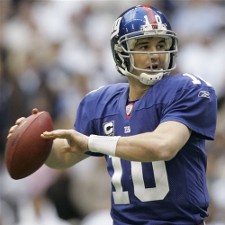
In the N.F.L., however, teams get away without guaranteeing contracts. The union was never strong enough to force that requirement because their free-agency plan was flawed. Thus, when Eli Manning recently agreed to a lucrative contract extension with the New York Giants, it was reported to be a $97.5 million deal. But oh by the way, only $35 million is guaranteed. Big difference.
Members of the news media aren’t responsible for paying out the money, but they are responsible for reporting a contract’s value accurately and they don’t do a good job with their reporting. Reports of the Manning extension said it gives him an average salary of $15.3 million a year, but with only $35 million guaranteed, the average is $5.83 million, but no one reported it that way.
Does it matter? Yes, because fans are given incorrect information. If Manning completed 10 or 20 passes for 200 yards and reports of the game said he passed for 400 yards, they would be wrong. Fans would find those reports troubling. So should they find incorrect contract reports troubling?
On the other hand, these are the same fans and reporters who meekly go along with the N.F.L. pretense that its teams don’t play exhibition games but pre-season games. At least baseball has too much respect for its fans’ intelligence than try to call their March games pre-season even though they are played before the season.
SHEFFIELD NOT GOING QUIETLY
Gary Sheffield has done a lot in his career that he can be criticized for, but asking the Mets for a contract extension last week was not one of them. That’s because, contrary to newspaper reports, Sheffield didn’t ask for a contract extension.
I was pleased to hear that correction because I have long liked Sheffield for his play on the field but have found some of his off-field antics unfortunate.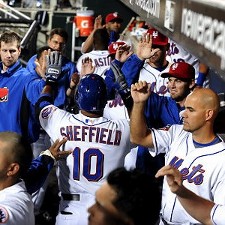
No one plays the game harder than Sheffield. No one is more willing to play hurt. No one hits the ball harder. But Sheffield the negotiator leaves much to be desired. He has punctuated his career with attempts to strong-arm teams into giving him contract extensions when they have no reason to give him an extension.
This, however, wasn’t one of those instances. The 40-year-old outfielder had heard that the Mets had put him on waivers, that the San Francisco Giants had claimed him and the Mets had withdrawn the waivers.
Confused about the development, Sheffield asked general manager Omar Minaya what the team’s plans were for him after this season.
“He didn’t ask for an extension,” Minaya said. “This was more about wanting to know our plans for him next year. He asked do you have any plans for me next year. I said I can’t tell you.”
Minaya tried to trade Sheffield to the Giants, but the player they offered didn’t impress him. “We’ve got a player who’s producing,” Minaya said. “We still have to win games here.”
Sheffield , Minaya added, “has been a model citizen. He’s been a great teammate and he’s done everything for the team.” Except ask if and where he fits for next season. And when he didn’t get the answer he wanted to hear, he asked out of the lineup for that night’s game.
Sheffield, of course, acted impetuously and didn’t think first. Why should the Mets tell him anything right now? They have not completed their disastrous season. They have not begun to figure out what and whom they have and whom they need for next year. There’s no reason for them to tell Sheffield in August what their plans are for him, if any, for next April.
But at least he didn’t ask for a contract extension.
FIRST AARON, NOW SCHMIDT
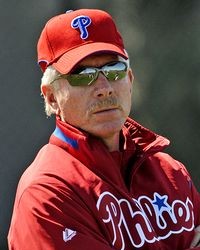 Mike Schmidt has joined fellow Hall of Famer Hank Aaron in putting his mouth where his brain should be. In a column written for the Associated Press, Schmidt echoed recent comments Aaron made in advocating Pete Rose’s eligibility for and election to the Hall of Fame.
Schmidt maintains that baseball has created a double standard because it has punished Rose for betting on baseball but has not punished players who used steroids.
“Pete bet on his team to win and has been banished from baseball for life,” Schmidt wrote. “Manny Ramirez, Alex Rodriguez et al bet that they would get bigger, stronger and have a distinct advantage over everyone and that they wouldn’t get caught. Which is worse? Does the penalty fit the crime?”
Schmidt makes critical mistakes in that position. The players he cites are active and not yet eligible for the Hall of Fame. When they become eligible five years after they retire, voting members of the Baseball Writers Association will decide if they should be in the Hall. Commissioner Bud Selig does not get a vote.
But the mistake that to me is most telling is the one many Rose supporters make: He bet on his team to win.
Since Schmidt evidently hasn’t caught up with this 20-year-old fact, he should know that Rose might not have ever placed a bet against the Reds, but his betting pattern, uncovered by baseball’s investigator John Dowd, showed that when Bill Gullickson pitched for the Reds, Rose did not bet on them to win.
By betting on other games but withholding a bet on a Gullickson game, Rose was telling the bookies he didn’t think Gullickson could win. That gave the bookies an edge that their bettors didn’t know about. Now Schmidt knows it, too.
