Masahiro Tanaka is on pace for the greatest rookie pitching season since World War I.
Mark Fidrych in 1976, Fernando Valenzuela in 1981, Dwight Gooden in 1984—by October, Tanaka in 2014 could be the new go-to reference for immediate success to start a career.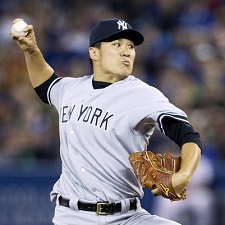
His most recent start, on Tuesday night against Toronto, is indicative of his rookie campaign thus far. The Yankees began a three-game series trailing the Blue Jays by 4.5 games in the division; they turned to their new ace in the first contest, and Tanaka didn’t disappoint. After surrendering a home run and two singles in the first inning, Tanaka pitched five scoreless frames, allowing just two more runners to reach scoring position and striking out 10 for the fifth time this year. The best offense in baseball could hardly even make contact, and three runs of support were enough for Tanaka, who earned his league-leading 11th win.
Just 14 starts into his MLB career, Tanaka is the heavy favorite to win both the American League Cy Young and Rookie of the Year Award—he would be the first to win both trophies in the same year. He also leads two pitching Triple Crown categories (wins and earned run average) and sits just eight strikeouts behind David Price in the third; winning all three would be a first for a rookie and is a feat that has been accomplished almost exclusively by Hall of Famers.
But let’s not get ahead of ourselves and give Tanaka a plaque in Cooperstown just yet. Instead, let’s appreciate just how good he has been for a first-year pitcher. Among qualified rookies, Tanaka’s 1.99 ERA ranks second in the last 100 years, barely behind Scott Perry’s 1.98 mark in 1918. Since the 1969 expansion, though, Tanaka has the best ERA with room to spare, besting Jose Fernandez’s 2.17 from last year. Beyond ERA, Tanaka tops every rookie pitcher from the last century in categories just about every fan can appreciate.
He leads in traditional measures such as win-loss percentage, and at his current pace, he would end the season with 25 wins, breaking the current record of 22 set by Monte Weaver back during the Great Depression. Midway along the metrics continuum, Tanaka has the best rookie marks in WHIP and strikeout-to-walk ratio, and at the most “advanced” end, he holds the all-time lead in ERA+, a metric that is relevant here because it aims to standardize a pitcher’s performance across eras. As a reference for just how unique Tanaka has been, the difference in ERA+ between him and the second-best rookie from the last century (Jose Fernandez) is the same as the career difference between David Price and Oliver Perez.
Tanaka’s excellence has been much needed for the Yankees, who made the Japanese star the fifth-highest-paid pitcher in history before he had ever thrown a pitch in the majors. New York missed the playoffs last year, and Tanaka has been the main factor keeping the middling Yankees in contention so far this season. Take out the team’s 12-2 record in games Tanaka has started, and New York would have a worse winning percentage than the Astros. Besides fellow rookie Chase Whitely, who has pitched well in the last month, Tanaka is the only member of the rotation with a winning record or an ERA better than 4.32.
The Yankees sit near the top of a jumble of 11 teams within six games of a wild card berth, and with three-fifths of the Yankees’ rotation out for at least another month—CC Sabathia until July, Michael Pineda until August, and Ivan Nova until next spring—they will continue relying on Tanaka to keep them afloat in the race. But there’s bad news for Yankee fans: unless Tanaka is an outlier among outliers, he has little chance of duplicating his performance thus far in the season’s second half.
The combination of skill, health, and luck necessary to produce such a dominant stretch of starts is simply too difficult to maintain for an entire season to be done with any regularity. Consider the 50 best first-half pitching performances of the last two decades, sorted by ERA. Only four of these pitchers fared better in the second half of their respective seasons, while a massive portion of the sample—44 of the 50—saw their ERAs rise. (The remaining two are Kevin Brown, whose first- and second-half numbers in 1996 were identical, and Brandon Beachy, whose 2012 season was cut short in mid-June for Tommy John surgery.)
These 50 second-half numbers were still impressive, as would be expected with names such as Maddux, Kershaw, and Clemens populating the list. But these 50 seasons saw an average ERA increase of 1.45 runs between the first and second halves; a similar drop-off for Tanaka would put him in undistinguished company closer to the league average than its lead.
A similarly pessimistic pattern exists for starting pitchers debuting in the MLB after pitching in Japan. Six Japanese pitchers have started more than 25 games as a rookie, and all six of them performed markedly worse in the second half of that first year. Taken as an average, Hideo Nomo, Masato Yoshii, Kaz Ishii, Daisuke Matsuzaka, Hiroki Kuroda, and Yu Darvish accumulated a 3.31 ERA before the All-Star break in their rookie seasons, but that number rose to 4.45 after the break. Each of the six recorded ERAs lower than 4.00 in the first half, but only Nomo bettered that benchmark in the second. And despite winning 64% of their first-half decisions, they had a cumulative losing record in the second half.
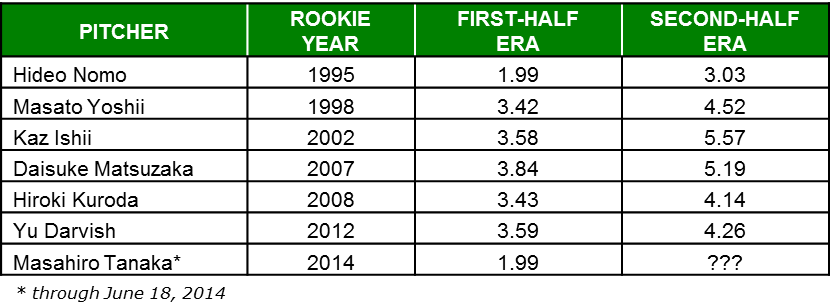
Curiously, this trend isn’t present for all first-year pitchers. Per Baseball Reference’s play index, between 1995 (Nomo’s rookie year) and 2013, 42 other first-year pitchers started more than 25 games (first-year pitchers, not all rookies, were used for this comparison to eliminate any potential advantages a pitcher might gain from a short big league stint before his full rookie year).
Unlike with the sample of just Japanese pitchers, this group had a near-even split between first- and second-half performance, with 23 holding a better first-half ERA and 18 a lower mark after the All-Star break (Horacio Ramirez, like Kevin Brown in 1996, had no difference between his two halves). It doesn’t seem that there is something inherently difficult about maintaining success as a rookie; this finding eliminates, for instance, the argument that perhaps first-year Japanese pitchers struggle in the second half because opposing hitters adjust to the new hurlers’ tendencies as the season progresses.
Nor does there seem to be anything inherently difficult about maintaining success when playing outside Japan for the first time. First-year Japanese hitters over the same time frame displayed no similar trend and, as a whole, played equally well in the first and second halves of their rookie seasons.
But combine “rookie pitchers” and “Japanese,” and there is an undeniable pattern. The most likely explanation concerns the pitchers’ transition from the larger rotations in Japan to the five-man staffs in America.
In Japan, not only are regular seasons shorter, meaning pitchers start fewer games each year (Tanaka’s career high was just 28), but starters also typically enjoy five or six days of rest between starts. In their rookie years in the MLB, 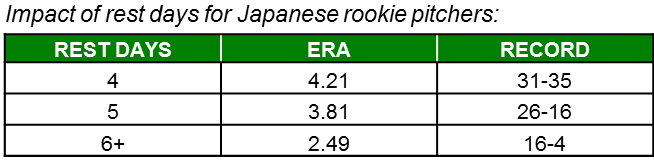 Japanese pitchers performed much better with that amount of time off. The six full-time starters studied earlier were merely mediocre on the standard four days between starts but improved to above-average with five days of rest and Cy Young-quality when given six days or more.
Hiroki Kuroda and Kaz Ishii as rookies, for instance, were worse than league average with four or five days between starts but turned into Bob Gibson circa 1968 when given more, each holding opponents to just two runs total in four starts on extended rest.
Tanaka, for his part, has had one start with more than five days of rest this year: a gem against the Cubs on April 16 in which he allowed just two hits and struck out 10 in eight shutout innings. The only reason the extra-rest trend doesn’t completely hold for Tanaka is that he’s been pretty dominant on four and five days between starts, too.
This performance difference disappears across Japanese pitchers’ entire careers, indicating that over time pitching in America, they grow accustomed to pitching on less rest. Whether or not rest variations between appearances can help explain Japanese starters’ tendency to fade in their first year with a new pitching schedule is not entirely confirmed, but it’s a start.
Though the last 800 words have all pointed to Tanaka spending August and September struggling to maintain a sub-2.00 ERA or throw a quality start every time on the mound, there is still some room for optimism.
Tanaka allowed just 10 home runs in nearly 400 innings across his last two seasons in Japan, but he’s already given up that many in a quarter of the innings this season. It makes sense that Tanaka might be more homer-prone facing better hitters in the MLB, but the numbers suggest that he has been unlucky in this regard.
It might be heresy to cite home-run-to-fly-ball rates on this website, but I’ll take the risk. The percentage of fly balls hit off Tanaka that have gone for home runs (13%) is quite high, suggesting that it is likely to decrease and that Tanaka will probably  start surrendering fewer homers. A 13% rate is by far the worst among any of the top 10 pitchers in ERA this year—most of whom have HR/FB rates hovering around 4 or 5%—and Tanaka allowed only eight earned runs all year that didn’t come from home runs, so imagine—and salivate, Yankees fans—at what he might do once his fly balls start landing short of the fence.
At any rate, it’s clear that general manager Brian Cashman was underselling his new purchase in the offseason when he predicted that Tanaka would be a No. 3 starter. Not many players can make $155 million look like a bargain, but that’s what Tanaka has done so far; he is the team’s undisputed ace, and he’ll remain in that slot even if his ERA rises by 1.45 runs in the second half and he doesn’t one-up Fernandez for the best rookie season in the modern era. And if he can propel the Yankees to at least a wild card berth, New York will almost assuredly have the pitching advantage in the playoffs’ play-in game.