The talk is all Tommy John surgery. There’s so much of the elbow injury going around, it must be contagious, like the black plague or MRSA. Every day seems to bring a new pitcher to the operating room. Or maybe he’s been there before for the same reason.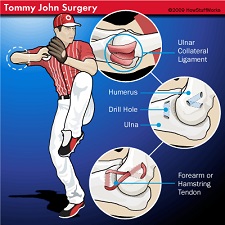
Much has been written about Kris Medlen, Brandon Beachy, Daniel Hudson, Jarrod Parker and Patrick Corbin, among others, but nothing new has been introduced into the discussion. Only speculation is offered about why pitchers tear or otherwise damage their ulnar collateral ligament and need to have it replaced by a tendon, often from the opposite wrist.
No one can explain why pitchers from earlier decades, such as Robin Roberts, Ferguson Jenkins, Bob Gibson and Tom Seaver, never encountered the problem despite the number of pitches they threw and the number of innings they pitched.
Some of their contemporaries incurred elbow injuries and had their careers end. That was before Dr. Frank Jobe introduced Tommy John surgery to Major League Baseball in 1974 by reconstructing John’s left elbow.
Despite the frequency and popularity of the operation, statistics are not readily available on the number of pitchers who have had the transplant operation.
The New York Times reported this week that about a third of all major league pitchers have had at least one ligament transplant operation, but it states it as a fact without attributing the information to any particular source, contrary to Times policy of a previous era.
However, in researching the subject I found a bleacherreport.com report by Will Carroll last July that said, “One-third of current MLB pitchers have had Tommy John surgery. Of the about 360 who started the season, 124 share the all-too-familiar triangular scar.” Perhaps that’s where Tyler Kepner got the information for his Times column.
In an earlier but more extensive report, USA Today in 2007 quoted the office of Dr. James Andrews, today’s most noted elbow surgeon, as saying he had performed 1,169 Tommy John operations in the 12-year period 1994-2005.
Besides the rash of elbow injuries, Tommy John surgery gained renewed prominence the past week because its creator died. Dr. Jobe died at the age of 88. The Hall of Fame honored him last July for the impact he had on baseball, which is more than it has done for Marvin Miller and the impact he had on baseball.
Jobe’s death, in my view, prompted a most intriguing comment about the operation he introduced into the game. It came in the form of a letter to The New York Times, written by Sol Gittleman, a former Provost and professor at Tufts University in Medford, Mass. for 50 years and a knowledgeable, life-long baseball fan.
 Although I have never met Dr. Gittleman, who is 79 years old, I have known about him for years because my daughter, son-in-law and son took courses with him, including Introduction to Yiddish Literature and Major German Writers of the 20th Century. He also teaches America and the National Pastime, which covers the history of baseball from the Civil War to the present.
In addition, he sent me an autographed copy of his 2007 book about the New York Yankees’ 1949-53 dynasty, “Reynolds, Raschi and Lopat.”
When I saw Gittleman’s letter in the Times, I contacted him and he provided me with his original letter, which the Times had edited:
The passing of Dr. Frank Jobe, (“Surgeon Who Saved Pitchers’ Careers”, March 6), gives me hesitant pause to ask the awkward questions: how different is having Tommy John surgery from using steroids? If the Steroid Age is asterisked in people’s minds, shouldn’t the period of “Frankensurgery” also be mentally asterisked? John was simply not the same pitcher after he had the surgery, which is now becoming elective. One-third of Major League pitchers have had it, whether they need it or not; and now some high school hurlers are asking their parents for a “Tommy John for Christmas”. If there is a Steroid Era, there should be a Tommy John Era; it’s all performance enhancement and career-extending. John pitched until he was forty-six: should all of those post-surgical wins be counted equally?
I was intrigued by Dr. Gittleman’s question because I have had similar questions about what players are permitted to do in recovering from injuries and what they are not.
While I have found problems with players who cheat, that is, use steroids, which are illegal, I am not convinced about the contradiction between players using machines to rehabilitate injuries but not substances like steroids, which can hasten recovery.
I posed the question Wednesday long distance to Rob Manfred, baseball’s chief operating officer, who was in Australia for the opening games of the season between the Dodgers and the Diamondbacks.
“I see the issues as very different,” Manfred responded in an e-mail. “Tommy John is a legal surgery that corrects a documented injury. It hopefully puts the player back where he was prior to the injury. Performance enhancing drugs are illegal and they are used to improve the performance of the player from his natural ability.”
I am certain that Manfred’s view is also that of Commissioner Bud Selig, but to me, it’s like the way baseball has always excused the excessive use of alcohol by players and members of management. Liquor is legal so its use is OK. Use of drugs is wrong because they are illegal.
I’m not suggesting that players should be permitted to use cocaine, but baseball could limit the use of legal alcoholic beverages in clubhouses and issue sterner discipline for managers and other management personnel for offenses like drunk driving.
I’ve strayed from steroids and Tommy John surgery, but I don’t often have a chance to raise the issue of baseball’s liberal view of alcohol.
As for elbow injuries, many people think pitchers throw too much. I think they don’t throw enough. Since the late 1960s, I believe pitchers have been pampered to the point where they are not trained properly in the minor leagues.
Organizations fear injuries will result if they let young pitchers throw too much in the minor leagues. Those young pitchers, though, are the ones having Tommy John surgery. Let them throw in the minors and build up their arm strength. The pitcher for whom the surgery is named is himself a proponent for pitchers throwing more often.
When he resumed pitching after his revolutionary 1974 operation, John adopted a pattern of throwing every day, not pitching but throwing. He pitched his final game four days after his 46th birthday.