Roberto Alomar is on the Hall of Fame ballot for the first time, and what memory does his name evoke? Not his .300 career batting average, not his combined .814 on-base and slugging percentages, not his 2,724 hits, not his 10 Gold Gloves in an 11-year stretch or his four Silver Sluggers or his presence on 12 consecutive All-Star teams.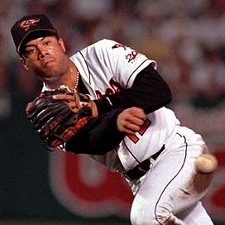
No, none of those. Those achievements will determine whether or not Alomar is elected to the Hall but so will the event that is best remembered from the second baseman’s 17-year career.
It occurred on Sept. 27, 1996, three days before the end of the season, in the first inning of Baltimore’s game at Toronto. John Hirschbeck, the home plate umpire, called Alomar out on strikes, Alomar vehemently disagreed, a heated argument ensued and Alomar spat in Hirschbeck’s face. It was an ugly scene, and it was a rare response by a player in a dispute with an umpire.
Spitting was bad enough. But Alomar, saying Hirschbeck uttered a racial slur at him, added a verbal shot, saying the umpire was bitter because one of his sons had died of a rare disease and a second son had just been diagnosed with it.
No way Hirschbeck would support Alomar’s candidacy for the Hall of Fame, right? Let’s not assume anything. Let’s ask him. John, do you want to see Alomar kept out of the Hall of Fame because of that incident?
“Absolutely not,” he replied. “I mean this with all my heart. It took a while. Because of the incident and everything that happened after that, it was difficult. But after he and I talked and worked things out, I hold no animosity whatever. I would hope people would not hold that incident against him. If that’s the worst thing he did in his life, he’s had a great life.”
Hirschbeck even looked for a reason for Alomar’s reaction to the called third strike. “He had a bad day or it was a pitch that was probably too far outside,” he said, then added, “I would hope people would not hold it against him. I don’t hold it against him.”
Alomar moved to Cleveland as a free agent in December 1998. That decision turned out to be critical in his relationship with Hirschbeck.
“I was in Cleveland early in May,” the umpire related, referring to the 1999 season. “Our clubhouse guy there, Jack Esta, is a personal friend of mine. I pulled him aside and said now that you’ve been around Alomar what do you think of him. He said, ‘John, he’s one of the two nicest people I’ve met in life. You’re the other one.’
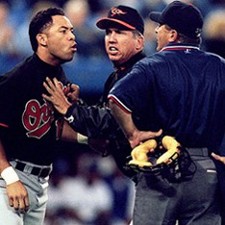 “That night I had first base and I said, ‘Hey, Rob, how ya doing?’ The flood gates opened. My wife said ‘What were you guys doing?’ He talked to me the whole night. It’s been fine ever since.”
More recently, Alomar heard that Hirschbeck had developed testicular cancer and, the umpire said, called him. “We talked for a while,” Hirschbeck said.
The cancer was discovered late last season, Hirschbeck, 55, said, and he had surgery. “Everything looks pretty good,” he said. “I’m healthy. I go for my first checkup the first week of January. I plan on working. I’m close to retirement, but I’m going to work this year.”
Despite his own problems, Hirschbeck remains concerned that Alomar will suffer in the Hall of Fame voting because of their incident.
“I would feel so bad if anyone held that against him,” Hirschbeck said. “The guy is probably the best second baseman I ever saw in 27 years in the major leagues and that includes Joe Morgan. Nothing against Joe but I just feel Robby had more artillery in the arsenal.”
The incident, Hirschbeck said, feeling the need to emphasize his feeling, “shouldn’t have anything to do with his getting into the Hall of Fame.”
HAS THE DH’S TIME ARRIVED?
Edgar Martinez is also on the Hall of Fame ballot for the first time, and he has his own stigma to overcome. He was a designated hitter for much of his career.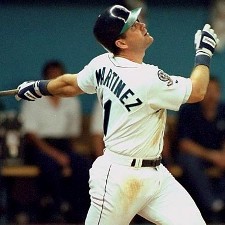
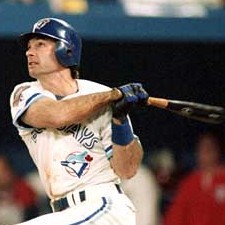
Martinez is the first player who will test the designated hitter’s role in baseball vis a vis the Hall of Fame. Paul Molitor, who was inducted into the Hall in 2004, is remembered as a designated hitter, forced into the position by injuries, but he was a latter-day DH.
He served primarily as a DH in approximately the last third of his 21-year career, but he had already been an everyday position player for 11 years, concluding that portion of his career in 1990, when he was a DH in 4 games and played second, first and third in 99 games.
Like Molitor, Martinez began baseball life as an infielder. Molitor was a second baseman, Martinez a third baseman. Martinez shifted to DH in his sixth full season, 1995, and batted from that spot almost exclusively for 10 years
Here, courtesy of Elias Sports Bureau, is a breakdown of their careers divided into times at bat as a DH and times at bat while playing positions in the field. The numbers show that 70.9 percent of Martinez’s at-bats were as a DH while Molitor’s DH at-bats came to 43.6 percent.
Martinez as DH: 1,607 hits, 5,111 at-bats (.314); non-DH: 640 hits, 2,102 at-bats (.304)
Molitor as DH: 1,457 hits, 4,727 at-bats (.308); non-DH: 1,862 hits, 6,108 at-bats (.305)
Martinez poses two questions for voters:
- Should his DH status count against him because he wasn’t a two-way player?
- If the answer to that question is no, does his career warrant Hall of Fame election?
You could get a spirited debate on the first question and not get an undisputed answer. The way I see it, Martinez’s DH activity should not be held against him or any other DH. The Seattle Mariners gave him a role to fill, and he filled it quite capably. The American League created the DH, and players should not be penalized for doing that job.
A player who isn’t a DH can benefit in voters’ views if he is a terrific defensive player, but seldom is a player’s mediocre defense held against him.
When I first voted for the Hall of Fame Ralph Kiner was on the ballot, and I initially did not vote for him. I watched him play when I was growing up, and his play in left field was less than impressive. As far as I was concerned, his defense undermined his Hall of Fame home run-hitting credentials.
 But by the time Kiner was on the ballot for the last time, in 1975, I had decided I was being unfair because I had seen him play more than others of his time in the majors so I was judging him on a basis different from others. In other words, I wasn’t penalizing anyone else for mediocre defense so I voted for him.
Will I vote for Martinez? I don’t know because my ballot sits on my desk unmarked and will remain that way until I have to submit it Dec. 31.
I also don’t know if I will vote for Roberto Alomar and Barry Larkin, but I am considering them. I am also reconsidering Andre Dawson and Bert Blyleven. I didn’t vote for them last year, which was the first year I voted in many years after I left The New York Times, which didn’t allow its employees to vote.
I do know that I will not be voting for Mark McGwire, who undermined his candidacy at a 2005 Congressional hearing by saying “I’m not here to talk about the past.”
In three years on the ballot McGwire has not received more than 24 percent of the vote. His chances might improve once he has the news conference he is expected to hold in connection with his new job as hitting coach of the St. Louis Cardinals. But that remains to be seen because we don’t know what McGwire will say about any use he might have made of performance-enhancing substances during his playing career, especially the year he hit 70 home runs.
MO’S BUDDY GOES TO COOPERSTOWN
Whitey Herzog has been elected to the Hall of Fame, and his good buddy Mo Chase congratulates him. Who is Mo Chase and why am I passing on his congratulations to the former manager? I am Mo Chase, and I am congratulating Herzog because he gave me that name.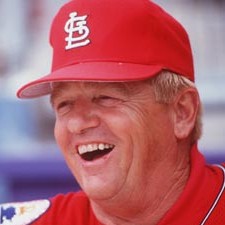
Herzog was the manager of the St. Louis Cardinals when he came up with that name for me. He was talking to reporters in his office before a game one night, and I called him about something I was writing. He got off the phone and said to the people in his office, “That was Mo Chase.”
The Chase was understandable. Many people have mispronounced my last name. But the “Mo” was strictly Whitey’s own creation. People named Maurice are or were often called “Mo,” and I guess to Herzog my first name was close enough to warrant the use of “Mo.”
But his name for me posed a quandary. When I would call him subsequent to his naming me, how should I identify myself? If I said it was Mo Chase, I would be reinforcing his belief that that was my name. But if I said it was Murray Chass, would he know who was calling?
I’m not sure I ever satisfactorily resolved that question.
Herzog readily took my calls because we had developed a good relationship. It stemmed from an ugly incident in which Herzog, then manager of the Kansas City Royals, tried to throttle me. It happened before a playoff game between the Royals and the Yankees at Yankee Stadium.
In a group of reporters on the field, I asked Herzog a question about Larry Gura, one of his starting pitchers, that he misinterpreted. He thought I was being critical of him, but I was referring to the way the Yankees used Gura when he pitched for them. Herzog responded angrily and loudly.
Some time later a reporter who had heard Herzog’s voice but not the question asked me what precipitated the outburst. I was in the process of telling him when Herzog, bat in one hand, came rushing toward the batting cage, where we were standing, and grabbed me by the throat with his empty hand.
“I wanna hear what you’re saying,” he said menacingly.
I was stunned, as was everyone who witnessed the scene. I don’t know how long Herzog kept his large hand wrapped around my throat, but it was long enough that I felt his hand the rest of the evening.
When he removed his hand, I explained to him that he had misunderstood my question, that I hadn’t been referring to him and wasn’t criticizing him.
“Oh,” he said, suddenly contrite. And then sincerely, “I’m sorry.”
Maybe half an hour or an hour later we passed in the runway leading from the dugout to the clubhouse, and he apologized a second time. From then on through the rest of his career he was my best buddy, and I was Mo Chase.
SPEAKING IN BAD FAITH
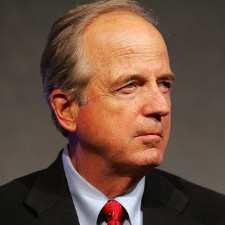 While doing research on collusion recently I came across an article I wrote on the subject in February 1987. It included, in retrospect, a mind-boggling comment from Peter Ueberroth, who was the baseball commissioner. Ueberroth was reacting to the growing number of grievances and threats of legal action against club owners.
“This is the only situation I know,” Ueberroth said before there had been any finding of collusion, “where people are testifying in legal proceedings against the buyer, so to speak, and threatening legal action outside the grievance procedure, and then expect that same person to negotiate in good faith and give a player a million-dollar contract. It doesn’t work in commerce; it doesn’t work in enterprise. It’s totally inconsistent; it’s too abrasive.”
Want to talk about negotiating in good faith? The players and owners negotiated a new collective bargaining agreement in August 1985. It included a provision in the free-agency rules that “clubs shall not act in concert with other clubs.” Three months later the clubs were acting in concert with other clubs.
Ueberroth, one of the central figures in the owners’ collusive activities, knew when he made those comments in February 1987 that the clubs were violating the labor agreement. Yet he talked about the poor-faith acts of the players.