The Yankees and the Dodgers may very well play each other in the World Series in October, as the odds established by the Las Vegas bookmaker Bovada forecast, but before they get there they have a common opponent they’re determined to overcome. It’s called the luxury tax threshold.
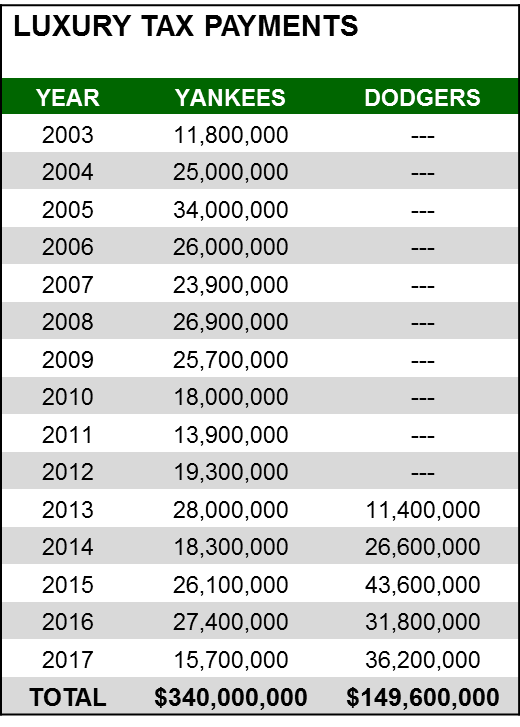
In the threshold’s 15-year existence the Yankees have never conquered it, paying a luxury tax every year ranging from $11.8 million to $34 million a year for a total of $340 million. The Dodgers, a latecomer to the challenge, have a five-year streak in progress, having contributed $149.6 million to the luxury-tax pool, their annual payments soaring as high as $43.6 million.
Both teams want to avoid the tax this year, though the Yankees have been more outspoken about it than the Dodgers.
“There’s no chance, zero chance of going over the threshold,” Randy Levine, the Yankees’ president, said “It’s not going to happen. There’s too much involved – money, draft picks.”
Avoiding the luxury tax was the reason the Dodgers made a blockbuster five-player trade with Atlanta last month, though they haven’t acknowledged it publicly.
When I recently asked Stan Kasten, the Dodgers’ president and CEO, about the luxury tax, he said, “I won’t discuss it at all. I’ve never discussed that since I’ve been here.”
Andrew Friedman, whom Kasten hired as president of baseball operations in 2014 after the Mark Walter group bought the Dodgers for $2 billion, didn’t utter the words “luxury tax threshold” when he slashed the team’s luxury tax payroll by trading Adrian Gonzalez and three other players to Atlanta for Matt Kemp.
“Obviously,” Friedman said at the time, “one of the main considerations in this deal were economic. But also the bigger picture, the long-term plan. It’s a necessary, strategic part of moves yet to come. Whether that’s this offseason, in July or next year, this move allows for increased flexibility going forward at a time when we have some depth.”
But he did not mention the luxury tax. It’s as if the commissioner has instructed club officials not to speak those words. If they are spoken enough, people might get the idea that the luxury tax serves as a salary cap or a payroll cap.
The union, however, has always opposed a salary cap so it wouldn’t likely agree to a plan that could be used as a cap.
Last year five teams exceeded the tax threshold. Five teams would not exceed a cap.
 I wonder, though, if there’s another name for what the clubs are doing. In case you haven’t noticed, many of this off-season’s premier free agents remain unsigned. Spring training is only a month away, and J.D. Martinez, Eric Hosmer, Mike Moustakas, Lorenzo Cain, Jake Arrieta and Yu Darvish don’t have anywhere to go.
When I came across a list of unsigned free agents, my first thought was collusion. Commissioner Rob Manfred would scoff at such a thought, but 32 years ago, when teams weren’t even making offers to free agents and I wrote or mentioned collusion, Barry Rona, the clubs’ chief labor official, laughed derisively. I don’t know where Rona is laughing now, but the $280 million laugh is on him.
I am not suggesting the owners are acting in concert against free agents; not even Tony Clark, the head of the players association, is doing that, but he is watching developments closely and taking notes.
The owners were forced to pay $280 million for their illegal collusion in the 1980s, and you would think they wouldn’t want to do the same thing again and incur the same kind of penalty again. But only two owners, Jerry Reinsdorf of the White Sox and Fred Wilpon of the Mets, remain from those illegally foolish days.
Collusion occurred so long ago that there are few people around who know the details. They include reporters who cover baseball and should know the history. Yet one prominent reporter acknowledged to former commissioner Fay Vincent that he didn’t know about collusion and asked Vincent to tell him about it.
Collusion, Vincent believes, is at the heart of the relations between players and owners. Prior to the 1994 players’ strike, collusion poisoned relations between the two sides. The owners’ effort to win a payroll cap was the very visible cause of the strike, but the ill feelings collusion engendered made it easier for the players to walk out and strike the game for 234 days.
There is another issue that has to be considered in the slow pace of the free-agent market. His name is Scott Boras, and he represents many of the most prominent free agents.
Boras has a well-known style of negotiating contracts for his clients. It can be called slow, slower and slowest. He is never in a hurry to sign a player, figuring there is always a more lucrative contract around the corner or down the street. Why not put off until tomorrow what you don’t have to do today?
Boras figures he creates anxiety in general managers with his slow style of negotiating. And it probably works more often than not.
I called Boras to discuss free agency in general, but he didn’t return the call. What I can say without talking to him, though, is his comments and criticism are usually aimed at clubs for their practices and at Major League Baseball for its rules that interfere with his negotiation. Sometimes he is right, but if baseball and the clubs did everything Boras thinks they should, he would be a much wealthier man.
As for the luxury tax, as the season nears, the Yankees and the Dodgers seem to be heading for success in their quest to avoid the tax.
With 15 major players signed, the Yankees’ luxury tax payroll is about $165 million. That figure includes about $14 million in benefits that is assigned to each club. The Dodgers are at about $126 million with 12 players signed. Both the Yankees and the Dodgers figure to be able to sign the other players on their 40-man rosters and remain under the $197 million threshold.
Their problem could come at the end of spring training or approaching the July 31 non-waiver trading deadline when a very good, very highly paid player becomes available and they are fighting for a division title or wild-card spot. If the player would put them over the threshold, what would they do?
I guess the way to look at that circumstance is wait until it happens.
In the event you are not well versed in luxury tax, I will tell you the reason the Yankees and the Dodgers want to be below the threshold is if they have paid the tax for three or more consecutive years, and then come in below the threshold, their luxury tax rate is reset from 50 percent to 20 percent. That’s a pretty good incentive even for the Yankees and the Dodgers.