The comment seemed strange coming from a general manager as sharp and as intelligent as Billy Beane.
“The way the system is right now,” the Oakland Athletics’ executive was quoted as telling mlb.com, “there really is no difference between a $75 million and $40 million payroll. I think a lot of small-market clubs look at that and ask, ‘Why pay $75 million when $40 million will buy me as many wins?’”
The comment seemed strange because so-called small-market teams (I prefer small-revenue teams) have exceeded Beane’s $40 million in recent years and have benefited from the expenditure. Consider these developments:
- The Minnesota Twins, a classic small-market team, had a $73 million payroll last season and won the American League Central championship. They would not have won it with a $40 million payroll. A year earlier they had a $65 million payroll and tied for first.
- Tampa Bay, as small a market as they come, was in contention with the Yankees and the Red Sox last season with a $71 million payroll. With a third of the season left, the Rays were only 5 games out on Aug. 1.
- The Rays’ payroll was as high as it was last season because the year before, 2008, they reached the World Series with a $51 million payroll, eschewing spending $10 million less to fit Beane’s theory.
- The 2007 season was full of teams that benefited from payrolls that Beane said they would have been better off avoiding: Cleveland ($72 million) and Arizona ($70 million) won division titles. Colorado ($61 million) was the National League wild card, edging San Diego ($67 million) with a 13-inning 9-8 playoff victory in the 163rd game of the season.
Certainly those teams wouldn’t have gained their positions had they played with a $40 million payroll. When asked about his comment, though, Beane said it had to be put in the context of what he had been talking about, which mlb.com hadn’t done.
“You can’t look at it as a rule of thumb,” Beane said. “It depends on your franchise. It doesn’t mean you would reduce your major league expenses, though we’ve had success spending half that. It depends on where you are as a franchise. Last year we spent a ton of money on our draft choices.”
In 2007 the Athletics had a $78 million payroll and finished third, 18 games from first. The next year they dropped the payroll to $55 million and finished third, 24 ½ games from first. But in July 2008 they signed a 16-year-old Dominican pitcher, 6-foot-7 Michael Ynoa, for a $4.5 million bonus, largest ever given to a Latin American amateur player.
“For us,” Beane said, “it’s a matter of allocating our resources at different stages of our development.”
The Twins allocated $72 million, $65 million and $73 million for their payrolls the past three years, and they finished in first place last year and tied for first the year before.
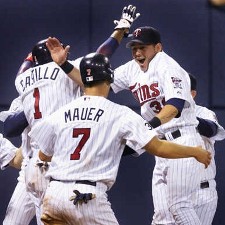 “I think every situation is different,” Bill Smith, the Twins’ general manager, said. “We have been in a very good cycle for most of this decade. Our payroll increases have been primarily to retain our own players. In our ideal world that’s how we would operate. We would retain our own players.”
They have retained most of their core players, but the cost has been greater than the Twins had become accustomed to. Yet Smith said, “When your team is in an up cycle, it’s money well spent.”
In a busy first three months of 2008, the Twins went a long way toward achieving their ideal, signing Justin Morneau (6 years, $80 million), Michael Cuddyer (3-$24 million) and Joe Nathan (4-$47 million).
The two players they didn’t sign were Johan Santana, whom they traded to the Mets, and Torii Hunter, who went to the Angels as a free agent. The Santana trade came in the same period the Twins were signing the other three players. Hunter (5-$90) signed with the Angels a few months earlier.
“It would have been difficult to sign Johan,” Smith said, “given the contract he signed with the Mets (6-$137.5 million). I have the highest respect in the world for Johan Santana, but he and Hunter were two players who had the charisma and poise to seek out a bigger stage. Torii wound up in southern California and Johan in New York. I think they were ready for the bigger stage. It’s not for everybody, but those two players were prepared for that. Looking back, if we had kept Santana another year, I don’t know what would have happened. We wound up in a tie with the White Sox without those two players.”
The core player the Twins don’t want to be without is their catcher and three-time league batting champion, Joe Mauer, who has one year left on his contract. The Twins have several factors going for them in their desire to sign Mauer to a long-term contract:
- A St. Paul native, Mauer has said he would like to stay with the Twins.
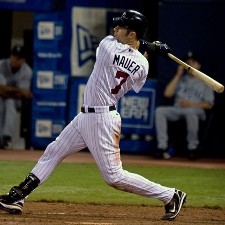
- His agent, Ron Shapiro, kept Kirby Puckett in Minnesota and Cal Ripken in Baltimore their entire careers.
- The Twins open a new park, Target Field, this year and will get a big revenue boost that will help them pay Mauer more than they otherwise could have.
“I truly believe if the player wants to stay here – and I believe Joe Mauer does – we have a chance to keep him,” Smith said. “We ran into that with Nathan, Morneau and Cuddyer. All three essentially came to us and said ‘I don’t want to leave; I want to stay in Minnesota. I like the team, my teammates, the people and the area.’ We were able to accommodate them.”
Target Field will be a huge economic weapon for the Twins. “Our payroll will be up this year,” Smith said. “But we expect a significant revenue boost and much of it will be dedicated to the major league team and player procurement.”
The Athletics are not in the same position. They continue to play at their antiquated mausoleum while their owner, Lew Wolff, seeks a way to move to San Jose. It has been an arduous process, one that may very well be unsuccessful.
The Athletics had the smallest attendance in the major leagues last season, falling short of even 1.5 million. The Twins fell just short of 2.5 million in their last season at the Metrodome.
THREE-PARK EMPLOYEES
Rick Stelmaszek, Jim Rantz, Remzi Kiratli and Raenell Dorn are not the household names in Minnesota that Rod Carew, Harmon Killebrew, Tony Oliva and Kirby Puckett are, but they are special people nonetheless. Employees of the Twins, they are about to begin working in their third Twins’ home.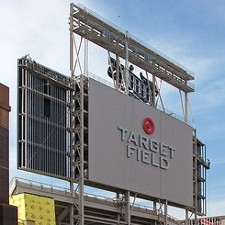
The team has actually moved into Target Field already so Rantz, Kiratli and Dorn are already in their new offices, Rantz as minor league director, Kiratli as director of team travel and Dorn as vice president of human resources. Stelmaszek, the bullpen coach, will join them when the Twins begin their first season at Target Field.
All four employees joined the Twins when they were still at Metropolitan Stadium in suburban Bloomington. They moved to the indoor Hubert H. Humphrey Metrodome in 1982 and helped close it last year.
The Twins are an unusual organization in Major League Baseball. Their employees like staying with the Twins, and the Twins like to keep their employees.
“We’re not without problems, general manager Bill Smith said, “but when we have problems, instead of finding new staff, they are challenged to find solutions.”
The Twins look forward to playing outdoors, but by moving out of the Metrodome they may lose an advantage over visiting teams. The dome’s white roof caused fielders to lose sight of balls hit in the air, and the home-team Twins were less susceptible to those problems than visiting fielders because of their familiarity with the conditions.
Outfielders also had to deal with the unnaturally high bounces fly balls took off the artificial surface of the field. If fielders got too close to fly balls without catching them, a single could easily become a triple.
Kiratli, who began working for the Twins in 1979 directly out of college (“He graduated, got in his car and drove to Minnesota,” Smith said), discovered another oddity that is not so readily apparent to most fans.
“If you’re standing on the field,” Kiratli said, “you can see that the seats directly behind home plate don’t face the plate or the pitcher’s mound. They were angled for football to face the football field. Our best box seats didn’t face home plate.”
Then thinking of how the Twins won’t have to share their new 40,000-seat park with the Vikings, he said, “It’s a great pleasure to be playing in a world-class facility and not in a corner of an end zone.”
LAST OF A KIND
 Mariano Rivera will be one of the guests of honor at a fund-raising dinner the Jackie Robinson Foundation is holding at its headquarters in New York Monday evening (Jan. 25). Rivera, however, will not receive an award.
He will be recognized as the last major league player to wear uniform No. 42.
Commissioner Bud Selig retired Robinson’s 42 in 1997, but players wearing the number were permitted to continue wearing it as long as they were playing.
THE TIMES IT IS A CHANGING
Just about a year has passed since The New York Times appeared to be trying to stir up a conflict between the commissioner’s office and the Players Association. I attribute that possible intention to the Times because it ran a story that was so far off base the newspaper could not have thought it was a legitimate news article.
The Times reported that the commissioner’s office might file a grievance against the union over an alleged violation of the performance-enhancing provision of the labor agreement. Furthermore, the article said, there was a “growing hostility between the two sides after years of relative labor peace.”
A year later, no grievance has been filed. Frankly, no grievance was even contemplated because no union official violated the agreement. Contrary to routine journalistic practice, however, the Times never spoke to the union abut the unfounded allegation.
As for the growing hostility, the growth didn’t need to be stunted because no hostility existed. Relations between baseball’s management and labor officials have remained peaceful and cordial and less than two weeks ago resulted in an unprecedented agreement about the Florida Marlins’ use of their revenue-sharing money.
In more recent matters dealing with baseball coverage, the Times seems to have abandoned one the foundations of its journalistic character. Two baseball articles violated the newspaper’s standard of fairness.
In one, the Times noted the absence of the Mets’ general manager, Omar Minaya, from a conference call about Carlos Beltran’s knee operation. The article suggested that Minaya  was not on the call because the Mets didn’t want him involved in such matters publicly, indicating a lack of trust and confidence in him. The speculation stemmed from an incident Minaya had with a reporter at a news conference last summer.
Whether there was any credence to that speculation is immaterial. What the article failed to mention was that at the time of the conference call Minaya was sitting in a meeting in Arizona where the baseball commissioner had asked general managers to join team owners. Speculate all you want, but at least report the factual circumstances of that meeting. The article made no mention of it, however.
A few days later another article omitted a relevant fact. This article was about Mark McGwire’s chances of being elected to the Hall of Fame following his admission of steroids use.
The article began, “If one of Mark McGwire’s objectives for confessing his use of performance-enhancing drugs was to help his Hall of Fame candidacy, he may need to find another approach.”
Maybe it was fair to speculate that the Hall of Fame was one of McGwire’s reasons for admitting that he had used steroids, but in his interview with Bob Costas, he was asked that question and he said, “I’m not here doing this for the Hall of Fame. I’m here doing it for me to get it off my chest. If I’m lucky enough to get in, that’s icing on the cake.”
Again, maybe McGwire’s real reason for his tardy admission was to enhance his chances for election to the Hall, but as long as the Times raised the question, it should at least have let McGwire answer it as he did in the Costas interview.