This is a tale of two general managers:
(Which would be more likely to be fired; which would be more likely to stay with a new contract?)
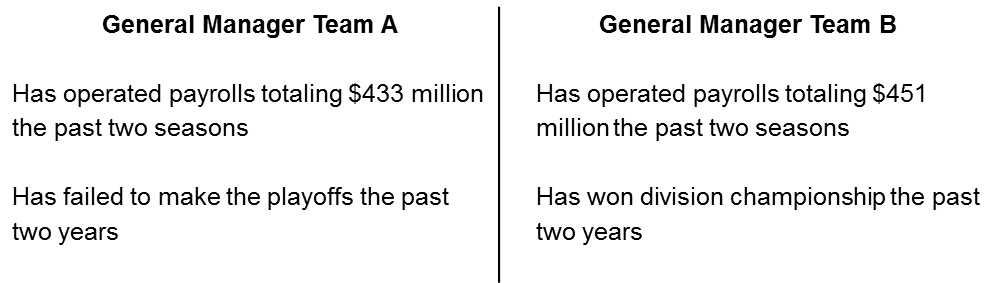
If you haven’t guessed, Team A is the New York Yankees, Team B the Los Angeles Dodgers. The Yankees last week gave Cashman a new three-year contract; the Dodgers this week fired Ned Colletti.
I’m not sure which move was more egregious. I have advocated a change in the Yankees’ general manager’s office, feeling that in 17 years, Cashman has done a poor job with the Yankees’ farm system.
For 17 years he allowed Mark Newman to make a wasteland of the Yankees’ farm and instead used the Steinbrenner millions to fill holes and shore up weaknesses. Many general managers could have done more with those millions and established a fertile farm as well.
The Dodgers fired Colletti because he didn’t win the World Series last year and this despite the record-breaking payrolls the new owners gave him to use. But Stan Kasten, the Dodgers’ veteran president, knows from his vast and successful experience in Atlanta that there is a huge difference between getting to the World Series and winning it.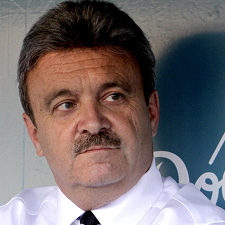
Had Kasten followed in Atlanta the practice he has applied to the Dodgers, John Schuerholz and Bobby Cox would never have lasted as general manager and manager, respectively.
Furthermore, in Los Angeles if Kasten was unhappy that the Dodgers didn’t have greater post-season success, he fired the wrong person.
In this year’s division series, Don Mattingly managed the Dodgers into one loss to St. Louis and threatened to repeat the trick the next night.
In the first instance Mattingly left Clayton Kershaw in the game too long, turning a 6-2 lead into a 10-9 loss. Kershaw gave up four successive singles, five singles to six batters and a three-run double before Mattingly called for help.
Colletti did not call Mattingly in the dugout that day and order him to leave Kershaw in the game. Nor did the general manager call the next night and order Mattingly to remove Zack Greinke after seven innings in which he had allowed two hits and no runs in a 2-0 game.
But Mattingly, presumable acting on Greinke’s total of 103 pitches, excused the starter, and brought in J.P. Howell, who gave up a game-tying homer to Matt Carpenter. The Dodgers, however, won, 3-2, on Matt Kemp’s home run against Pat Neshek.
If Colletti was guilty of anything, it was his inability to put together an impenetrable bullpen. That problem was familiar to Kasten, too.
In the years the Braves couldn’t finish off their World Series opponents, they didn’t have a Mariano Rivera to close games. I always said if the Braves had had Rivera, they would have won more than one World Series in the Kasten-Schuerholz-Cox era.
Kasten, though, didn’t fire anyone. He, in fact, left his Braves’ position before Schuerholz and Cox left theirs. Kasten, a usually accessible executive who once told me he never failed to return a call, did not return my call Wednesday to discuss his thinking in replacing Colletti with Andrew Friedman, general manager of the Tampa Bay Rays.
In order to land Friedman, Kasten gave him a loftier title, president of baseball operations rather than general manager. In baseball practice, an executive who is under contract as general manager cannot change teams for the same title.
When Theo Epstein left the Boston Red Sox as general manager, he became the Chicago Cubs’ president of baseball operations. Jeffrey Loria, the Miami owner, wanted to promote Michael Hill so he gave him the title of general manager and made Larry Beinfest president of baseball operations.
Beinfest nevertheless performed the general manager’s duties and when the general managers posed for a picture at the general managers’ meetings, Beinfest and not Hill was in the photo.
Last year the co-owners of the Texas Rangers gave general manager Jon Daniels the title of president of baseball operations at the expense of Nolan Ryan, who had been team president and chief executive officer.
When the Arizona Diamondbacks hired Tony La Russa earlier this year, they had a general manager and named La Russa chief of baseball operations.
And as one club executive pointed out, clubs that have someone in the position of president of baseball operations usually have a general manager as well. In fact, when the Cubs named Epstein to the elevated position in 2011, he had already hired Jed Hoyer as general manager.
Dismissed general managers follow post-dismissal paths. When Kevin Towers was recently fired as Arizona general manager, he was offered another job in the Diamondbacks’ organization, but he ultimately declined it and left.
Colletti, on the other hand, is staying with the Dodgers as a special adviser to Kasten. He is not expected to have much to do despite Kasten’s comments to Los Angeles reporters.
When Colletti was asked if he viewed the change in his position as a demotion, Kasten cut in and said, “Wait, wait, wait. It’s a moving over. That’s how we feel. A moving aside.”
That’s one of the weakest euphemisms I have ever heard, and Kasten knows better than to expect anyone to believe it.
Colletti declined to talk about his dismissal. “I’d rather accent the positive of it,” he said in a telephone interview, demonstrating the class he has always had. “I’m grateful for the chance to do the job that had its share of celebrations as well as challenges.”
He noted that the year before he became general manager the Dodgers had a 71-91 record, one of the worst in their history. Colletti engineered the team’s turnaround, even before they had $200 million payrolls.
“I also left the farm system in great shape,” he said. “I’m proud of that, and I’m at peace with everything I had.”
What would he like to do in his new role? “I’d like to be responsible and I want to be accountable. I’ll do anything I can to help.”
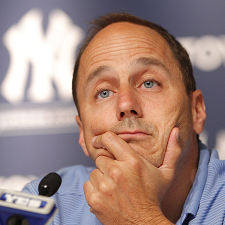 I found it interesting that Colletti said he was proud of what he was able to do with the farm system. Cashman cannot match that statement. If he talked about the Yankees’ farm system and talked truthfully, he’d have to acknowledge what an awful job he has done.
A Cashman supporter, speaking without identification, said the poor state of the farm system lies with Newman, who ran it for 25 years. But for the last 17 years, Cashman, as general manager, had the ultimate authority and responsibility, and he abdicated it.
In 2005, when Cashman was negotiating a new contract, he said he wanted to be in charge of the entire organization, ending the organization’s civil war between the New York and Tampa factions. Cashman was given full authority. What has he done with it?