While I was away last week, Lou Piniella announced on Tuesday that he planned to retire after the season and on Wednesday Ralph Houk died.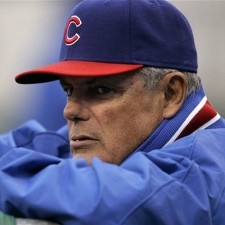
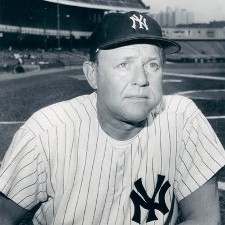
Piniella and Houk worked for the same team, the Yankees, but never together. Houk managed his last game for the Yankees Sept. 30, 1973; they acquired Piniella in a trade about 10 weeks later, Dec. 7.
Piniella, however, wound up doing the exact same jobs in his Yankees career that Houk had done 20 or so years earlier. They were both players, coaches, managers and general managers.
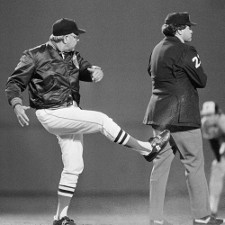
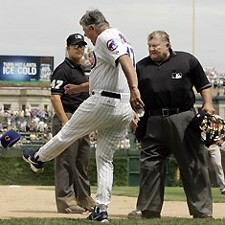
They had something else in common: they both kicked a lot of dirt in their rages at umpires.
“Houk was a very accomplished dirt kicker; he helped make it an art form,” said Marty Appel, a former Yankees’ public relations director, who is writing a book about the Yankees.
I don’t recall that Houk ever yanked bases from their moorings and flung them around the field; that was a Piniella specialty. But Piniella never used the writers the way Houk did. I think, to his credit, he had too much respect for us to use us and abuse us.
Houk was good at both. He would set the tone of his teams’ view of the media by telling the players in his spring training address to the team that the writers were their enemy. When he deemed it appropriate, he would use the writers to show the players he was in their corner.
My turn came after a day game in Milwaukee June 1, 1972. The Yankees lost, 9-8, when Jim Roland walked in a run. That walk by itself was not the problem. The problem was that Roland, working in his fifth inning of relief for a tired staff, had already walked three other batters that inning, loading the bases.
After the game the reporters gathered in the tiny space in front of Houk. Questions were asked and answered, but no one had asked the obvious question. No one wanted to ask the obvious question because we all knew it would ignite the notorious Houk fuse, and no one wanted to be the target of Houk’s wrath.
But it had to be asked, darn it, so finally and reluctantly, I said, “During any of the four walks, did you consider bringing in another pitcher?”
“Who’d ya expect me to bring in,” Houk erupted, “the center field post?”
If I recall correctly, there was an expletive of an adjective before the center field post, but I’ve promised to refrain from using profanity here.
 The point of the story, though, is not that Houk had a temper. He exploded because he knew the players were easily within hearing range of him, and his outburst served as his latest message to the players that “the writers are out to get you, but I’m on your side and I’ve got your back.”
That’s one of the reasons players loved playing for Houk and would, as one player said, run through a wall for him.
But there’s more to the story: part II, the apology. Houk would apologize to the used writer. Except he would do it privately, where his eruption was always public.
On the next stop on the road trip, Chicago, I was waiting for the down elevator at the hotel where we were staying, and when it arrived and the doors opened, lo and behold, there was one passenger, and it was Houk.
“Hey,” he said, his face filled with the big smile he liked to use, “I’m sorry about the other day. I shouldn’t have said that.”
I looked around, but there was no one else there to hear him.
Words were not Houk’s only weapon of attack. He confronted writers physically, too, if he thought they were questioning him or treating him unfairly. I did not experience that aspect of his demeanor.
Houk took three teams to the World Series in successive seasons in the early 1960s but did not stay around long enough to experience the Yankees’ return to the World Series, if George Steinbrenner would have allowed him that opportunity.
Houk looked at the new owner and saw that he was not good for him. He decided he did not want to work for an owner who on opening day at Yankee Stadium wrote some players’ uniform numbers on the back of an envelope; gave it to Houk after the game and told him to tell those players to get their hair cut.
After the last game of the season, Houk resigned, knowing he had another job to go to. The Yankees never accused the Detroit Tigers of tampering but probably should have because he’d had the job lined up before he resigned the Yankees’ job.
Houk managed the Tigers for five years and the Red Sox for four. Piniella managed four other teams after the Yankees but didn’t duplicate Houk again. What he did was become the only person to manage for Steinbrenner and Marge Schott, two of the most controversial owners in baseball history.
Schott liked hiring Steinbrenner castoffs, and Piniella was the most prominent and successful. He delighted Schott by directing the Reds to the World Series championship in his first season, 1990, but she didn’t delight him and he left Cincinnati two years later. Seattle, Tampa Bay and the Chicago Cubs followed.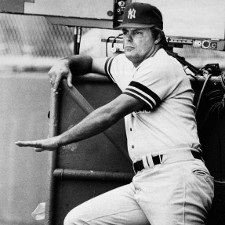
Piniella became a good and highly sought manager, but it wouldn’t have seemed likely watching Piniella in his first spring training with the Yankees.
Bill Virdon was the Yankees’ manager, having succeeded Houk, and he was a drill sergeant compared with the relaxed camp Houk ran. Piniella hadn’t experienced Houk’s spring camp, but he was not an advocate of hard workouts.
But his lack of work didn’t undermine Piniella’s ability as a player. An excellent and knowledgeable hitter, Piniella wasn’t a speedy runner, but he was a savvy and smart baserunner; he wasn’t a fast or flashy outfielder, but he played his position well and caught everything he reached.
Piniella’s real strength as a player was his honesty. He played for the Yankees in the era of Steinbrenner, Martin and Jackson, and he was a beacon of light in the clubhouse.
While all of the other players would comment on George and Billy and Reggie only anonymously, Piniella would comment only if reporters used his name.
Unfortunately, as a manager with the Yankees, Piniella wasn’t as forthcoming, but it was a minor issue. Nor was Piniella able to be as irreverent toward Steinbrenner as a manager as he was as a player.
One day Steinbrenner was delivering one of his angry pep talks in the clubhouse and started talking about the players needing to be tough, like the longshoremen Steinbrenner dealt with down on the docks as part of his shipbuilding business. Piniella yelled out, “C’mon George, the only time you were down on the docks was to put gas in your father’s yacht.” Steinbrenner looked at him and started laughing.
Another time Steinbrenner was chastising the players about the incident in Chicago when a young woman walked onto the team bus, pulled down her jeans and asked for autographs on her bare backside.
Piniella interrupted Steinbrenner and said, “If you had been on the bus and saw her, you would have signed ‘George M. Steinbrenner III Esquire’ and anything else you could think of.”
But Piniella would also be the one to get mad when things were going badly and he sensed that other players didn’t care.
After a bad loss in Seattle in August 1977, when there had been daily stories about players being unhappy and wanting to be traded, Piniella erupted just as the reporters got into the clubhouse.
 “Okay all you whiners, here come the writers,” he said. “Tell them all your problems. We just got beat 9-to-bleeping-2 by a bleeping expansion team and all you want to do is complain. You’re all a bunch of losers.”
The clubhouse became and remained quiet. The winning surge that carried the Yankees to the pennant, whether a coincidence or not, began the next day with a victory in the series finale in Seattle.
When Piniella was on his way to becoming the Yankees’ general manager in 1987, Steinbrenner called Piniella during the World Series on the day on which there happened to be a stock market crash. Piniella, however, was preoccupied with his investments and when the owner began to explain the move – Billy Martin would be manager, Piniella general manager – Piniella interrupted him.
“George, you do anything you want and I’m fine with it,” Piniella said. “But I can’t talk now. My IBM stock is crashing and I have to deal with my broker. Just let me know later what you did.”
When Piniella was the Yankees’ manager in spring training 1986, he made an arrangement with Steinbrenner that the owner would be the “manager” for an exhibition game in Miami. Steinbrenner would sit near the dugout and make all of the moves. When the day arrived, Steinbrenner showed up and Piniella asked him what he wanted to do.
“Oh no,” Steinbrenner told him, “you’re not going to trick me that easily. You’re the manager. You manage. I’m the owner. I’ll second-guess you.”
Just think of what Houk missed.