According to Billy Beane, his wife Tara recently asked him a baseball question. “Did you really trade Mulder and Hudson?” Mrs. Beane asked the Oakland Athletics’ general manager. Told that indeed he had, Tara Beane asked a follow-up question: “Is this Groundhog Day?”
Ouch. In the span of less than three weeks last month, Beane traded his team’s two best starting pitchers, Gio Gonzalez and Trevor Cahill, and its closer, Andrew Bailey. In a 48-hour span in December 2004 Beane traded two of his three best starters, Tim Hudson and Mark Mulder. Two years later the A’s let Barry Zito, their remaining best starter, leave as a free agent.
Beane is being blistered by fans and news media for his latest trades, but he shouldn’t be their target of scorn. Question those trades all you want – and they are easily questioned – but Beane is doing what he feels is necessary to keep the Athletics afloat so they can live another day and some day again compete in the American League West.
This is not the Billy Beane of “Moneyball” fame, the overglorified general manager who found a way to compete a decade ago with a small payroll. I didn’t particularly care for the Billy Beane whom Michael Lewis portrayed in his best-selling book. I like this Billy Beane because he is struggling with real problems that have no magical sabremetric solutions.
The solution lies in San Jose, but Major League Baseball apparently doesn’t know the way there. Bud Selig’s GPS is on the fritz.
It has been nearly three years since the commissioner appointed a three-man committee to study the San Jose situation. Selig has always said it’s more important to take time and get it right than to make a premature decision, but this is ridiculous.
By now, after nearly three years, Selig has all of the facts and information he needs to decide if the Athletics should be allowed to move to San Jose or if the San Francisco Giants should be able to retain San Jose as part of its territory. He just doesn’t want to make a decision and alienate one of the teams.
Last week news reports said Selig had decided to show the Athletics the way to San Jose, but everyone involved denied them.
In response to an e-mail request for comment on those reports and the status of San Jose, Pat Courtney, M.L.B.’s chief spokesman, said, “We have established a committee and a process to study the situation in Oakland and they continue to work and meet on this very complicated issue. I do not know when their work will be completed.”
The committee’s work won’t be completed until Selig tells the committee that its work has been completed, that is when he decides he can delay no longer and finally gives his life-long friend Lew Wolff an answer.
 Wolff, the Athletics’ owner, was a college classmate of Selig way back in some other century and is in baseball only because Selig urged him to buy the A’s. It is his long-time friendship with Wolff that very likely has Selig procrastinating over his decision.
I suspect that Selig wants to do the right thing and let the Athletics move to San Jose; it would certainly strengthen baseball by opening a vibrant new area and eliminating the weakness of the two-team Bay area.
But Selig is reluctant to authorize that step because he doesn’t want to seem biased in his friend’s favor. I’m certain he understands, however, that letting the A’s go to San Jose would be in the best interests of baseball and is the right thing for baseball.
The Giants are doing well enough – they have the fifth highest revenue in baseball – that they can afford to give up Santa Clara County, in which San Jose is located, and not be hurt by its absence from Giants’ “territory.”
The Giants’ position on San Jose is untenable. Although they have refused to acknowledge it, San Jose is part of their constitutionally (baseball) protected area because Walter Haas Jr., the A’s owner, agreed to cede it to them in 1990 before which both teams shared the territory.
Haas made his magnanimous gesture because the Giants were struggling in San Francisco, as the A’s are now in Oakland, and wanted to move to Santa Clara. Now the Giants selfishly hold tightly to the territory, refusing even to concede that they have no legitimate right to it.
So the A’s continue to suffer in Oakland, where Beane feels the only way they can compete is by playing a shell game, growing good young pitchers, then trading them when they’re ripe for even younger and cheaper prospects whom they hope they can develop into major league-ready talent, which they can then trade for … you get the idea.
Beane, meanwhile, suffers the slings and arrows of outraged fans as well as the severely critical news media.
“I don’t read any of that stuff; that’s why I’ve lasted 15 years,” Beane said by telephone last Thursday evening. “Running a small market isn’t easy. I acknowledge the pitchers we gave up are good. But we need a bunch of good young players. I’m not comfortable with the middle ground. Do it right or don’t do it.”
The A’s problems have become harder for them to deal with. For example, the Angels not long ago were the team to beat in the A.L. West. The Rangers, however, have played in the World Series the last two years.
“Texas has done a great job of building an organization and now they have great resources,” Beane said.
This is what the Athletics are dealing with. Last season the Rangers surpassed the $100 million payroll level for the first time ($104 million) while the Angels had the majors’ fourth highest payroll at $143 million.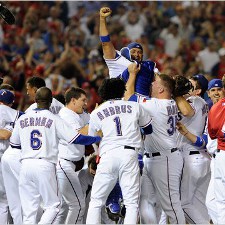
“We now are in a division,” Beane said, “where you have two teams with those payrolls. You just don’t play the Yankees and the Red Sox. You’re playing 19 games against teams in your division with higher payrolls.”
Oakland’s payroll last season was about $62 million, Beane said. That put the Athletics in the bottom half dozen of payrolls, “and we’ll be lower this year.”
“We don’t have any other choice,” he added. “The fact of the matter is to spend more than you have isn’t a good business plan. We spend what we have, but we have a lot less than anyone else. I’m given a budget based on our revenue and I have to figure out how to deal within that budget.
“We’re in a position to carry a payroll in the 50s, depending on what we can bring in as a business. It doesn’t make sense to go beyond that.
The challenge for us is the span is getting shorter and shorter. In any business you’d like to have a three to five-year plan. Our plan is April to October.”
And so Beane trades his good young pitchers.
“It’s a necessity right now,” he said. “We need a lot of good young players.” But doesn’t each trade signify a startover?
“It does,” Beane said. “That’s the nature of this situation. We had these good young pitchers last year and finished third. We also lost our outfielders. To sign them would take our payroll beyond where we were.
“We’ve got the revenue to carry about a $50 million payroll and we’re competing against teams with $150-$170 million payrolls. You’re either building a great team or you have a great team, but when you’re swimming in the middle you’re going nowhere.”
The primary question facing Beane is this: when he feels he is forced to trade his good young pitchers, has he received value in return that has helped the A’s compete? The results of his trades have not been impressive, but few teams guess right on prospects when they are acquiring them for established players.
There are the trades in question:
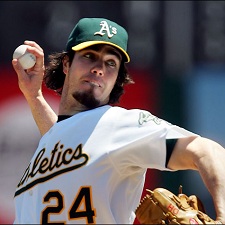
- In December 2004, Beane traded Mulder to St. Louis and Hudson to Atlanta. The A’s received Dan Haren, Kiko Calero, Daric Barton, Juan Cruz, Dan Meyer and Charles Thomas.
- In December 2007, Beane traded Haren (plus Connor Robertson) to the Diamondbacks for Dana Eveland, Carlos Gonzalez, Aaron Cunningham, and Chris Carter. Brett Anderson and Greg Smith.
- In July 2008 Beane traded Joe Blanton (Phillies) and Rich Harden (Cubs) and received Josh Outman, Adrian Cardenas, Matt Spencer, Sean Gallagher, Matt Murton, Eric Patterson and Joshua Donaldson.
- In December 2011 Beane sent Cahill, Craig Breslow and cash to the Diamondbacks for pitchers Jarrod Parker and Ryan Cook and right fielder Collin Cowgill; Gio Gonzalez and pitcher Robert Gilliam to the Nationals for pitchers A.J. Cole, Brad Peacock, Derek Norris and Tom Milone and Bailey and right fielder Ryan Sweeney to the Red Sox for right fielder Josh Reddick, first baseman Miles Head and pitcher Raul Alcantara.
Obviously, we have to give the players in the most recent trades time to develop, but based on Beanie’s history with such deals the Athletics shouldn’t expect too much from them.
By my count, the A’s received a total of 29 players in those trades plus additional trades when Beane subsequently swapped some of those he received in the original transactions.
Dan Haren clearly developed into the best of that bunch, compiling a 43-34 record for the A’s, but they traded him after only three seasons for the same reason Beane traded Mulder and Hudson and would trade the others.
Some of the players the A’s acquired never reached the majors; some got there but only for the proverbial cup of coffee. Some, like pitcher Dan Meyer, were major disappointments. On balance, the A’s have acquired few productive players for their talented pitchers.
First baseman Daric Barton, obtained in the Mulder deal, has lasted the longest as an Oakland player, a five-year term in which he has hit .252. Kiko Calero pitched for the A’s for four seasons (2005-08) before leaving as a free agent. He joined the A’s with Haren and Barton in the Mulder trade, which based on results has been Beane’s best.
His worst? In November 2008 Beane wanted Matt Holliday from the Cardinals and got him for closer Huston Street, starting pitcher Greg Smith and Carlos Gonzalez, who that year had been a rookie starting outfielder for the Athletics.
Beane had acquired Gonzalez a year before from the Diamondbacks in a six-player package for Haren and willingly surrendered him to the Rockies, who were trading Holliday because – why else? – he could be a free agent after the 2009 season.
Unknown to Beane, Gonzalez was on the verge of stardom. In his second season with the Rockies, 2010, Gonzalez batted .336, slugged 34 home runs and drove in 117 runs. That was a glaring example of one time where a team trading a player before losing him to free agency actually got a gem in the return package.
For all of the trades he has made, though, this one burned Beane.
PRACTICING REVISIONIST HISTORY
“No-no sets stage for Verlander’s historic season”
That was the headline on an article on MLB.com last week, and it caught my attention because I wasn’t aware that Justin Verlander had had an historic season.
I knew that the Detroit pitcher had enjoyed a great season, winning both of the major American League awards, most valuable player and Cy Young; leading the major leagues in wins, strikeouts, innings pitched and lowest opponents’ batting average and the American League in earned run average and winning percentage.
But historic? What did Verlander do that was historic, that no one had ever done?
Other pitchers have won both the m.v.p. and Cy Young awards. Others have led in the Triple Crown categories of wins, e.r.a. and strikeouts. If those proclaiming Verlander historic cherry-picking categories to focus on the ones Verlander led?
Well, Verlander didn’t lead the majors or his league in shutouts. Without wasting a lot of time on unnecessary research, I recall a pitching performance that stands out as the most memorable in my daily coverage of baseball.
In 1978, Ron Guidry led the majors in wins, e.r.a. and winning percentage. He won the Cy Young award but wasn’t named m.v.p. However, he also led the majors in shutouts with nine, something Verlander didn’t do. He didn’t even pitch the most shutouts in the American League.
Guidry’s e.r.a. that glorious season was 1.74, more than half a run lower than Jon Matlack’s second-best 2.30. Verlander had the lowest e.r.a. last season by .01.
The point here isn’t to denigrate Verlander’s season, which was terrific. It is to appeal to those who misuse the term “historic” to stop eroding its significance. Something historic should be just that. If it has been done before, it doesn’t make history.
REINSDORF RUFFLES HIS TEAM’S FEATHERS
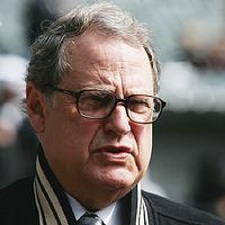 Just weeks after he voted against the labor agreement that followed the most devastating work stoppage in baseball history, Jerry Reinsdorf, the Chicago White Sox chairman, made free-agent Albert Belle the highest-paid player in baseball history, signing him to a then mind-boggling 5-year, $55 million contract.
“It is perfectly fiscally responsible for us to give him this money,” Reinsdorf said on that November 1996 day. “We have to compete under the system that exists. We have an obligation to our fans to try to win.”
On Saturday that obligation apparently no longer existed. On that day, the White Sox traded Carlos Quentin, one of their two most productive hitters, to San Diego for two minor league pitchers.
“This is not about money; this is about winning,” Reinsdorf added in his 1996 remarks on the Belle signing.
Reinsdorf comments did not accompany the Quentin trade, but the deal was all about money and had nothing to do with winning. Quentin can be a free agent after next season, and the White Sox decided he would cost too much to sign. Trade him now, they decided, and get something for him.
It is a strategy that will not go over well in Chicago, where trust in the White Sox has plummeted since their World Series triumph in 2005.
The White Sox 2011 payroll of $126 million was seventh in the majors, apparently too much for Reinsdorf to spend on a third-place team with a losing record (79-83).
“For Jerry Reinsdorf, who’s been a proponent of all the things he’s been a proponent of, to walk up to the podium and bust the market, I think that says something there,” John Hart, the Cleveland general manager, who lost Belle, said that day. “But they have Albert Belle, and I’m sure he feels good about it. What this means to the industry, that’s for Jerry to live with.”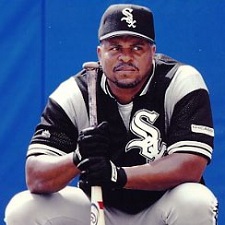
Despite Reinsdorf’s explanation for why he gave Belle that huge, industry-breaking contract, his fellow owners were certain he did it for selfish reasons. They believed he did it to spite them for supporting the labor agreement he bitterly opposed – “I’ll show you what I can do with this system” – or he signed Belle before the new agreement took effect to avoid paying the new luxury tax on a bloated payroll.
”You can’t advocate one position publicly and do another thing privately,” one owner said. Another owner said: ”A lot of people are infuriated. You can’t say one thing and do another.”
Now Reinsdorf has done yet something else. He has weakened his team rather than pay to keep one of its best players.